CEO of Time to Stand Up for Israel
Never Again Is Now And Loods 24
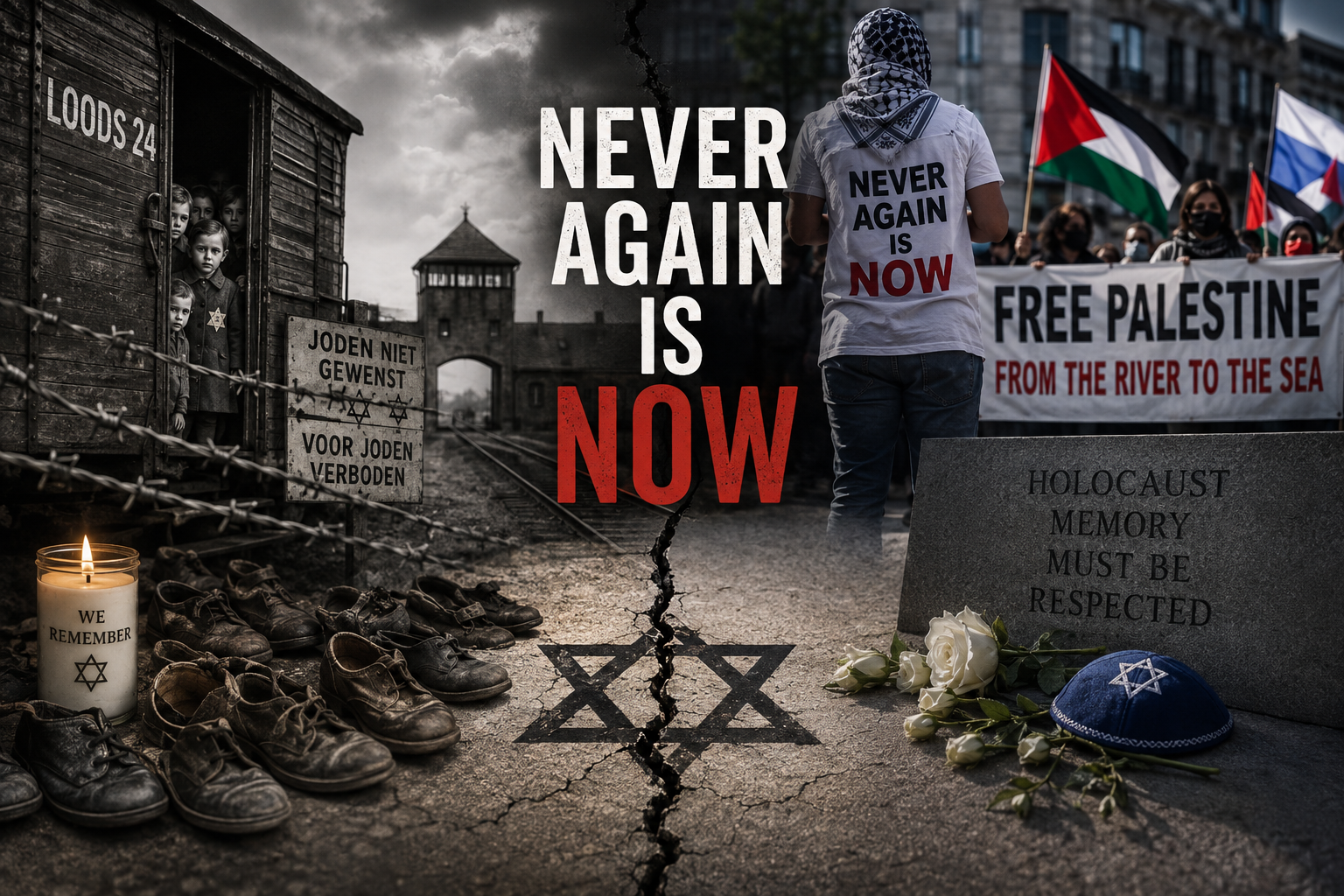
Photo Credits: Sabine Sterk (AI)
Never Again Is Now
The Holocaust did not begin with gas chambers. It did not begin with Auschwitz, Treblinka, or Sobibor. It began with words. It began with propaganda, the normalization of hatred, the dehumanization of Jews, and the gradual removal of rights. It began with a society being taught that Jews were different, dangerous, and somehow responsible for the problems of others.
From 1933 onward, the Nazi regime systematically isolated German Jews from public life. Antisemitic propaganda poisoned minds. The Nuremberg Laws stripped Jews of citizenship and legal protections. Kristallnacht transformed hatred into organized violence. Ghettos followed. Then mass shootings. Then extermination camps. By the end of the Second World War, six million Jewish men, women, and children had been murdered.
The phrase “Never Again” emerged from the ashes of that catastrophe. It was supposed to be a universal warning. A promise that the world would recognize the warning signs before persecution became violence and before violence became genocide. It was a moral commitment to confront antisemitism wherever it emerged.
Today, however, we are witnessing something deeply disturbing. Not only is antisemitism once again becoming normalized in parts of society, but there are also efforts to appropriate Jewish history, Jewish suffering, and Jewish memory for political purposes.
Nowhere was this more visible than during the commemoration of the deportation of Jewish children from Loods 24 in Rotterdam.
Before the war, Rotterdam was home to approximately 13,000 Jews, making it one of the largest Jewish communities in the Netherlands. The German occupation brought exclusion, humiliation, discrimination, and ultimately deportation. Jewish children were forced into separate schools. Jews were compelled to wear the Star of David. Signs declaring “Joden niet gewenst” and “Voor Joden verboden” became part of daily life. Families were torn apart. Children were loaded onto transports. Most never returned.
Loods 24 is not merely a historical site. It is sacred ground. It represents a uniquely Jewish tragedy that forms part of the broader horror of the Holocaust. For many Dutch Jews and their descendants, it is a place of mourning, remembrance, and reflection.
Yet even this solemn commemoration became the target of political activism.
Members of the pro “palestinian” movement, led by convicted Hamas fundraiser Amin Abu Rashed in Rotterdam, reportedly sought to pressure city officials regarding attendance at the event and the presence of the Israeli Ambassador to the Netherlands. Fortunately, Rotterdam’s mayor did not yield to these demands, and the commemoration proceeded as planned, with dignity and respect.
What happened next was both shocking and revealing.
Activists appeared wearing shirts bearing the slogan “Never Again Is Now” while simultaneously chanting “Free Palestine, from the river to the sea.” Whatever interpretations some may try to attach to that slogan, it is a call for the elimination of the world’s only Jewish state. In the context of a Holocaust memorial, directed at a ceremony commemorating Jewish children murdered by the Nazis, the effect was profoundly offensive.
There is a fundamental difference between advocating for civilians during a conflict and appropriating Holocaust remembrance. The memory of Jewish children deported to death camps should not be transformed into a stage for contemporary political campaigns. Doing so diminishes the uniqueness of the event being commemorated and disrespects the victims whose names and lives are being remembered.
The slogan “Never Again” was born from the experience of the Jewish people after the Holocaust. That experience cannot be compared to a war that indeed caused suffering and death to the “palestinians” but was started by the same “palestinians,” while Israel, the Jewish state, did everything in its power to avoid civilian casualties.
The lessons of the Holocaust are universal. But the phrase carries a specific historical weight rooted in the attempted extermination of the Jewish people. Using it while simultaneously targeting Jewish institutions, excluding Jewish representatives, or disrupting Holocaust commemorations twists its meaning beyond recognition.
The tragedy is that many Jews today feel that the warning embodied in “Never Again” remains necessary. Across Europe and beyond, incidents of antisemitism have increased. Jewish schools, synagogues, and community centers require security. Jewish students often conceal their identity on university campuses. Online platforms teem with antisemitic conspiracy theories and hatred.
These realities cannot simply be dismissed as misunderstandings or isolated incidents. They reflect a continuing problem that far too many people prefer to ignore.
“Never Again” was meant to teach us that antisemitism begins long before physical violence appears. It begins when Jewish voices are excluded. It begins when Jewish history is rewritten. It begins when Jewish suffering is questioned, appropriated, or minimized. Above all, it begins when society becomes comfortable treating Jews differently from everyone else.
That is why the events surrounding the Loods 24 commemoration matter. They are not simply about a disagreement over the Middle East. They are about whether Jewish memory can remain Jewish. They are about whether Holocaust remembrance will be respected or transformed into a political battleground.
The lesson of history is clear. The persecution of Jews did not start with death camps. It started with hostility, exclusion, and indifference. That is precisely why “Never Again” remains relevant today.
Never Again is now because remembrance requires vigilance.
Never Again is now because antisemitism has not disappeared.
Never Again is now because the promise made after 1945 was not a slogan. It was a responsibility.
And it remains our responsibility today.
Related Topics
Related Posts