
The Trap of ‘1967 Lines’: How Israel’s Borders Are Being Rewritten
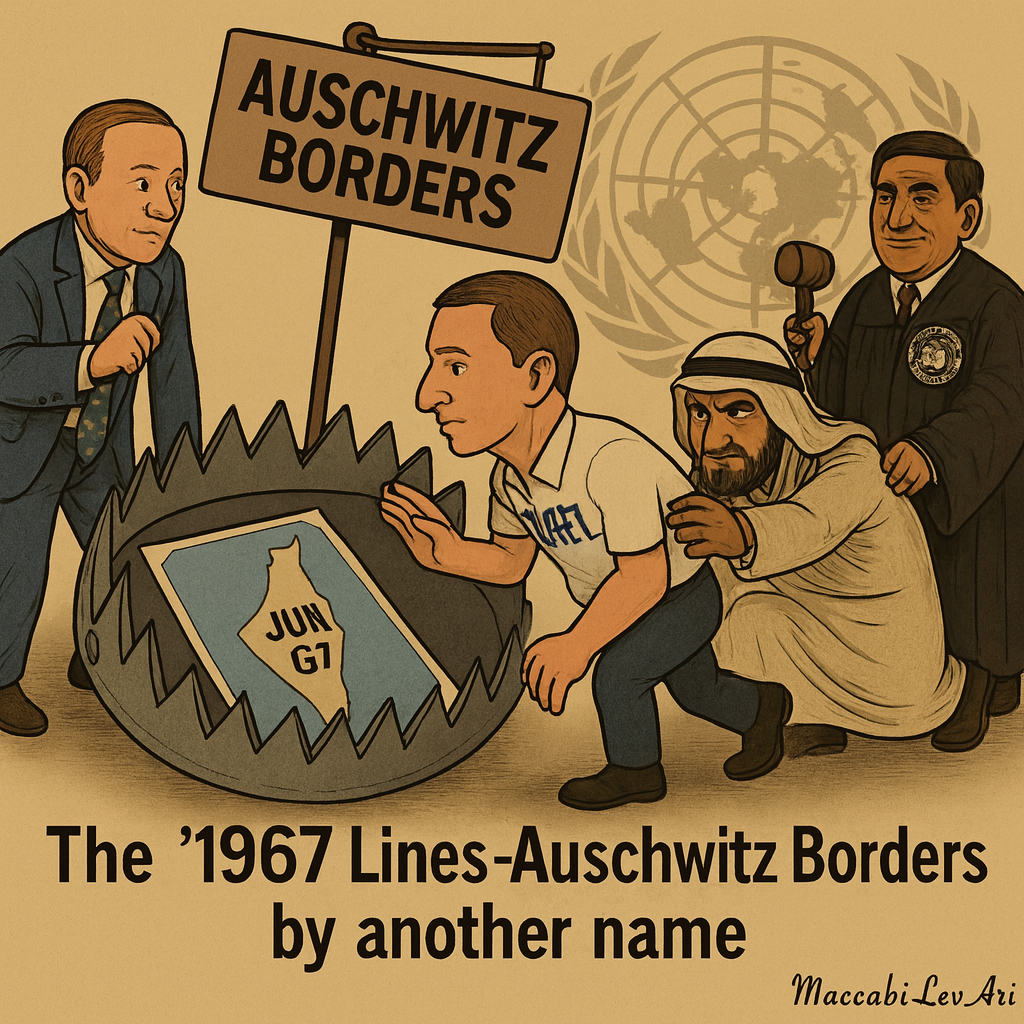
President Trump’s recent declaration that he “will not allow Israel to annex the ‘West Bank’” came as European governments fast-tracked recognition of “Palestine,” while Arab states renewed pressure to freeze Israel behind the 1967 armistice lines.
This is not coincidence—it is convergence. Different actors, often at odds with one another’s values, are united in a single goal: to rebrand Israel’s temporary ceasefire lines into its permanent borders.
Trump, for his part, has played some very smart geopolitical games vis-à-vis Iran, saying one thing and doing another. It is hard to know whether this statement reflects his true intention or whether it is simply part of the “art of the deal.”
The 1949 armistice lines, however, were NEVER borders. They were military demarcations after Israel survived multiple Arab wars of aggression , explicitly defined as temporary.
What is Uti Possidetis Juris and How it Works
International law offers a principle designed to prevent chaos: Uti Possidetis Juris. In plain English, it means when a territory gains independence, it inherits the borders defined under its last legal sovereign authority.
That principle stabilized Latin American republics after Spanish rule. It was formally adopted across Africa in the 1960s to prevent border wars. And it has been repeatedly affirmed by the International Court of Justice (ICJ).
In the Burkina Faso v. Mali case of 1986, the ICJ explained:
“The principle of Uti Possidetis… is a general principle, logically connected with the phenomenon of the obtaining of independence, wherever it occurs.”
Applied to Israel, the principle is straightforward: the Jewish state’s borders derive from the Mandate for Palestine, not from ceasefire lines imposed after it was attacked.
How the Mandate Was Undone
The 1922 Mandate for Palestine was already gutted when 77% of its land was carved off to create Transjordan for the Hashemites. Israel was left with the remainder—and even that remainder was then being divided further to create a third Arab state (Palestine) leaving Israel with just 12% of the original Mandate territory.
Yet Britain, as the mandatory power, did not have the legal right to give away land in violation of Mandate law. The mandate was not a colonial possession to be bartered, but what the League of Nations called a “sacred trust of civilization” — sometimes referred to as the “treaty of treaties.”
As Professor Eugene Kontorovich has explained:
“Under Uti Possidetis Juris, Israel’s borders are determined by the Mandate lines, not the armistice lines of 1949. The attempt to lock Israel into the latter has no basis in international law.”
The fact that international actors were willing to ignore Mandate law once to appease the Hashemites should give pause to anyone who believes they will not ignore it again to appease others.
How Law Gets Rewritten
Israel has become the test case for bending definitions to fit political agendas at the United Nations. This is lawfare in practice — the use of legal arguments and international institutions as weapons of war.
• Famine was redefined to accuse Israel in Gaza, despite daily shipments of food.
• Genocide was stretched to absurdity and weaponized against Israel, while real genocides were neglected.
• Borders are now being rewritten by treating armistice lines as sovereign frontiers.
Former ICJ President Stephen Schwebel recognized the truth as early as 1970:
“Israel has better title in the territory of what was Palestine, including the whole of Jerusalem, than do Jordan and Egypt.”
And international law scholar Malcolm Shaw underscored the danger of ignoring this principle:
“Uti Possidetis Juris has an essential function in international law: it provides stability at the moment of statehood. To ignore it is to invite disorder.”
The principle provides stability everywhere else. Only when it comes to Israel does the world suddenly pretend it does not exist.
Why Pushback Matters
For me, this is not a call for Israel to annex every inch of Judea and Samaria. Reasonable people can and will disagree on the scope of sovereignty.
The LEGAL CLAIM, however, itself must not be erased. If the world can ignore the Mandate, dismiss Uti Possidetis Juris, and pretend that temporary armistice lines are binding borders, then Israel’s legitimacy itself becomes negotiable.
Pushback is necessary by insisting that Israel’s legal baseline is the Mandate, not 1967; by correcting the narrative every time “1967 borders” are repeated as fact; by amplifying jurists who have already laid down the law; and by exposing the pattern of selective redefinitions — famine, genocide, borders — that represent nothing less than lawfare.
Silence allows distortion to harden into reality. Pushback keeps the truth alive.
How Erasure Happens, and How to Stop It
Israel’s borders are not being erased with tanks or treaties — they tried that and failed — now, it’s with definitions, decrees, and lawfare. Step by step, law is bent, precedent is ignored, and temporary lines are dressed up as binding frontiers.
That is how Israel’s legal inheritance is being dismantled in real time. And the only way to stop it is to insist, loudly and relentlessly, on the principles international law itself enshrines—principles that apply to every other nation, and must apply to the Jewish state as well.
Otherwise, the world has proven once again that Israel is the Jew among nations.