
The Tyranny of Certainty: On Self-Indoctrination, Peer Pressure, and the Courage to Doubt
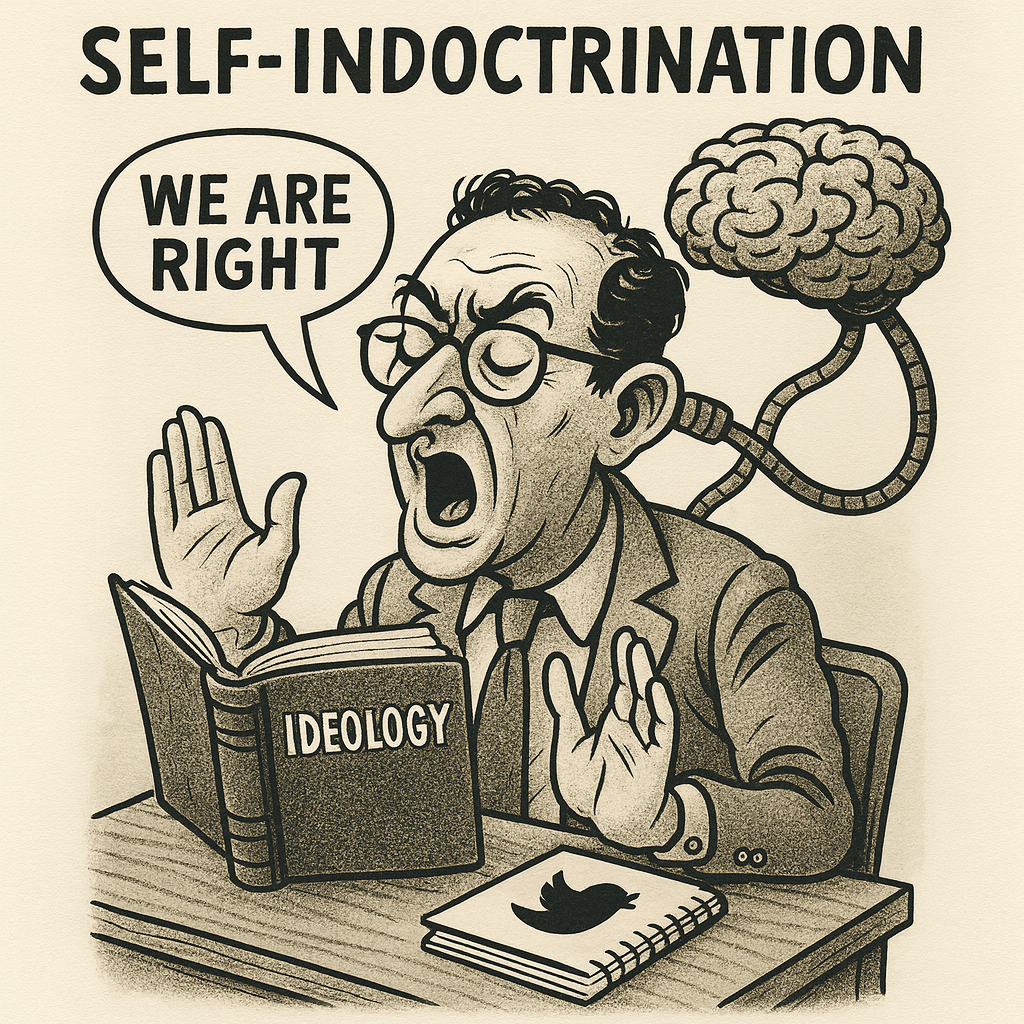
There are prisons of brick, iron and barbed wire, and then there are prisons invisible, ethereal, yet no less confining. The human mind, that most exquisite instrument in the orchestra of creation, is capable of composing its own bars and bolting its own doors. This is the tragedy of self-indoctrination: the quiet, relentless process by which we convince ourselves into captivity, singing our chains into song until we call them freedom.
We often mistake indoctrination as a purely external force — the preacher, the propagandist, the politician, the algorithm. But the most enduring indoctrination comes not from without, but from within. It is the slow daily ritual of confirming one’s prejudices, of telling and retelling oneself the same story until it hardens into identity. One does not need a dictator when one can be one’s own.
And here lies the tragedy compounded: for while self-indoctrination supplies the interior walls, society obligingly supplies the locks. The courage to peer above the parapet, to question, to doubt, is punished not with reasoned debate but with ostracism, shame, and the withering ire of one’s peers. How much easier it is to chant in unison than to raise one’s voice in dissonance. Conformity is rewarded with applause, while dissent is met with suspicion, hostility, or worse. It is little wonder so few dare it.
Critical thinking, that most glorious of human faculties, is thus quietly euthanized. Its crime? Impoliteness. To question the slogans of one’s tribe is to risk being branded a traitor. To ask for evidence is to invite excommunication. And so, whole communities, whole nations, fall silent in the presence of dogma, preferring the balm of belonging to the sting of truth.
This, of course, is not new. Socrates was made to drink hemlock for his trouble. Galileo was shown the instruments of torture for daring to suggest the earth moved. The courage to think critically has always been a lonely and often dangerous undertaking. Yet one might have hoped that in our age — with its freedoms, its technologies, its supposed enlightenment — we might have cultivated a broader tolerance for dissent. Alas, no. The internet has given us echo chambers of unprecedented efficiency, cocoons of reinforcement where doubt is treated as heresy and heresy as violence.
And what of those ideologies that do not merely sulk when questioned but threaten violence should you fail to conform? Here we leave the nursery of peer pressure and enter the dungeon of tyranny. Some creeds do not content themselves with persuasion. They demand submission. Refusal is met not with argument but with the cudgel, the knife, the gun. “Believe, or else” — the oldest, ugliest refrain in human history.
It is here that the parallel between slavery of the body and slavery of the mind becomes grotesquely clear. Where once chains were forged of iron, they are now fashioned from terror. To dissent from such ideologies is to risk not merely unpopularity but obliteration. And so communities are co-opted, whole populations drawn into the orbit of violence, not necessarily by conviction but by fear. When the price of thinking differently is death, how many dare to pay it?
This is not intellectual freedom but intellectual servitude, a slavery subtler perhaps than the plantations of old but no less real. The lash is replaced by stigma, the whip by fatwa, the overseer by the online mob. Minds are corralled, policed, surveilled — not by Big Brother but by little brothers and sisters eager to denounce, cancel, or worse.
Yet let us be fair: the urge to conform, even at the expense of truth, is not merely cowardice. It is deeply human. Belonging is a primal need. To be cast out from one’s tribe is to experience a death of sorts. Little wonder that most will bend the knee to consensus rather than risk exile.
And self-indoctrination offers a peculiar comfort. It saves us from the exhausting labour of doubt. To live with uncertainty is to live unmoored, perpetually questioning, perpetually adrift. Far easier to anchor oneself in dogma, however absurd, than to endure the stormy seas of ambiguity. Certainty, even false certainty, is warm and reassuring. It allows one to sleep at night.
But when such certainty couples with authority — the authority of religion, of ideology, of identity — it becomes lethal. Communities are swept up not by reasoned conviction but by the inertia of conformity. The crowd shouts “death to Zionists,” or “death to apostates,” or “death to unbelievers,” and each member of the crowd feels a little taller, a little braver, a little more righteous, for joining in. To resist is to risk being singled out. Better to howl with the wolves than be devoured by them.
It is here that the insidious genius of violent ideologies lies. They make obedience not merely expedient but virtuous. To question is to sin, to doubt is to betray, to think is to rebel. And so people cease to think, not because they lack the capacity, but because they fear the consequences. The intellect is enslaved by the whip of ideology, the lash of peer judgement, the threat of violence.
Is there such a thing as intellectual slavery? Yes, and it is among the most pernicious of all servitudes. Unlike physical slavery, where the body is constrained but the mind may still dream of freedom, intellectual slavery constrains the very faculty of dreaming. The slave of the mind does not merely submit; he forgets that he might ever have been free.
When a community convinces itself that certain questions cannot be asked, that certain truths cannot be entertained, it has already built the plantation in which its members toil. And tragically, many defend their chains. They parade them as badges of honor, mistaking imprisonment for identity, servitude for solidarity.
What, then, is the antidote? Courage. The courage to doubt, to risk ridicule, to endure exile. To stand above the parapet, even when the arrows fly. It is not comfortable, it is not easy, and it is rarely rewarded in one’s lifetime. But it is essential. For without the courage to question, societies ossify. They become brittle, fanatical, incapable of self-correction.
We must celebrate those who doubt, not punish them. We must build cultures where to question is not to betray but to participate. We must remember that progress — whether scientific, political, or moral — has always depended on those who dared to dissent. Every liberty we now enjoy was once considered heresy.
And perhaps we must also learn to turn the tools of self-indoctrination towards nobler ends. If we can rehearse ourselves into hatred, can we not also rehearse ourselves into tolerance? If we can daily whisper into our own ears the mantras of suspicion, can we not whisper instead the refrains of empathy? The mind is pliable. It can build prisons, yes, but it can also build cathedrals.
The power of self-indoctrination is immense. It can transform ordinary people into zealots, neighbors into spies, doctors into preachers of hate. Coupled with the cowardice imposed by peer pressure and the terror enforced by violent ideologies, it can enslave entire populations in the chains of unreason.
But the power to resist is also within us. To cultivate critical thinking, to defend the right to doubt, to honor the courage of dissenters — these are the duties of any society that would remain free.
For in the end, freedom is not the absence of chains around our wrists but the absence of chains around our minds. And if there is one lesson history repeats with weary insistence, it is this: that the greatest tyranny of all is the tyranny of certainty, and the greatest courage is the courage to think.