
Director of the Center for Law and Antisemitism, Striks Faculty of Law
Anti-Zionism Without Zionism
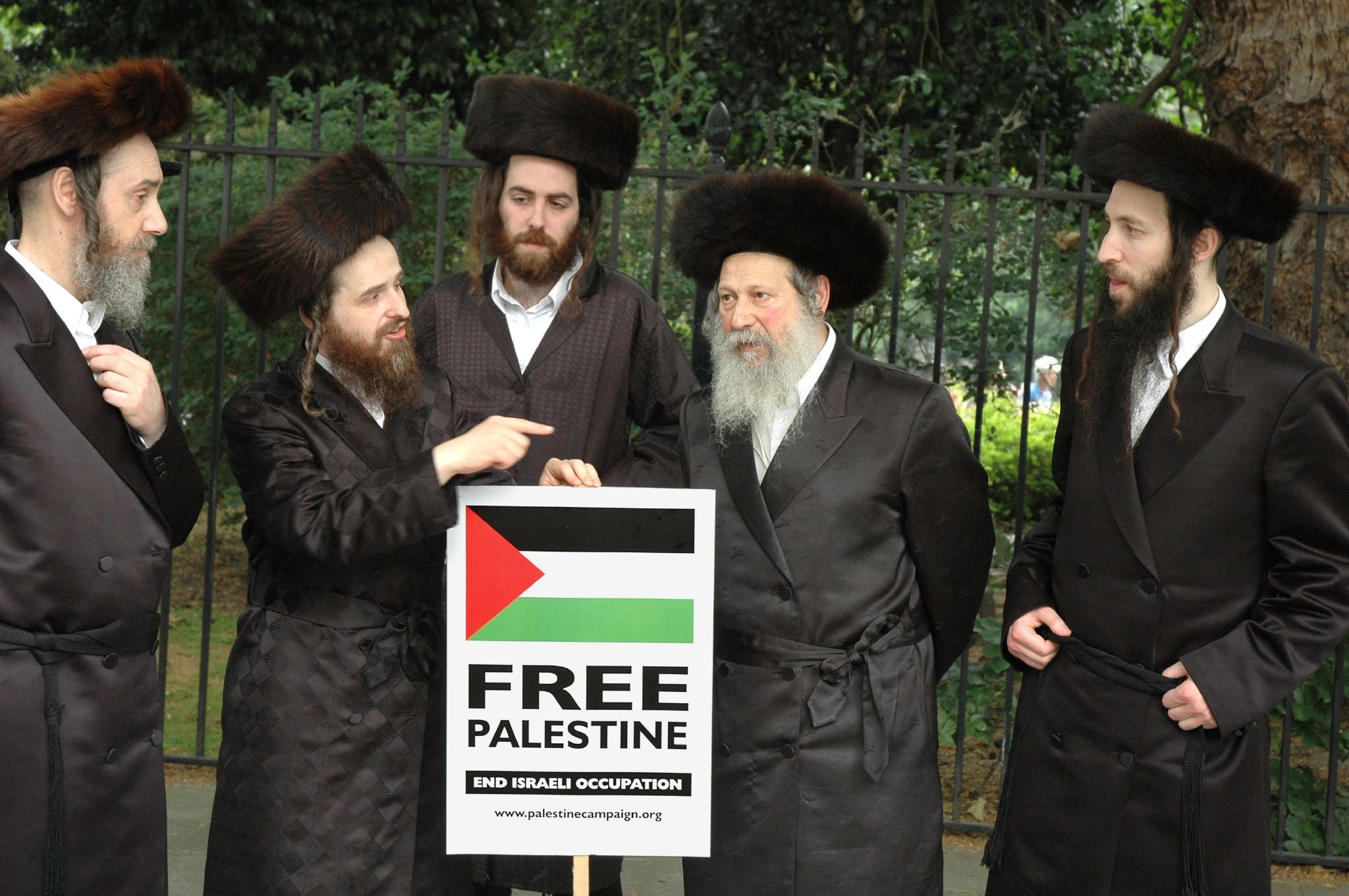
Members of Neturei Karta protest against Israel, June 2005. Photo: Peter / Wikimedia Commons, licensed under CC BY 2.0.
This essay is, in a sense, a continuation of two previous pieces I wrote about antisemitism and anti-Zionism. In the first, A Chimerical Test for Antisemitism, I suggested that one useful way of identifying when hostility toward Israel or Zionism becomes antisemitic is to ask whether Israel, Zionism, or “Zionists” have ceased to function as real political objects and have instead been transformed into imaginary, demonic, or conspiratorial forces. In the second, Three Notes on Anti-Zionism, I argued against treating the relationship between anti-Zionism and antisemitism as a simple either-or question. Some forms of anti-Zionism are antisemitic and others are not, but even when anti-Zionism is not antisemitic, that does not make it reasonable, moral, or worthy of support. This time, I want to take one step back and ask a more basic question: when someone says that they are anti-Zionist, what exactly are they against?
For a moment, however, I want to put antisemitism aside. Not because it is irrelevant, but because the argument over antisemitism sometimes obscures a prior question: what is the “Zionism” that people declare themselves either for or against? The answer is less obvious than it may seem. Today, different groups use the word “Zionism” to describe very different things, and both Zionists and anti-Zionists sometimes appear to be talking about something quite distant from the historical movement that originally carried that name.
Historical Zionism was extraordinarily diverse. Herzl was not Ahad Ha’am, Jabotinsky was not Ben-Gurion, and religious Zionism was not socialist Zionism. Nor was there from the outset a single agreed political destination. As historian Dmitry Shumsky and others have emphasized, important Zionist thinkers imagined Jewish self-determination through different political arrangements, including forms of national autonomy and multinational political frameworks as well as, increasingly, sovereign statehood.
What united important currents of Zionism was something more fundamental: the aspiration to transform the collective condition of the Jews and enable them to shape their own national future in the Land of Israel. The political form that this self-determination should take remained contested. In different currents and periods, Zionists imagined national autonomy, self-government within multinational frameworks and, increasingly, sovereign statehood. These political aspirations were accompanied by immigration, settlement, institution-building and the revival of Hebrew, although the place assigned to each differed considerably across Zionist movements and periods.
For many Zionists, the ambition went considerably further. Zionism was supposed to transform Jewish life and, in some versions, even the Jew himself. Different currents imagined the “New Jew” differently, but recurring ideals included a Hebrew-speaking Jew rooted in the land, engaged in productive labor, physically capable, able to defend himself, and no longer dependent on the goodwill of others. These ideals often went together with a sharp critique of what Zionists regarded, fairly or unfairly, as the passivity, vulnerability or dependency of diaspora existence. Zionism, in other words, meant much more than simply supporting a Jewish state, much less “supporting Israel.”
This does not require abandoning the more minimal contemporary meaning of Zionism that I used in my previous essay: support for Jewish national self-determination and for the continued existence of Israel as a Jewish state. The point is rather that this contemporary core is considerably thinner than many of the historical programs, expectations and ambitions that once travelled under the name Zionism.
The creation of Israel in 1948 complicates the picture further. Once a Jewish state had been established, had Zionism, in one important sense, largely accomplished a central historical task? Zionist institutions certainly did not disappear, nor did Zionist ideas. Many Zionists themselves would have rejected the suggestion that the work was finished. Ben-Gurion, most notably, continued to regard aliyah and the relationship between Israel and the diaspora as unfinished Zionist tasks. But the disagreement itself is revealing. After 1948, Zionism could no longer mean quite the same thing it had meant before the existence of the state. Supporting, defending, strengthening or identifying with an already existing Israel is not necessarily the same thing as participating in a movement that sought to transform the political condition of a people without a state of its own.
That historical shift matters when we turn to contemporary anti-Zionism. There are people in the West who call themselves anti-Zionists but, when pressed, support a two-state solution, do not reject Jewish national self-determination, and do not seek the abolition of Israel or the end of its existence as a Jewish state. Their objections are directed primarily at a particular government, the settlements, the occupation or a particular war. They may be extremely harsh critics of Israel, but if they accept both Jewish self-determination and the continued existence of Israel as a Jewish state, it is difficult to see in what meaningful sense they are anti-Zionists. In such cases, “anti-Zionism” sometimes functions less as a description of a position on Zionism than as a declaration of political and moral distance from Israel.
In other cases, the anti-Zionism is more substantive, but the “Zionism” being opposed bears only a partial resemblance to historical Zionism. In some Western discourse, Zionism becomes a catch-all term for colonialism, racism, white supremacy, imperialism, and sometimes a much wider system of oppression. There are serious historical questions to be asked about colonial frameworks, the Zionist encounter with the Arab population, dispossession and relations of power. But when the complexity of Zionist history disappears and “Zionism” becomes a container into which virtually every political evil can be placed, one has to ask whether the object of opposition is still Zionism itself or a political construction created under its name.
The distortion need not begin with pure invention. A real feature of Zionist history can be taken out of context, turned into the essence of the entire movement, and then combined with characteristics that were never central to it. What gradually emerges is an imagined Zionism, one that still draws on fragments of historical reality but no longer describes that reality accurately. In my view, this is also where such discourse can begin to cross into antisemitism. The problem is not the use of any one category such as colonialism or racism. It is the transformation of Zionism from a concrete historical movement into an all-encompassing and morally absolute force that seems to stand behind an ever-expanding range of evils. When this imagined Zionism is also endowed with hidden, pervasive or almost limitless power, it begins to resemble what I have elsewhere called chimerical Zionism.
The picture is more complicated in the Arab and Muslim worlds. Historically, Arab opponents of Zionism sometimes understood quite well what Zionism was trying to achieve. They saw a movement encouraging Jewish immigration, land purchase and settlement, the construction of national institutions, and the growth of Jewish political power in the Land of Israel. Their opposition was therefore not necessarily directed at a straw man. Jabotinsky’s argument in “The Iron Wall” rested precisely on the assumption that the Arabs understood the implications of the Zionist project and opposed it for that reason. Over time, however, other images were added. Zionism was sometimes portrayed as a hidden regional conspiracy, a force seeking domination far beyond the actual objectives of the Zionist movement, or part of a much larger secret design. Here too, the distinction matters between opposing what Zionism actually sought to accomplish and opposing things attributed to “Zionism” that did not belong to the historical movement.
The same problem appears on the other side of the argument. People who call themselves Zionists do not always mean by Zionism what the term historically meant either. In Israel, for example, someone may say, “I am a Zionist,” when what they really mean is that they love the country, identify with it, are willing to defend it, and want it to succeed. These are meaningful commitments, but they can also be described as Israeli patriotism. At other times, “Zionism” is used to describe a more assertive nationalist outlook, sometimes involving a strong preference for national interests, territorial claims or state power over competing considerations. Nationalist currents have of course existed within Zionism, sometimes very prominently. But neither Israeli patriotism nor Israeli nationalism is automatically identical with Zionism. Neither necessarily tells us anything about aliyah, diaspora life, the “New Jew,” or the transformation of Jewish existence that occupied so much of historical Zionist thought.
The gap may be even more striking in the diaspora. An American Jew can be passionately committed to Israel, visit regularly, donate substantial sums of money, send their children on programs in Israel, oppose BDS, fight antisemitism on campus, and proudly call themselves a Zionist. At the same time, they may regard American Jewish life as desirable and permanent, have no intention whatsoever of making aliyah, and reject any idea that diaspora existence is inherently deficient. None of this means that such a person “is not a Zionist.” Political concepts change, and Zionism has changed as well. But there is a real historical and conceptual question here. If aliyah, the concentration of Jewish life in Israel, and the transformation of Jewish existence are no longer central to this identity, what precisely distinguishes it from an extraordinarily strong attachment to Israel or from being strongly pro-Israel?
Contemporary anti-Zionism may itself be making the label “Zionist” more important to people who otherwise would not have considered it central to their identity. A diaspora Jew with no intention of moving to Israel may begin declaring “I am a Zionist” precisely because Zionism has become morally suspect in their surroundings. Anti-Zionism, in this sense, may not merely attack a pre-existing Zionist identity. It may also help produce and intensify that identity. The meaning of contemporary Zionism may therefore be shaped not only by what Zionists themselves believe, but also by what their opponents say Zionism is.
The ultra-Orthodox case produces a striking paradox. Some of Zionism’s fiercest opponents may also be among the groups that still remember most clearly what historical Zionism actually sought to do. Here it is important not to speak of the ultra-Orthodox, or Haredi, world as a single bloc. There is a spectrum ranging from non-Zionism and deep ideological distance from Zionism to explicit theological anti-Zionism. Satmar and parts of the Edah HaChareidis stand at the explicitly anti-Zionist end of this spectrum. Agudat Yisrael and major Hasidic groups such as Gur have historically occupied a more complicated non-Zionist position, combining ideological distance from Zionism with deep practical involvement in Israeli political life. Parts of the Jerusalem Faction, particularly amid conflicts over military conscription, have at times adopted much sharper anti-state and anti-Zionist rhetoric.
Despite these differences, when Haredi critics reject Zionism on ideological grounds, their objections often target features that genuinely belonged to historical Zionism. They may reject the transformation of Jewish existence from a predominantly diasporic condition into one centered on national collective life in the Land of Israel; the conviction that Jews should take their collective political fate into their own hands; the centrality of immigration, settlement and Jewish political power; and, in some Zionist traditions, the ambition to create a new type of Jew. In explicitly theological forms of anti-Zionism, the objection can go deeper still, challenging the very attempt to use human political action to transform the collective Jewish condition before redemption.
One can reject this ultra-Orthodox position entirely. I do not share it, and in contemporary Israel there are additional reasons why many Israelis find it difficult to sympathize with it, particularly when ideological distance from the Zionist state is combined with opposition to military service while institutions associated with the same communities receive substantial public funding and their political representatives remain deeply involved in the institutions of the state. Yet one thing can still be said in its favor, analytically rather than politically: this form of anti-Zionism often knows what it is arguing against. Paradoxically, some of Zionism’s most uncompromising religious opponents may be among the few contemporary groups that still argue with historical Zionism largely on its own terms.
Consider a simple thought experiment. Imagine two identical signs reading “Zionism is evil.” One is held by ultra-Orthodox protesters in Jerusalem; the other by students at Columbia University. It is entirely possible that the second sign would anger an Israeli more than the first. Perhaps this is because the ultra-Orthodox opponent is an internal and familiar adversary whose religious and ideological objections are recognizable. Perhaps it is because they are rejecting elements of historical Zionism with which many contemporary Israelis themselves no longer fully identify. And perhaps it is because at Columbia, “Zionism” may function not simply as the name of a historical ideology but as a moral label attached to living Israelis and Jews, placing them in the category of oppressors, colonizers or racists. In the first case, the argument is largely about an ideology. In the second, the term can also become a judgment on people living here and now.
At this point, antisemitism returns fully to the discussion. Not every distortion or reductive interpretation of Zionism is antisemitic. A person can understand Zionism partially, incorrectly or even very negatively without being antisemitic. But there is a point at which distortion changes character. In A Chimerical Test for Antisemitism, I argued that one important warning sign appears when Israel, Zionism or “Zionists” cease to be treated as real historical and political phenomena and instead become hidden, demonic, almost omnipotent forces. When “Zionism” is transformed from the name of a historical political movement into a force said to control governments, the media, finance or the world itself, we are no longer dealing merely with a poor reading of history. Imagined Zionism has become chimerical Zionism, and at that point the connection to familiar structures of antisemitism becomes much clearer.
Perhaps putting antisemitism aside for a moment ultimately helps us understand it better. It is not enough to know that someone is “against Zionism.” We need to ask what Zionism that person imagines, what exactly is being rejected, toward whom the term is directed, and what the speaker is doing by using it. The question of whether anti-Zionism is antisemitic remains crucial, but answering it well may sometimes require another question first: what Zionism is the anti-Zionist actually against? One of the peculiarities of contemporary anti-Zionism may be that, surprisingly often, Zionism itself has almost disappeared from it.
Related Topics
Related Posts