The voice that carried a brother home
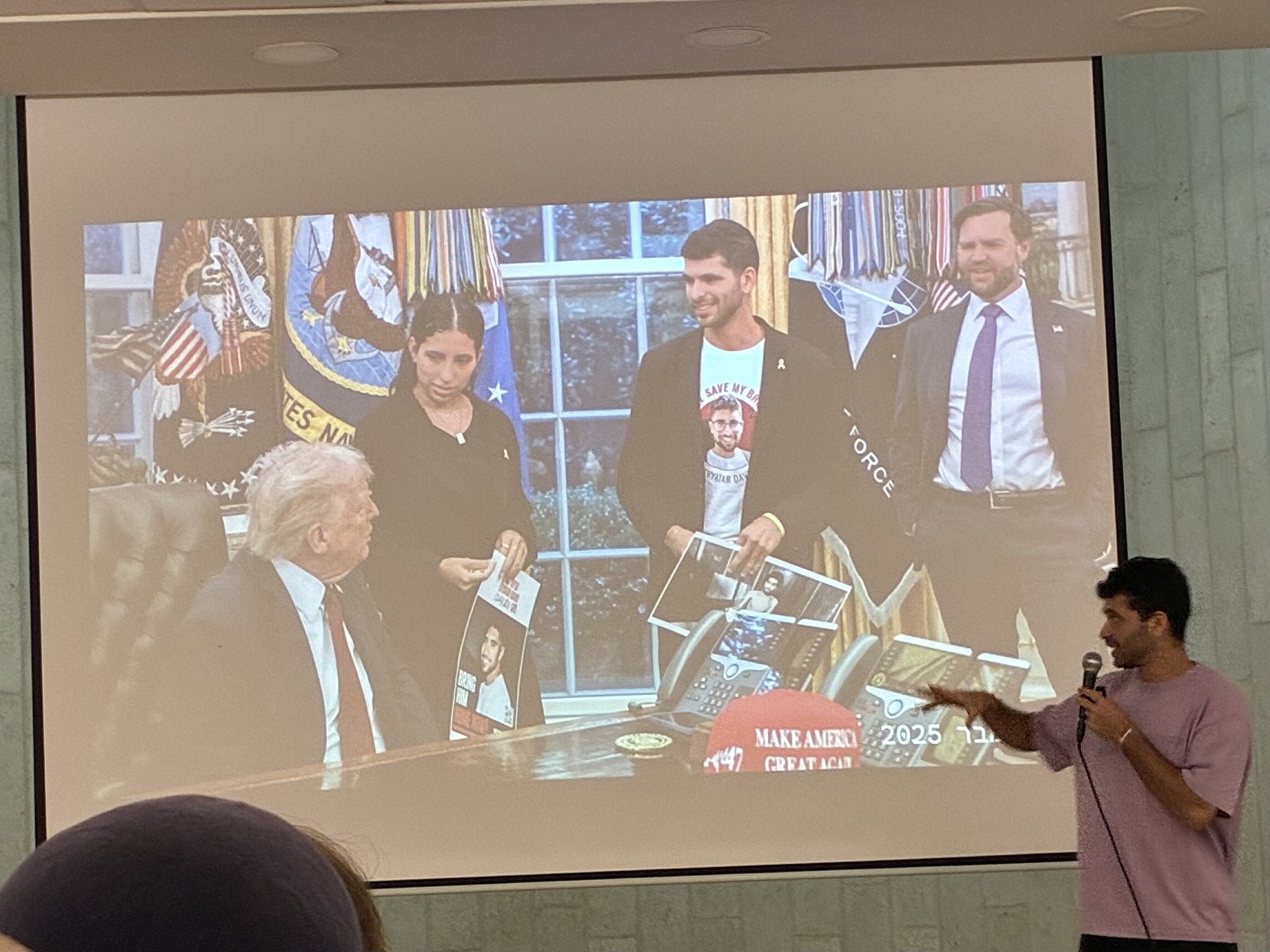
This week, Ilay David told us that after his brother Evyatar returned from captivity, he lost his voice.
Not figuratively. Literally.
For nearly a week, he could barely talk. His voice was totally gone. He could not speak above a whisper. Only later did he understand what had happened. For two years, he had been his brother’s voice.
He had spoken in every interview, at every gathering, during every rally. He had carried Evyatar’s story to the White House, the United Nations and to government officials around the world. Evyatar could not speak for himself and so Ilay spoke for him.
Then, suddenly, his brother came home.
The voice that Ilay had borrowed was no longer his to carry. Now, he said quietly, he is trying to find his own voice again.
I don’t think he realizes that he already has. His voice was loud and clear.
When Ilay last came to Alon Shvut in September 2024, his brother Evyatar was still a hostage, and yet I left his talk feeling that I had been given “a desperately needed breath of fresh air.”
This week, he returned to close the circle and address us on the topic: “A Guide to Being the Brother of a Hostage: What I Learned About Times of Crisis, Life’s Breaking Points, and Living with Uncertainty.”
We often think resilience means being fearless. Ilay described something far less glamorous and much more real. He spoke about building resilience long before you know you will need it. He built his own through challenging himself academically and then by choosing to draft as a combat soldier in the Israeli army, when so many of his peers chose less demanding roles.
Using an experience familiar to combat soldiers he did his best to capture what it had felt like to be “the brother of a hostage.” He depicted those two years as carrying an “alonkah shechorah.” a “black stretcher.” This is a term used in the army to describe an exercise in which soldiers carry a stretcher with a fellow soldier on it for many miles, with no relief in sight. It is heavy and relentless. There is no one to switch with you, and you have no idea how much longer you will be carrying the burden. If you tire and let go, everyone and everything will collapse.
Returning to some of what he had shared with us during his first visit, Ilay spoke about how gratitude and maintaining perspective helped give him strength. Even in unimaginable pain, he trained himself to notice what they still had.
Yes, his brother was a hostage. But he was alive unlike so many others. His extended family and many cousins were a tremendous source of support. They had an extraordinary community and friends who helped in different ways – some to strategize, some to support and give hugs and some to distract, elicit laughter and help them recharge and gather energy.
He spoke about refusing to surrender completely to helplessness. Every Thursday, there was a jam session at Hostages Square in Evyatar’s honor. Every Shabbat, there was a run. These events anchored them and created predictable rituals that reminded him that life was still moving, even when time itself seemed frozen.
The entire talk was powerful and inspiring but there was one thing he shared that completely blew me away.
One of the things Ilay has done since Evyatar returned home was return to miluim, reserve duty. As a combat soldier, he had spent two years feeling disconnected from his friends, his peers, and his entire generation. While everyone else was serving, he was fighting a different battle, the battle to bring his brother home. Now he wanted to stand beside them again.
The silent audience erupted in applause.
As Ilay described how meaningful it felt to be back serving, I found myself thinking about a voice note that my husband had recently sent to our extended family from his army base during his basic training with other middle-aged men, after deciding to draft at the age of 47.
“I feel so lucky to be here,” he said. “I get the sense that Jews in Israel and around the world are watching the news and feeling helpless, with no control over what is happening. I feel so blessed to be in a place with so much energy and activity. Here, everyone has found something they can do and completely throw themselves into. It is such a positive place to be.”
This week, hearing Ilay, I understood my husband’s words on a different level.
Perhaps one of the deepest human needs is not certainty. It is purpose. It is meaning. It is the ability to take active responsibility for our destiny.
We are now in the Three Weeks, a period when we mourn the destruction that the sages teach was brought about by sinat chinam, baseless hatred between brothers.
The first story of brothers in the Torah is a tragic one. It is the story of a brother who refuses to recognize his responsibility toward his brother. Cain kills Abel.
And then God asks a haunting question: “Where is Abel, your brother?”
When Cain denies responsibility, God responds with words that have continued to echo throughout history:
“The voice of your brother’s blood cries out to Me from the ground.”
The Torah’s first story of brothers is the story of a voice that was silenced.
Ilay David lived the opposite story.
For two years, he refused to allow his brother’s voice to disappear. When Evyatar could not speak for himself, Ilay carried his story across Israel and around the world, to anyone who would listen. He became the voice of his brother until Evyatar could speak again for himself.
And now, having finally laid down that burden, his own voice has emerged.
A voice that encourages an entire generation to recognize its responsibility toward one another. A voice that reminds us to step up and do our part – to build, to serve, to show up, to carry what we can.
A voice that calls us toward action and away from hatred, blame, and division.
Some voices cry out from the ground, reminding us of the pain we have inherited. Others rise above that pain, reminding us of the responsibility we carry.