The Vulcan of ‘Secret Jewish Power’
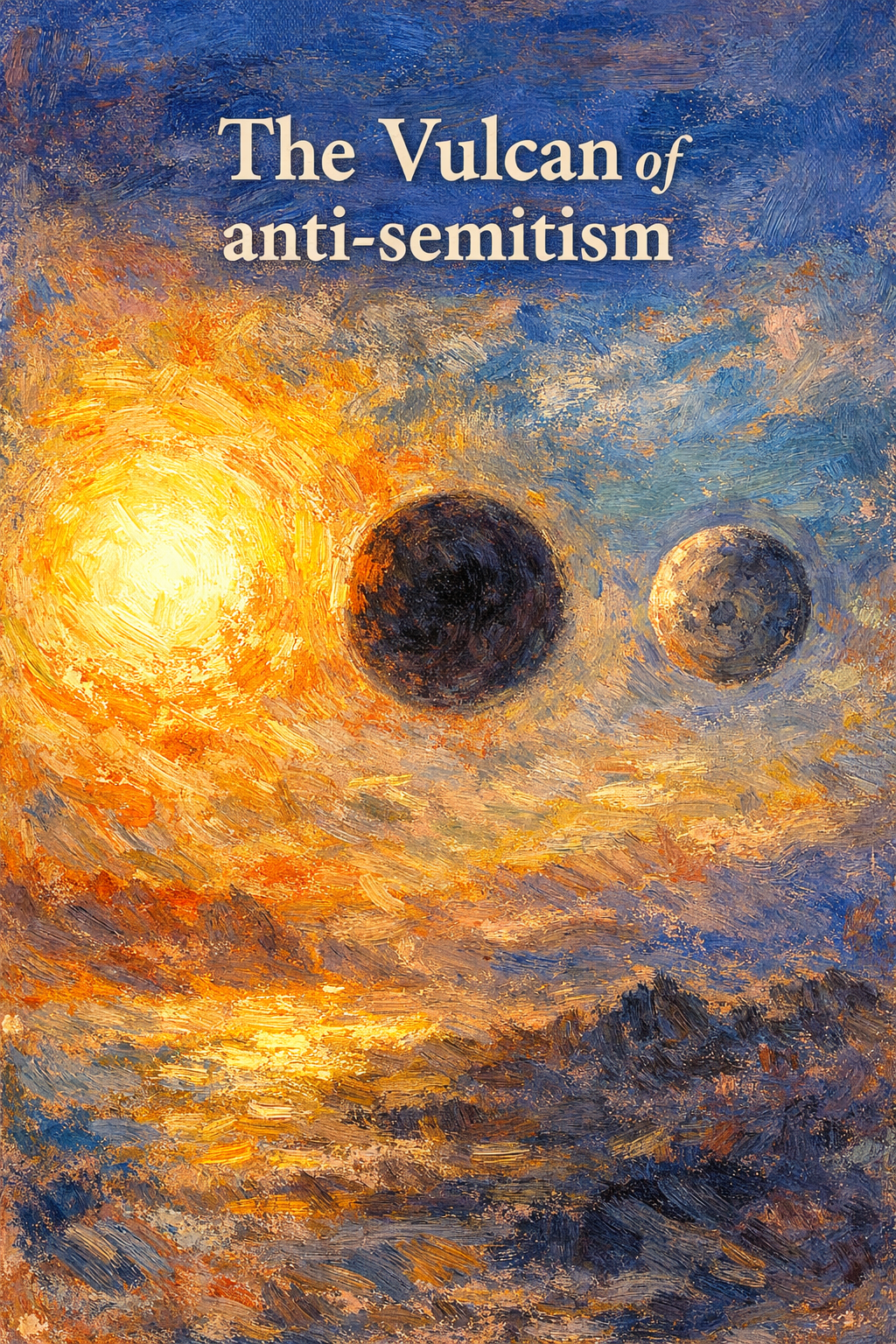
How a 19th-century phantom planet explains a 21st-century antisemitic reflex. Inspired by The Arc of a Covenant by Walter Russell Mead
In the mid-1800s, astronomers faced a stubborn puzzle: Mercury’s orbit didn’t behave exactly as Newton’s equations predicted. The discrepancy was small, but it was real. And because Newton’s framework worked so beautifully everywhere else, many scientists made a reasonable—almost irresistible—move: they proposed an unseen planet orbiting closer to the Sun than Mercury. They even named it Vulcan.
Vulcan was not discovered because someone saw it and then concluded it existed. Vulcan was “discovered” because people needed it to keep a beloved explanation intact.
For decades, reports came in: dark specks crossing the Sun, glimpses during eclipses, confident claims. None of them cohered. Vulcan’s orbit could never be nailed down. Still, the idea endured because it solved the problem—at least emotionally and mathematically—without requiring anyone to rethink the core theory.
Then Einstein arrived. General Relativity accounted for Mercury’s anomaly without any hidden planet at all. Vulcan evaporated, not as a scandal but as a lesson: smart people can invent a phantom object when reality pressures a cherished model.
That story matters today because we are living through a social and political version of Vulcan—one far more toxic than an astronomical mistake. I’m speaking of the enduring myth of “secret Jewish power”: the claim that Jews operate as a concealed force steering governments, banks, media, revolutions, wars, and cultural change. This is not merely a prejudice; it’s a patch—a phantom entity adopted to rescue an explanation of the world. And once adopted, it becomes “proof” for itself.
How the Vulcan logic works
The psychological structure is simple:
- A person encounters complexity and fear.
A war erupts. The economy whiplashes. Institutions fail. Culture shifts. A pandemic rewrites daily life. Individuals feel disoriented and powerless. - They reach for a story that restores control.
The world can’t be this chaotic, they think. Someone must be driving it. - They add an invisible “necessary” cause.
A hidden cabal. A shadow network. A secret hand. - They select a familiar target.
Jews are an old, ready-made scapegoat—portable across countries and eras, already stocked in cultural memory with rumors and caricatures. - They reverse the burden of proof.
The absence of evidence becomes evidence of concealment. Disagreement among Jews becomes “a façade.” Success by a few becomes proof of a collective plot. Failure becomes proof of manipulation. Everything becomes confirmation.
That is Vulcan logic: “Because I can’t otherwise explain this, the hidden object must exist.”
The “secret Jewish power” trope is not an argument that occasionally goes wrong. It is a design—a self-sealing structure built so it cannot lose. It explains anything, and precisely because it explains anything, it explains nothing.
Why this particular Vulcan is so appealing
The phantom planet Vulcan was comforting in a strangely noble way: it preserved the elegance of Newton’s laws. The Vulcan of secret Jewish power is comforting in a darker way: it preserves the ego.
If outcomes are caused by incentives, institutions, bureaucratic inertia, competing interests, historical accidents, and human error, then no single villain can be blamed—and no simple remedy exists. That’s an unbearable conclusion for many of us, especially in times of stress.
But if outcomes are caused by a hidden group, then the world becomes legible again. Chaos becomes intention. Complexity becomes conspiracy. Personal disappointment becomes sabotage. And moral confusion becomes clarity: I am righteous; they are wicked.
This is why antisemitism keeps returning even when facts change. Jews have been accused, across centuries, of being simultaneously too powerful and too weak, cosmopolitan manipulators and clannish outsiders, capitalist exploiters and communist subversives, imperialist colonizers and rootless parasites. The contradictions don’t matter because the claim isn’t trying to describe Jews. It’s trying to stabilize the believer’s world.
A conspiracy theory is often less a map of reality than a tranquilizer for anxiety.
The cost: a moral shortcut that becomes a habit
Once the Vulcan of secret Jewish power is installed, it does more than mislead. It trains a mind to stop looking.
Why learn the tedious mechanics of how policies fail, how supply chains break, how wars escalate, how social media amplifies outrage, how institutions corrode, how ideology hijacks judgment? You don’t need to. You already have your answer.
Antisemitism is not only hatred. It is intellectual laziness weaponized. It is the abandonment of civic responsibility in favor of a single, intoxicating explanation.
And it spreads because it is efficient. It turns history into a melodrama. It turns a complicated world into a children’s story: heroes, villains, secrets, and a final reveal.
The test antisemitic Vulcans cannot pass
In science, one of the most honest questions you can ask is: What would prove me wrong?
Vulcan failed that test because it kept sliding away from verification. “Secret Jewish power” fails it far more aggressively, because it is constructed to convert disproof into proof. When a claim is built so that no evidence can count against it, it is not a hypothesis—it is a superstition.
A second test is equally important: Where is the mechanism?
Real power is visible in mechanisms: laws, budgets, institutions, elections, lobbying disclosures, organizational charts, tradeoffs, minutes, incentives, public records, traceable decisions. Conspiracism rarely names mechanisms with precision because precision creates vulnerability. Vague power cannot be audited. Vague power cannot be disproven. Vague power cannot be punished—only hated.
That is why “secret Jewish power” is so useful to those who wield it: it is unfalsifiable, unauditable, and therefore endlessly reusable.
What to do when you hear it
We are often told to “debate” conspiracies point by point. That can be a trap. The goal of Vulcan thinking is not to seek truth; it is to keep a worldview intact. Still, there are responses that can puncture the spell without dignifying the myth:
- Name the structure, not the insult.
“That theory explains everything and can’t be disproven. Those feel satisfying, but they’re usually false.” - Demand a falsifier.
“What fact would make you abandon this idea?”
If the answer is “nothing,” you’ve exposed the armor. - Shift from identity to systems.
“Before blaming a people, let’s look at incentives, institutions, and documented decisions.” - Refuse the moral shortcut.
“Complex events have many causes. Scapegoating is a way of opting out of understanding.”
And for those of us writing, teaching, or shaping public discourse, the task is larger: we must make non-conspiratorial explanations emotionally satisfying again. We need stories that acknowledge fear and grievance without handing them a scapegoat. We must teach how power actually works—messily, bureaucratically, competitively—so that the urge to invent phantoms loses its seduction.
The difference between a mistaken planet and a murderous myth
Astronomy’s Vulcan disappeared harmlessly when a better theory arrived. The Vulcan of secret Jewish power does not disappear on its own because it is not primarily about evidence. It is about permission—permission to hate, permission to simplify, permission to harm.
That is why antisemitism is so persistent: it offers a single lever to move the world, and when the world does not move, it offers a single throat to blame.
We should retire this Vulcan the way science retires its phantoms: by insisting on mechanisms, on falsifiability, and on humility before complexity. But we must also name the moral truth: scapegoating Jews is not a theory. It is a failure of conscience dressed up as insight.
Mercury’s orbit didn’t require an invisible planet. Our political and cultural anxieties don’t require an invisible enemy. When people reach for “secret Jewish power,” they are not discovering something hidden. They are installing a phantom—one that has already, many times in history, turned deadly.
We know where that road leads. And we know, too, the simplest antidote: refuse the phantom, do the harder work of understanding, and insist that complexity is not a conspiracy—it is the human condition.