
Writer covering Israel–Africa, Jewish affairs, and Israel worldwide
The War Against Jewish Grief: Even Jewish Grief Is Occupied
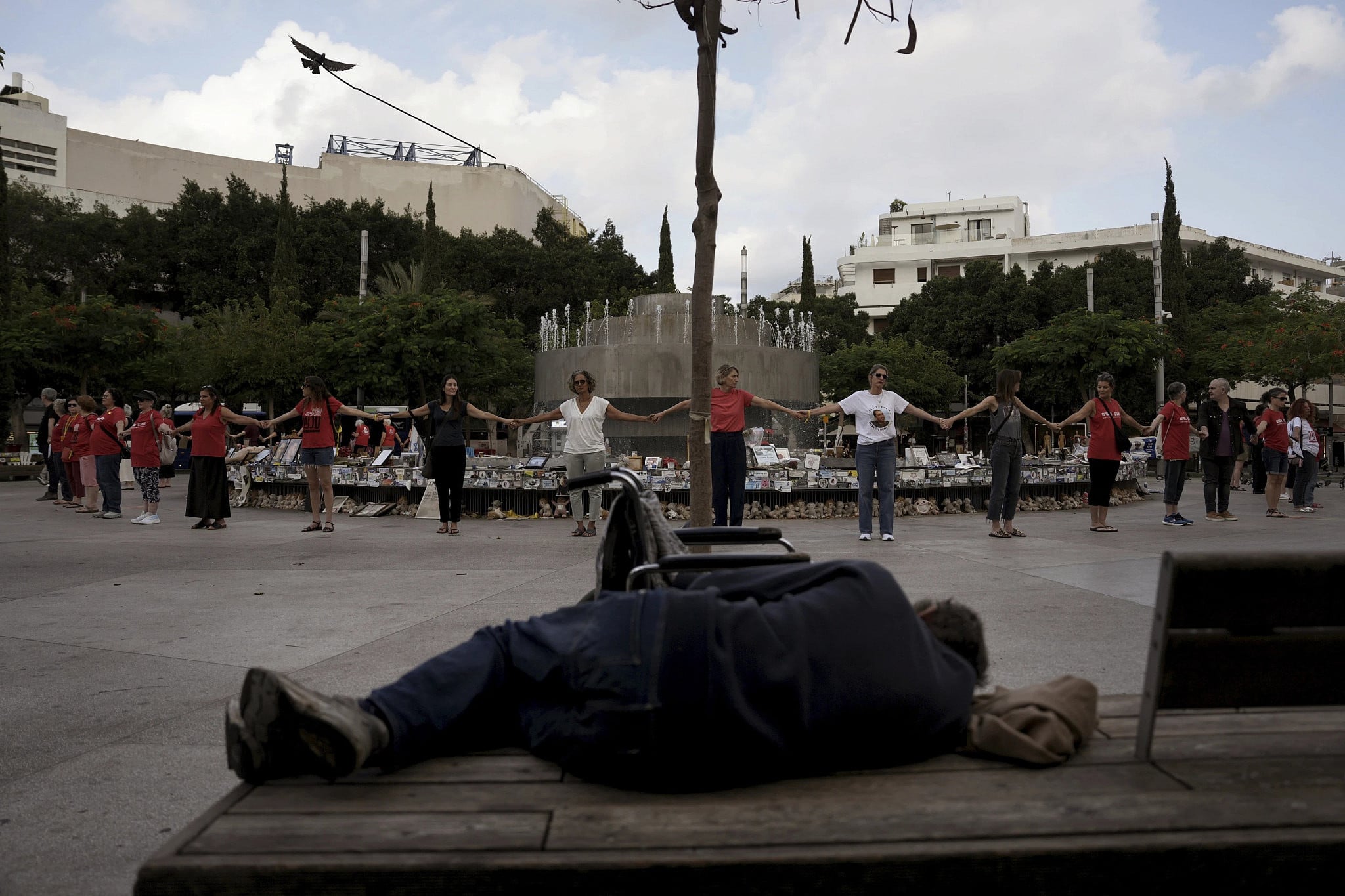
A man sleeps on a bench as people hold hands at a memorial marking the one-year anniversary of the Hamas attack on Israel, in Tel Aviv, Monday, Oct. 7, 2024. (AP Photo/Oded Balilty)
Some cannot allow Jews to celebrate in peace. Increasingly, they cannot allow them to mourn in peace either.
In 1948, after two thousand years of exile, centuries of persecution, and the ashes of the Holocaust still warm across Europe, the Jewish people re-established sovereignty in their ancestral homeland. For Israelis, it became Independence Day. For Palestinians, it became the Nakba—the “catastrophe.”
That was the first great inversion. Jewish survival itself was recast as someone else’s tragedy. The mere existence of a Jewish state became the original offense, not the repeated attempts to destroy it.
That moral inversion did not end in 1948. It became the operating system of Palestinian nationalism.
Every Israeli holiday requires a Palestinian counter-narrative. Every Israeli achievement must be diminished. Every Israeli funeral demands a competing victimhood. Israelis are not permitted the ordinary privilege of celebrating their victories or burying their dead without Palestinians insisting that the spotlight belongs to them.
The suffering of Israelis is considered incomplete until it has been rewritten as Palestinian victimhood.
That familiar script unfolded once again on July 2, 2026.
Israelis marked one thousand days since the October 7 massacre. Across the country, families remembered murdered relatives and prayed for hostages who remain in Gaza—alive or dead. For once, ideology should have yielded to simple human decency. Instead, Palestinians declared the occasion “one thousand days of genocide.”
Even Jewish mourning had to become Palestinian theatre.
Imagine arriving at a shiva only to insist the bereaved family vacate the mourning tent because your grievance deserves the chairs. That is the logic on display. Israeli grief is never allowed to remain Israeli grief. It must be annexed into the Palestinian narrative.
Shiri Bibas was abducted from Kibbutz Nir Oz alongside her two sons—Ariel, aged four, and Kfir, just nine months old. The images of the terrified mother clutching her red-haired children became among the defining images of October 7. The children were later confirmed to have been murdered in captivity.
Not killed in crossfire.
Not victims of some unfortunate battlefield accident.
Murdered.
Hamas first blamed Israeli airstrikes before quietly abandoning the story once forensic evidence destroyed it. But admitting responsibility was never really the objective. Narrative management was. Almost immediately the accusation was inverted. Israel, somehow, became the regime that murders babies.
The same script reappeared over sexual violence.
On October 7, Palestinian militants committed rapes, gang rapes and acts of sexual torture documented by eyewitnesses, forensic evidence, survivors, first responders, and later corroborated by the United Nations. The evidence was sufficient for Hamas to be blacklisted by the UN for systematic conflict-related sexual violence.
Yet almost before the evidence had settled, another campaign emerged.
Articles, activists and advocacy groups redirected attention toward allegations that Israel was the systematic sexual predator. Pieces such as Nicholas Kristof’s New York Times essay amplified those claims internationally. Eventually, Israel itself found its way onto the UN’s sexual violence blacklist.
Observe how elegantly the inversion works.
The perpetrators become victims.
The victims become perpetrators.
Reality itself becomes negotiable.
None of this exists in isolation.
The PA continues rewarding terrorists through its notorious “pay-for-slay” programme, where financial stipends increase according to the severity of attacks against Israelis. Schoolchildren continue learning maps in which Israel simply does not exist. Generation after generation is taught not coexistence but elimination. Every rejected peace proposal becomes further evidence that Israel refuses peace.
They overturned every negotiating table on which a Palestinian state was offered, only to spend decades claiming no table ever existed.
The origins of this psychology are hardly mysterious.
The Arab leadership rejected the 1947 UN Partition Plan, rejecting a Palestinian state because accepting one would also have meant accepting a Jewish one. War followed. Defeat followed. Displacement followed. Even early Arab intellectuals such as Constantine Zurayk described the Nakba less as an injustice inflicted by Zionists than as an Arab failure—a humiliation born of losing a war intended to prevent Jewish independence.
That uncomfortable truth gradually gave way to something politically more useful.
Failure became victimhood.
Aggression became resistance.
Responsibility became oppression.
The catastrophe was no longer the decision to wage war. It became the existence of the Jews who survived it.
Ever since, Israelis have never been permitted a day that belongs solely to them.
Independence Day becomes the Nakba.
Jerusalem Day becomes another grievance.
One thousand days since October 7 becomes another opportunity to erase October 7.
There is something almost comic about the predictability of it all—were the consequences not so deadly.
A society that glorifies “martyrs,” broadcasts children’s programmes celebrating jihad, stores rockets beneath civilian neighbourhoods, and counts casualties with greater enthusiasm than peace proposals somehow cannot tolerate Israelis quietly remembering murdered families without staging a competing spectacle of grievance.
The obsession says far more about Palestinian politics than it does about Israel.
A healthy society does not construct its identity around sabotaging another nation’s moments of joy and grief. It builds institutions. It accepts responsibility. It prepares its people for compromise instead of permanent resentment.
Palestinian politics has largely chosen the opposite path.
By insisting that every Israeli celebration is an insult and every Israeli tragedy is somehow about Palestinians, it traps its own people inside a perpetual hall of mirrors where accountability never appears and history endlessly repeats itself.
Israelis should be allowed to celebrate their independence without apology.
They should be allowed to commemorate their murdered children without interruption.
They should even be allowed the remarkably modest privilege of mourning in peace.
But that would require abandoning the central doctrine that has animated Palestinian politics for generations, that Jewish happiness is illegitimate, Jewish suffering is insufficient, and Jewish existence itself remains the original crime.
Until that changes, the inversion will continue.
Every Israeli wedding will require a protest.
Every Israeli funeral will require a slogan.
If this argument offends you more than the murder of Jewish children ever did, then perhaps you’ve just discovered the very inversion I’ve been describing. Some will leave this essay convinced it is unfair to Palestinians. Others will wonder why it took so long to say the obvious. History, I suspect, will be kinder to the latter.
Related Topics
Related Posts