Thinking about 'Resilient Zionism'
The war and my “Nebach” syndrome
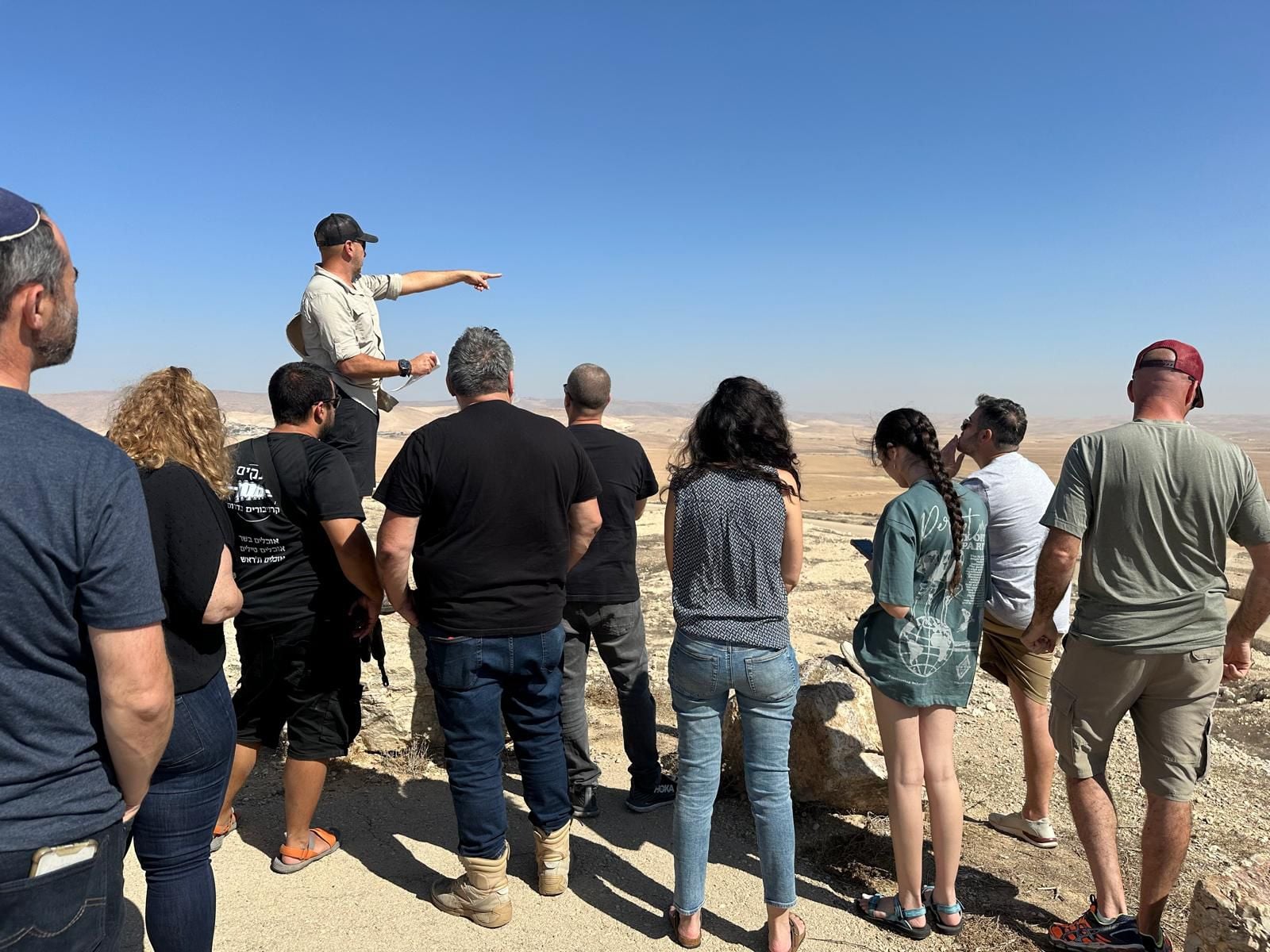
Yachad community site tour (Courtesy)
No matter how many cookies the kids baked for soldiers, how many visits I made to rehabilitation hospitals or how much support I tried to give my son serving in an elite combat unit, I couldn’t shake a lingering feeling of nebachkeit since the outbreak of the war.
As someone who did not merit to serve in the IDF, intellectually I knew my role was different. My contribution was on the home front—family, community, civil society. Still emotionally, it often felt like not enough. I felt like a nebach – I felt inadequate. This feeling was exacerbated as I watched my neighbors, friends and colleagues go off to round after round of miluim.
That feeling is probably what led me to respond to a social media post some two years ago asking: “Do you want to be part of something special?” Shortly after, I got a call from someone by the name of Gal Shochami. Little did I know that Gal was a decorated and revered IDF Brigadier General who had already accomplished a few things in his life to say the least. In that initial conversation Gal succinctly and clearly laid out a vision of creating a value-driven diverse community settlement in the Negev that he aptly called ‘Yachad’. It was clear that Gal’s narrative was not that of raw ideological zealotry but rather one rooted in national responsibility and transparent reality. Gal was not trying to convince or inspire on that initial call, he was simply articulating a vision that deeply resonated with me in a post October 7 reality.
At its heart, Yachad – Adam Ve’Adama is about building an intentional community in the Negev, a microcosm of the “beautiful Israel” (“Yisrael Hayafa”) where secular and religious live and proposer together not by erasing differences but by respecting them. With the Negev sitting at the intersection of Israel’s security needs, demographic future and economic potential Yachad approaches settlement in the Negev as a disciplined act of Zionistic nation-building.
A Living Proof of Concept
Over the last year or so I have come to think of Yachad as a kind of living proof of concept. In a period when Israeli society often feels pulled apart from within there is something quietly powerful about a diverse group of well-established people who choose to build and live together in a challenging environment. Not as a statement, but as a way of life.
Resilient Zionism, Up Close
Over time, I have started thinking about the Yachad initiative in terms I’m more familiar with.
In my professional capacity I spend a lot of time thinking about sustainability and resilience— what makes systems hold under stress, what allows them to recover and what helps them grow stronger rather than fracture. Seen through this lens, what Yachad is doing feels like a very grounded form of what I’ve come to call Resilient Zionism.
Resilience here isn’t only about security or economics. It’s about whether communities and ecosystems can absorb challenges and grow from them. Whether people feel rooted enough to stay. Whether disagreement can exist without unraveling the fabric of shared life.
From Community to Investment Thinking
Once I started seeing the Yachad community in this way, it was hard not to think about how this kind of lived reality translates into the language of investment and impact.
Communities like Yachad create things of economic significance that are harder to capture on balance sheets but easy to feel: stability, trust, continuity. Still, many of these elements can be observed and measured — social cohesiveness, economic propensity, environmental resilience to name but a few.
For me, this opens the door to thinking about an investment approach that expands upon robust international sustainable finance frameworks and tweaks them to the unique nuances on the ground in Israel. In this sense, resilience metrics underpinned by Zionist values aren’t abstract ideals – they are empirical and measurable signals that something is working,
From “Nebachkeit” to Meaningfulness
Joining Yachad did not suddenly make everything feel resolved. But it did change something important for me. It shifted me from watching to participating. From feeling peripheral to feeling connected in these monumental times.
Zionism has always been built by people who showed up in imperfect ways, with whatever they had to give. For me, Yachad became a place where I can do that together with others and with a sense of tangible meaningfulness.
I look forward to sharing experiences and updates as our Yachad journey continues to shift from dreams to reality.
Related Topics