The views expressed herein are solely mine.
The War Both Morocco and Algeria Fear to Win
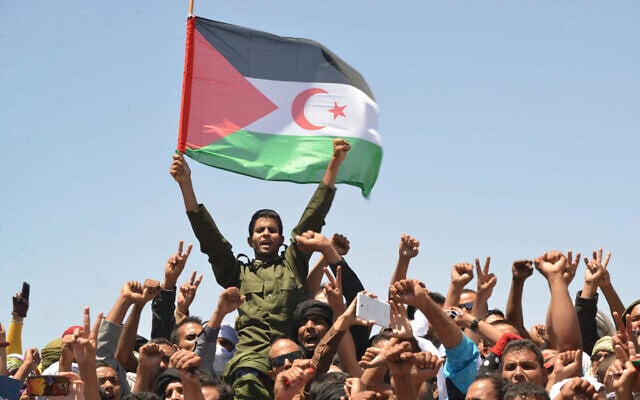
Members of the Polisario Front, the organization disputing sovereignty over Western Sahara with Morocco, mourn their leader, Mohamed Abdelaziz, during his funeral held in the Rabouni refugees camp, south western Algeria, June 3, 2016. (AP Photo/Sidali Djarboub, File)
Both Morocco and Algeria survive on the same dangerous truth: their regimes need the Polisario Front. Not to defeat it, not to resolve the conflict—but to justify their own existence.
Morocco looks triumphant on paper. The UN leans toward Rabat’s autonomy plan. Europe is lining up behind the kingdom. The Polisario has no real arsenal—no drones, no short- or mid-range missiles, no capacity for territorial warfare. Militarily, it is a ghost.
Yet Morocco still cannot finish it.
If the Polisario disappears, the Moroccan monarchy faces the question it fears most: what now justifies the King’s unchecked power?
For decades, the Western Sahara issue has been the glue that holds the throne — the mythic mission that turns political obedience into patriotic duty. End that story, and Moroccans start demanding answers about corruption, unemployment, repression, and a security apparatus that treats dissent as treason.
Worse, peace would expose the kingdom’s shadow economy.
Today, Morocco produces roughly 70% of the world’s cannabis resin — a black-market empire worth $10–12 billion a year, with an estimated $2–3 billion feeding networks tied to the palace, military brass, and intelligence brokers.
That is why the Western Sahara conflict is priceless: it justifies secrecy, swollen budgets, smuggling corridors, and unaccountable power. Peace threatens the money — and the people living off it would not hesitate to force a regime reset to protect their interests.
Hence, Morocco’s biggest risk is not the Polisario; it is a deep state that cannot afford to win the conflict it depends on.
Meanwhile, Algeria lives a parallel lie.
The Argel-based regime wraps itself in “anti-colonial solidarity,” hosts the Polisario in Tindouf, and screams about Moroccan expansionism while using the conflict to distract Algerians from a collapsing economy, mass youth unemployment, and a political class that has not had legitimacy since the 1962 revolution.
Thus, a Polisario collapse would strip Algeria of the scapegoat that keeps its streets from exploding.
If the Polisario fights, the regime steps into its nightmare: a war it is too weak to sustain. Russian weapons are no longer arriving as before, the army is a paper giant with brittle bones, and Hirak already revealed the cracks. One more regional shock could break the whole structure.
Inevitably, the hard truth emerges: Morocco cannot win without shaking its own foundations, and Algeria cannot escalate without cracking its own regime. The Polisario endures as the pressure valve that keeps both systems from detonating.
Every diplomat knows it. Every intelligence service banks on it.
And every regime involved prays the conflict never ends — because the Western Sahara is the one battlefield where victory is more dangerous than war itself.
Related Topics
Related Posts