Our People helping our people
The War Isn’t Over. Israel Is Just Holding Its Breath
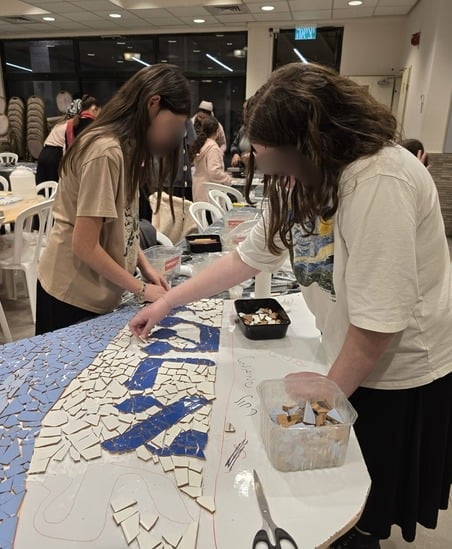
Children of wounded IDF soldiers create an Am Israel Chai mosaic at a therapeutic arts workshop (Courtesy of the author))
People keep saying the war is over.
They say it casually. Almost hopefully.
As if saying it out loud might make it true.
But in Israel, the war has not ended.
It has simply gone underground.
We are living in the long pause between sirens.
Between headlines.
Waking up in the morning to check the news and see if another shoe has dropped.
Everyone here is waiting for Iran.
Waiting for the escalation we all know is not theoretical. Rooting for the protesters, while worrying that the sadistic regime may make Israel its doomsday scapegoats. Waiting, while pretending it’s business as usual, as we go back to work, school, routine.
But wars do not end when the shooting slows down.
They end when lives stop unraveling.
And for tens of thousands of Israelis, nothing has stopped unraveling.
The war is not over for Daniel*.
Daniel is twelve years old.
His father is currently on his sixth round of reserve duty.
His mother gave birth a few months ago.
Every day when Daniel gets home from school, he puts his bag down and picks up the baby. As he cuddles baby Shira, he gently reminds his mom to go shower, get something to eat, or go for a walk.
Daniel does not complain.
He understands something no child should have to understand.
That his mother is barely standing.
At camp, a place where nothing was asked of him, it took a full week before Daniel put down the instinct to take care of everyone else and allowed himself to just be twelve.
The war is not over for Yael.
Yael sent her husband to war with love and faith.
When he came back, he was not the same man.
The anger came first.
Then the control.
Then the credit card cancellation.
After escaping the PTSD-induced violence, Yael now lives in a run-down apartment with four children, trying to piece together the money, the paperwork, and the courage to leave a marriage that became dangerous after the uniform came off.
There are no medals for women like her.
A small community stepped in to make sure Yael and the children had beds to sleep in and food on the table.
The war is not over for Katya.
8-year-old Katya arrived in Israel from Ukraine during the first weeks of that war, already broken.
She survived the bombings in Odessa hiding in a bathtub.
She survived the flight.
She survived starting over in a new country with a new language and her flute being the only object from her old life.
And then the war here began.
Now she cannot breathe when she hears loud noises.
She cannot sleep without reliving explosions from two countries at once.
Her parents are struggling to get through the bureaucratic web to ensure she gets the therapeutic support they cannot afford on their own.
Her parents needed help navigating the system, and without it, Katya would still be waiting.
It’s not over for Maya.
Maya is an ordinary Israeli 10-year-old.
She has not slept normally in two years.
When she closes her eyes, she sees faces from of Nasrallah and Sinwar.
Names she was never supposed to know.
Deaths she was never supposed to understand.
Her body does not know the war is “over.”
Her nervous system never got the memo.
And so Maya (and Yehudit, her mother) were hardly functioning , until Yehudit found the help they needed through a women’s circle, where women sit together, speak honestly, and keep each other standing.
It’s not over for the Levine family from Be’er Sheva.
After arriving from Kiev 3 years ago, they had a business.
They had stability.
They had a life that worked.
Then an Iranian rocket made their home became unlivable.
They moved.
They lost customers.
They lost footing.
Now they are rebuilding from zero, quietly, without drama, without attention.
Just one more family erased from the illusion of normalcy.
This is what war looks like after the cameras move on.
Not tanks.
Not soldiers.
Children holding babies.
Women hiding bank cards.
Immigrant kids reliving sirens in two languages.
Families rebuilding lives they never planned to lose.
At Our People, we meet these families every day.
We do not talk about “the day after.”
We live in the day during.
Because wars do not end when people stop talking about them.
They end when people stop bleeding quietly.
And we are not there yet.
Not even close.
*All names have been changed to protect privacy.
Related Topics
Related Posts