
The war over Gaza fatality numbers: A new push to prove Hamas’ count is too low
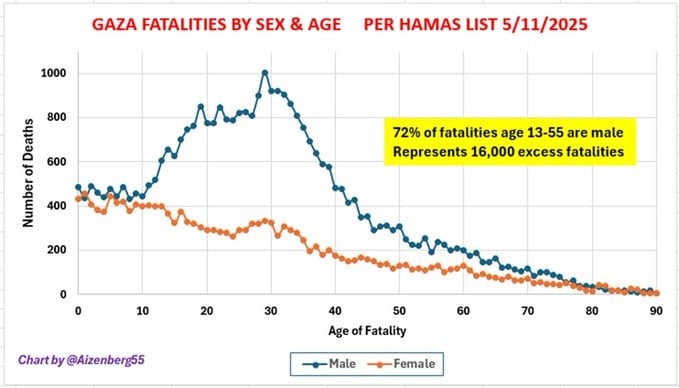
The battle over the number of fatalities in Gaza began soon after October 7. On October 25, 2023, President Biden stated that he had “no confidence” in the Gaza death toll, which at the time had surpassed 6,500 according to the Hamas-run Ministry of Health (MoH).[1] Two days later, the MoH published a fatality list in response to mounting skepticism.[2] From the outset, two critical data points undermined the credibility of Hamas’ reported fatality figures.
The first major example came on October 17, 2023, when Hamas claimed that approximately 500 Gazans were killed in an Israeli airstrike on al-Ahli Hospital.[3] The hospital itself was not hit; instead, the explosion occurred in the parking lot and was later attributed to a misfired rocket launched by Palestinian Islamic Jihad. This assessment was confirmed by intelligence agencies from the U.S., France, the U.K., and Canada.[4] The actual death toll was hundreds lower. Yet the MoH folded the original figure of 471 fatalities into its official casualty list the next day and never issued a correction.[5] These alleged deaths remain embedded in the MoH’s running casualty total to this day.
The second falsehood was the widely repeated claim that 70% of Gaza’s fatalities were women and children.[6] This figure circulated for months, until May 2024, when an updated fatality list showed the actual proportion was closer to 50%.[7] Since then, even analysts who generally treat Hamas’ data as credible have adjusted their estimates to the low-to-mid-50% range.[8] Yet for over six months, the 70% figure was reported as fact. Even after this blatant distortion, Hamas’ fatality reports continue to be cited by the media and NGOs as if they’re objective fact.
Over the past 20 months, a range of studies have surfaced, some claiming Hamas’ fatality numbers are riddled with errors,[9] others insisting they are reliable.[10] This essay does not aim to litigate each one. Instead, it focuses on the flawed assumptions behind the stance of what I call the “Hamas list defenders”—those who treat fatality figures from a U.S., U.K., and EU-designated terrorist organization as sacrosanct, despite Hamas’ well-documented history of deception.
These defenders often rely on two main fallacies. The first is that Hamas was accurate in previous wars and so should be trusted now. This ignores the vastly different stakes of the current war, in which Hamas’ very survival is on the line. Hamas has also lied about casualties before: after the 2009 Gaza War, a Hamas spokesperson initially claimed that only 48 of its fighters had died out of 1,300 Gazan fatalities. Months later, Hamas admitted that between 600 and 700 of the dead were their own members, matching the Israeli figure of 709.[11] Similar examples have been documented in other Gaza wars.[12]
The second fallacy is the claim that Israeli intelligence trusts Hamas’ numbers. This can be traced to a January 2024 article in the Israeli outlet Mekomit citing unnamed intelligence sources, then cited by Vice.[13] But senior Israeli officials have rejected it outright. In May 2024, Oren Marmorstein, spokesperson for Israel’s Foreign Ministry, wrote: “Israel has repeatedly stated that the numbers coming out of Gaza, which are being echoed by UN agencies, have been manipulated by the Hamas terrorist organization. They are not accurate and they do not reflect the reality on the ground.”[14]
In recent months, a new trend has emerged: not only are Hamas’ numbers said to be accurate, but supposedly too low. The narrative now claims that the true death toll in Gaza is tens of thousands higher than Hamas admits, the war in Gaza as uniquely deadly, with the subtext that Israel is conducting a genocide. Other wars with far more staggering civilian death tolls, such as in Congo where there are literally millions of civilian fatalities, don’t factor into their comparisons.
The first of the “undercount” studies appeared in July 2024 as a correspondence in The Lancet, suggesting that “it is not implausible to estimate that up to 186,000 or even more deaths could be attributable to the current conflict in Gaza.”[15] The authors arrived at this figure by taking a multiplier used in other wars to estimate indirect deaths and applying it to the Gaza war, without providing any specific evidence to justify the comparison. One of the authors admitted the number was “purely illustrative,” and The Lancet published a rebuttal letter shortly afterward.[16]
In February 2025, The Lancet published another “undercount” piece claiming that 64,000 Gazans had died, 30,000 more than Hamas claimed.[17] That study used a “capture-recapture” technique using two Hamas fatality lists and social media. But University of Pennsylvania statistician Abraham Wyner found the methodology deeply flawed, noting a “small but highly influential subset of bad data.”[18]
In June 2025, a new “undercount” study by Michael Spagat and colleagues estimated 75,200 violent deaths in Gaza by January 2025—more than 30,000 above the Ministry of Health’s reported total.[19] This estimate was based on surveys conducted inside Gaza, which were then used to extrapolate a broader fatality count. Notably, Spagat’s team dismissed the earlier capture-recapture study as unreliable, despite both studies reaching nearly identical conclusions about a significant undercount.
Yet all of these studies overlook one critical flaw: the premise that Gazans have underreported fatalities is almost certainly false. Claims of large-scale undercounting contradict what we know about both the incentives to report and the ease of reporting deaths to the MoH. In reality, there is a strong incentive for overreporting, not underreporting. Families routinely register deaths with the MoH to receive real-time benefits or future compensation, a dynamic acknowledged by both MoH officials and Spagat.
In April 2025, Sky News reported that thousands of names had been removed from the MoH fatality list. Zaher al-Wahidi, a senior official of the MoH, explained that some were removed because they had died natural deaths, while others were removed because of “false claims… motivated by the promise of government financial assistance.”[20]
This seriously undermines the logic behind claims of an undercount in the tens of thousands. In addition, al-Wahidi revealed that many natural deaths had been misclassified as war-related fatalities. Based on Gaza’s pre-war mortality data, more than 10,000 natural deaths would have been expected since October 7. Many of these appear to have been included in the official toll, making the Hamas fatality list even less reliable.
Importantly, the MoH has stated that families in Gaza can report deaths through Google Forms, paper forms at hospitals, or by phone—even without a recovered body. In April 2024, Al Wahidi told Sky News that widows are submitting such reports because they “must formally register their husband’s deaths to obtain government assistance.”[21] Yet Spagat’s study claims that over 10,000 men of marriage age died and went unreported. This lacks plausability given the evidence.
Even Spagat’s own paper concedes the incentive to overreport: “Respondents may have overreported deaths, perhaps with the objective of collecting compensation for dead relatives or otherwise inflating the conflict’s mortality counts.” But there is a second admission as well. In explaining why one of the ten surveys showed a disproportionately high number of fatalities, the study notes that the families surveyed “were in shelters that give special preference to families that have lost members during the fighting.” This confirms that families were not only expecting future compensation, but many were also receiving tangible benefits in real time based on reported fatalities.
The study never reconciles these facts with its claim that 40% of deaths went unreported. When Haaretz followed up with the researchers, asking what happened to the unreported bodies, the response was that families quietly buried them without informing the MoH.[22] But this contradicts everything we know: Gazans are incentivized to report deaths in order to qualify for compensation and gain immediate tangible benefits.
The fatality count in Gaza has become a central feature of international discourse, often shaped more by advocacy aims than grounded analysis. While the true toll may not be known for years, the most widely repeated claims rely on speculative models and unverified assumptions, particularly the idea that tens of thousands of deaths were never recorded by a system that actively encourages reporting and makes it very easy to do so. Multiple sources, including officials from Gaza’s own health ministry and researchers themselves, have acknowledged that families are motivated to report deaths in order to access compensation and other benefits. Yet none of the recent studies addressing a supposed undercount attempt to quantify combatant deaths or reconcile their findings with this reporting incentive reality. As a result, these analyses appear to reinforce predetermined narratives rather than contributing to a credible understanding of the conflict.
[1] https://www.reuters.com/world/middle-east/biden-says-he-has-no-confidence-palestinian-death-count-2023-10-26/
[2] https://www.cnn.com/2023/10/27/middleeast/gaza-death-toll-report-intl
[3] https://www.aljazeera.com/gallery/2023/10/17/photos-an-israeli-air-raid-on-al-ahli-arab-hospital-kills-an-estimated-500
[4] https://www.nbcnews.com/politics/national-security/us-intel-agencies-believe-hospital-blast-caused-palestinian-rocket-bro-rcna122031
[5] https://www.ochaopt.org/content/hostilities-gaza-strip-and-israel-flash-update-12
[6] https://www.reuters.com/world/middle-east/nearly-70-gaza-war-dead-women-children-un-rights-office-says-2024-11-08/
[7] https://www.cfr.org/blog/un-halves-its-estimate-women-and-children-killed-gaza
[8] https://aoav.org.uk/2024/analysis-of-new-death-data-from-gazas-health-ministry-reveals-several-concerns/
[9] https://henryjacksonsociety.org/publications/hamas-casualty-reports-are-a-tangle-of-technical-problems/
[10] https://aoav.org.uk/2023/are-the-gazan-casualty-figures-being-reported-reliable-two-conflict-experts-compared-the-numbers-to-previous-attacks-and-conclude-they-are-credible/
[11] www.haaretz.com/2010-11-09/ty-article/hamas-admits-600-700-of-its-men-were-killed-in-cast-lead/0000017f-ee02-ddba-a37f-ee6edc3f0000
[12] https://x.com/Aizenberg55/status/1764317959327989907
[13] https://www.vice.com/en/article/israeli-intelligence-health-ministry-death-toll/
[14] https://x.com/OrenMarmorstein/status/1790057643001692580
[15] https://www.thelancet.com/journals/lancet/article/PIIS0140-6736(24)01169-3/fulltext
[16] https://www.thelancet.com/journals/lancet/article/PIIS0140-6736(24)01683-0/fulltext
[17] https://www.thelancet.com/journals/lancet/article/PIIS0140-6736(24)02678-3/fulltext
[18] https://papers.ssrn.com/sol3/papers.cfm?abstract_id=5115647
[19] https://www.medrxiv.org/content/10.1101/2025.06.19.25329797v1.full
[20] https://news.sky.com/story/hundreds-of-names-removed-from-official-gaza-death-list-13341928
[21] https://news.sky.com/story/israel-hamas-war-health-system-collapse-in-gaza-leaves-authorities-struggling-to-count-the-dead-13107279
[22] https://www.haaretz.com/israel-news/2025-06-26/ty-article-magazine/.highlight/100-000-dead-what-we-know-about-gazas-true-death-toll/00000197-ad6b-d6b3-abf7-edfbb1e20000