World’s Only One-Armed Special Forces Sharpshooter
Featured Post
The war within: A dispatch from Gaza
When the call came through on my IDF reserve unit’s WhatsApp thread, I rushed in from LA and jumped back into the fighting with both feet
'These men'
I’m kneeling in what’s left of an alleyway in northern Gaza, rifle pivoting from shadow to shadow. Behind me, the battalion commander murmurs into his radio. Voice low, calm. I glance back and tap his arm. He lowers the receiver.
“You’re standing in his blood, sir.”
He looks down. “So I am…”
One respectful step forward, and he’s back to giving orders. I don’t know how anyone hears him over all this gunfire.
There’s so much blood.
It belongs to a fellow reservist who took shrapnel through the cheek, where it clipped something vital. The medic I’m paired with is working fast. He needs pressure. Two steady hands. He turns to me. Pauses. Then calls on someone else.
I don’t blame him. If you need two hands, I’m not your guy. I lost one on this same patch of dirt more than fifteen years ago. And much like the mortar that took my arm, it hits me – how strange this is. The noise, the blood, the familiarity. Just a week ago, I was sitting at my local café in Los Angeles, dog curled at my feet, wondering what book to read.
We weren’t given much notice. Our unit’s WhatsApp thread lit up with a call-up date.
“I’ll start swimming now…” I replied, only half-joking.
Ballistic missiles were hitting Tel Aviv. Israel was at war with Iran, and all flights were grounded. If I had to get to Cyprus and hail a boat, so be it.
Just like that, I’m signing out my customized rifle. A buddy in line turns to ask why I look so lost. Maybe it’s because most of my friends spend their time off in Tulum. I’ve spent every vacation day accrued since 10/7 in Gaza. Or the tunnels under Lebanon.
We arrive at base camp, a kilometer inside Gaza. Four steep mounds of earth mark the perimeter, each topped with a concrete tower and a spotlight you could see from orbit. There’s the thump of artillery. The crack of machine-gun fire. The low churn of choppers overhead. Explosions – some distant, others close enough to adjust your posture.
It all fades into background noise before long. Sirens that once yanked you from sweaty sleep don’t even register. You’ve got four seconds to find cover. Just enough time to realize you won’t be fast enough. I remind my guys that the safest place to stand is next to the soldier who’s already been hit by the same shit on a different day. They seem to accept that and huddle closer.
The dogs are different here. All ribs and hunger. They tear each other apart for the high ground. At first, you try to stop them. You yell. Throw rocks. But it doesn’t matter. It’s another war within the war. And eventually, you learn to leave them to it.
Moonlight
No time to acclimate. From base camp, we move out on nightly missions. The landscape doesn’t look real. Moonlight slides across broken buildings, twisted rebar reaching toward the sky like steel vertebrae. It’s like that scene in The Matrix when Morpheus shows Neo what’s left of the real world. There isn’t much.
Explosions roll through the dark, shockwaves visibly displacing air long before the sound reaches you. The occasional bullet snaps overhead. You glance at the soldier beside you. Neither of you says it, but the question lingers: Was that meant for us?
It’s often the smaller details you remember. One night, we were holed up in a crumbling duplex when our sergeant sneezed. From around the dark room came a quiet chorus of “bless you” – equal parts Hebrew, English, and Russian. Moments later, the building next to us exploded.
“Bless you,” I said, deadpan.
I don’t remember what we did after that. Just the sound of them laughing.
Two nights later, that reservist caught shrapnel to the face. The medic and I were sent forward alone. We found our guy in what was left of an alleyway, covered by his team. Rounds cracked overhead as I took up a post, glancing back to watch my friend work.
No theatrics. No panic. Just steady hands and breath through clenched teeth. The reservist never made a sound. Just shook his head when offered painkillers. It was 10 pm when we loaded him onto an open Humvee. The mission wouldn’t end until 5:15 the next morning.
There was only one moment when I remember thinking I didn’t sign up for this. I was sitting backwards on the rear seat of the last Humvee. Legs propped on literal tons of explosives being hauled beyond the front line. Two terrorists were spotted and neutralized maybe a dozen meters from where we stopped to offload.
Not ideal, but there was one silver lining. I’d run out of underwear that morning. The only thing I could find in the donation pile was a neon-orange Speedo. Fluorescent. And unfortunately, my size. Small comfort knowing that if we took a direct hit, there wouldn’t be a trace left of my sheer humiliation.
Murmurs
I was out of vacation days…
As quickly as I arrived, it was time to head back to LA. On my final mission, we found a tunnel shaft, and I was ordered to clear it. I threw a grenade. Pulled the pin with my teeth. The guys couldn’t get enough of it. Like something out of a ’90s action flick. They kept bringing it up, like they were worried I’d forget. It obviously means something to them that I fly in from so far away. That I show up, one arm short and still in the fight.
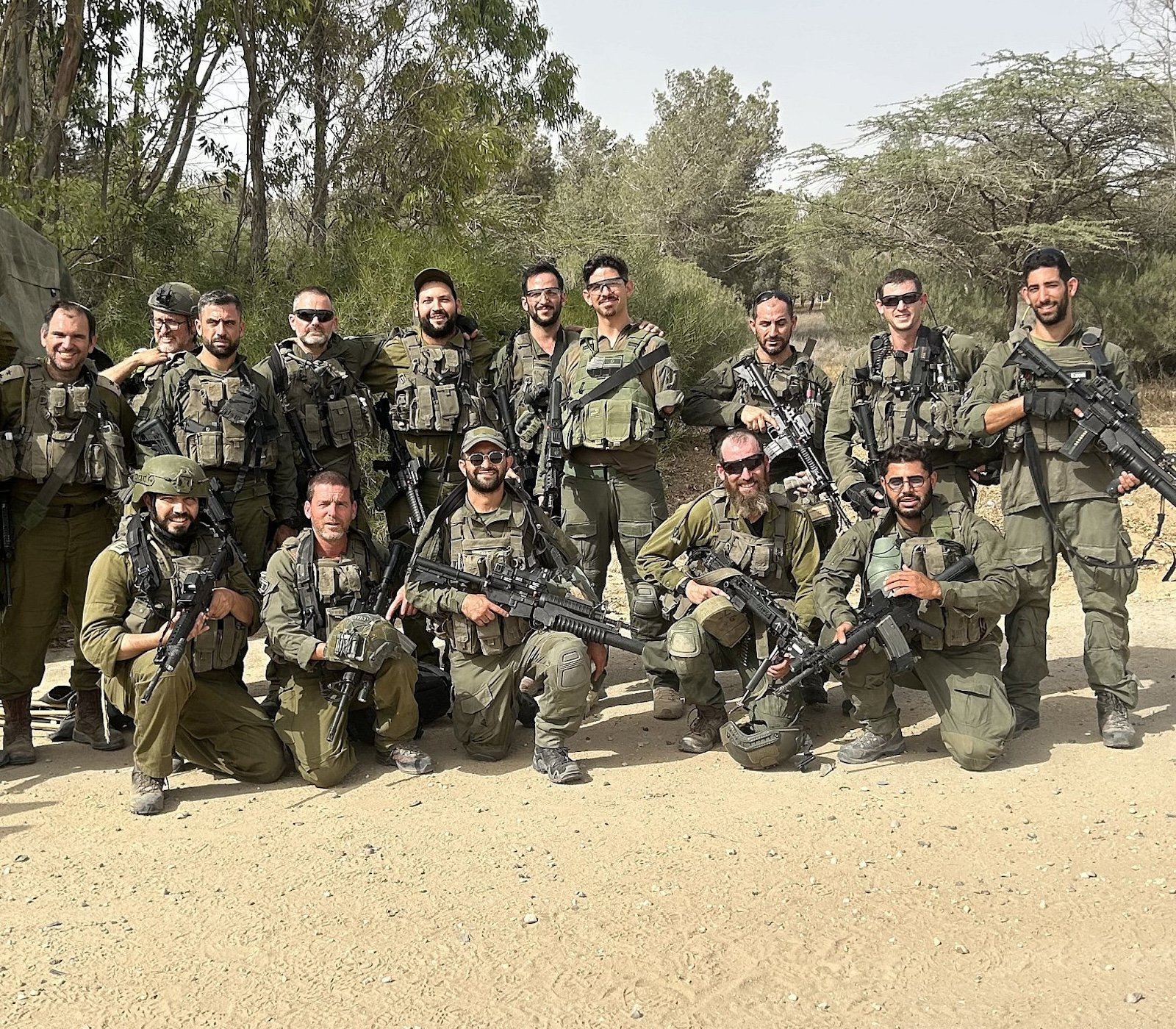
They mean something to me, too. These men who risk everything. They leave behind spouses, infants, careers. Full lives. They don’t complain. They don’t make speeches. They just pack a bag and come. And somewhere out here, between the danger and the waiting, the words begin to flow.
No big declarations. Just murmurs in the dark. They talk about the war within. The strain at home. The economy. Kids who won’t sleep while they’re gone. Wives who cry in the kitchen but stay strong on the phone. They talk about October 7th. About the bodies. The friends they lost. The pieces they had to gather. How, sometimes, there weren’t enough left to bring back. And what it takes to keep going after that.
They’d never call it therapy, but some of what I heard, I don’t think they’ve said to anyone else.
Maybe it’s the dust. The quiet. Maybe it’s because out here, no one needs to pretend. It’s the realest place I’ve ever been. And it isn’t until I’m boarding my flight home that I begin to understand:
For a few short weeks each year, in this place, with these men – it’s the only time I feel whole.
Related Topics