The Week That Could Seal Khamenei’s Fate
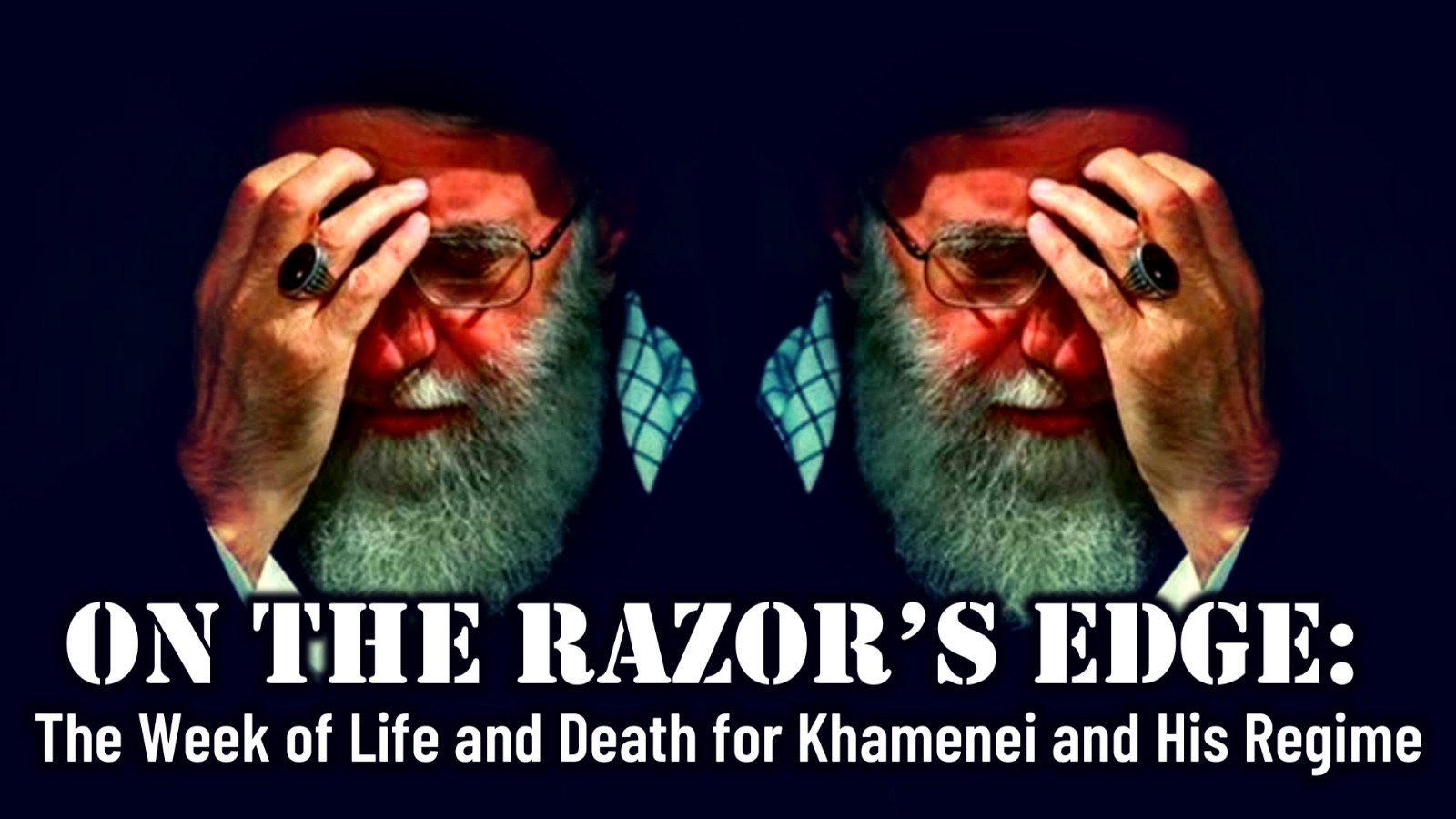
On the Razor’s Edge: The ‘Week of Life and Death’ for Khamenei and His Regime
When in politics terms like “week of death” or “group of death” are used, they should not be understood as immediate annihilation or total collapse. These terms refer to a stage where a decisive process begins and there is no turning back. At such a point, every decision and every move no longer opens new paths but merely determines the speed of the march toward collapse or submission. Today, the Islamic Republic stands exactly at such a crossroads. From Friday, September 19 until September 28, a period has begun that media and analysts call “the week of life and death for the Islamic Republic” — a week in which diplomatic failures, international isolation, mounting pressure, and even military threats have converged to put the regime in an unprecedented position.
The Defeat of the South Korean Resolution and the Countdown of the Snapback
It started with the UN Security Council session on Friday, September 19, when South Korea, as the rotating president, was obliged to table a draft resolution to extend sanctions relief for the Islamic Republic. This was not a symbolic duty but part of the so-called “snapback mechanism” included in the 2015 nuclear deal (JCPOA), designed so that if Iran failed to meet its commitments, sanctions would automatically return. As expected, the South Korean draft failed. Nine countries voted against, four supported it, and two abstained. The result was clear: the resolution was rejected, and the countdown began.
According to this mechanism, the Islamic Republic has until September 28 to either reach a new agreement with the West or face the full return of all UN Security Council sanctions. Crucially, this process cannot be vetoed; not even Russia or China can block it. Once the deadline passes, all sanctions imposed between 2006 and 2010 will snap back: from arms embargoes to severe restrictions on missile programs, travel bans for regime officials, asset freezes, and mandatory inspection of maritime and air cargo. But this is not only about economic and political costs. More important is Iran’s return under Chapter VII of the UN Charter, a designation reserved for states deemed threats to global peace and security. This status gives the international community the legitimacy not only to impose sanctions but to authorize any measures deemed necessary to remove the threat, including military action.
The SNSC Statement and the Word Games
A day after this heavy defeat, the regime’s Supreme National Security Council (SNSC) issued a statement. At first glance, it sought to project firmness in response to Europe and the Security Council setback. But closer inspection revealed the familiar word games of the Islamic Republic. The SNSC wrote: “Despite the cooperation of the Foreign Ministry with the IAEA and presenting proposals to resolve the issue, due to the actions of European countries, in practice the path of cooperation with the IAEA will be suspended.”
The key lies in the phrase “in practice.” The council did not say “we suspend cooperation,” but rather that “due to Europe’s actions, in practice cooperation will be suspended.” This is the regime’s classic “said and unsaid” tactic. For domestic consumption, it is spun as though the regime has decisively cut ties. For foreign audiences, it leaves a back door open to deny any outright suspension: “We never declared suspension; we said circumstances have made cooperation problematic.” This linguistic tactic has long been part of the Islamic Republic’s diplomacy, creating ambiguity for internal and external audiences alike.
Pezeshkian’s Rhetoric; Slogans for Domestic Consumption
The same day, before the SNSC statement, Masoud Pezeshkian, the regime’s handpicked president, attacked Europe in a speech. He declared: “Last night they held a meeting to bring back the snapback. Do they think they can block our path? It is minds and ideas that either find a way or create one.” These words are nothing more than hollow slogans for a domestic audience. He also referred to Israeli and American strikes during the 12-Day War, saying: “They can hit Natanz and Fordow, unaware that it is people who will rebuild Natanz and even more important than Natanz.” Such statements, while perhaps momentarily uplifting for loyalists, only highlight the regime’s bankruptcy internationally. When nuclear facilities have already been destroyed and IAEA inspectors barred from access, such rhetoric underscores Tehran’s loss of credibility.
Netanyahu’s Words Today; A Meaningful Coincidence
Meanwhile, this morning Israeli Prime Minister Benjamin Netanyahu opened his weekly cabinet meeting with remarks that again highlighted the achievements of the 12-Day War. He declared that Israel had eliminated the threat of Iranian nuclear bombs and tens of thousands of ballistic missiles. He also referred to his upcoming trip to New York and his fourth meeting with U.S. President Donald Trump, stressing there are many issues to discuss. The timing is no coincidence: in the very week when the snapback countdown has begun and the Islamic Republic is under maximum pressure, Israel’s prime minister sends a clear signal that Iran will be the central subject of discussions with Washington.
Let us not forget that the last Netanyahu-Trump meeting resulted in a 60-day ultimatum to the Islamic Republic, after which, on the 61st day, the 12-Day War began. The pressing question now is: what will come out of this new meeting? Should the world expect another surprise?
Connecting the Dots: Why This Is the “Week of Death”
Taken together, these three developments — the failed resolution at the UN Security Council, the SNSC’s ambiguous statement, and Netanyahu’s remarks — paint a clear picture of the Islamic Republic’s predicament. Externally, sanctions are poised to return with near-universal support. Internally, vague statements and empty slogans betray confusion and weakness. Regionally, Israel openly claims to have neutralized Iran’s threats and is preparing for further steps.
Here the term “week of death” gains its true meaning. Death here does not mean immediate collapse but the end of one phase and the start of another. The Islamic Republic loses either way: if it retreats and accepts Western conditions, it will be a humiliating surrender. If it refuses, UN sanctions will return, intensifying economic and political pressures. In both scenarios, the regime enters an irreversible path.
Conclusion
The “week of death for the Islamic Republic” does not mean instant destruction but the start of an irreversible decline. During this week, the regime must choose between two paths: surrender or escalation. Either option accelerates its downfall. The convergence of Netanyahu’s words, the SNSC’s statement, and the Security Council’s rejection of the South Korean draft resolution underscore that this is no ordinary moment on the global political calendar; it is the dawn of a new era. An era in which the Islamic Republic can neither return to the past nor secure a stable future.
But external pressure, however intense, is only half the equation. The other half belongs to the people of Iran. They are not passive spectators. The real battlefield is the street, where the Iranian people, through their cries for freedom, can paralyze the regime and deliver the final blow. The “week of death” will only achieve its full meaning when it becomes the “symphony of the streets” — a symphony of continuous, coordinated protests echoing across Iranian cities. Every chant, every gathering, every uprising is a note in this symphony. It is the streets that will decide the outcome and bring about the end of the Islamic Republic. Global support and external pressure may create opportunities, but without the Iranian people rising in the streets, nothing will be resolved.