The White House effect: Jewish climate scientists clashed, but led the debate
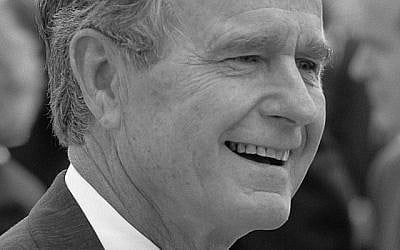
This new documentary film about the political moment when the Republican candidate for president in 1988, George Bush Sr., promises to do something about global warming begins with the blistering heatwave of 1988. The directors, Bonni Cohen, Pedro Kos and Jon Shenk rely mainly on news footage and TV reportage to relay their message. In New York City the sidewalk hydrants are gushing, and the subways resemble steaming malodorous saunas. These are scenes I happened to have experienced as I lived and worked in Manhattan that summer. In the film, Bush is seen making made pains to show his sympathy for Americans suffering from the heat and drought and visits farmers in the Midwest, proclaiming about global warming, “It is not a liberal or a conservative thing…I intend to do something about it.”
Once elected, Bush chooses the experienced environmental advocate, William Reilly to be head of the US Environmental Protection Agency but he also appoints the anti-environmental John Sununu as chief of staff. George Bush Sr.’s rival Michael Dukakis had promised to promote the EPA head to a cabinet-level position, but in the Bush administration, Reilly is several notches below Sununu in the pecking order. In 1991 John Sununu initiates a meeting of climate sceptics with the aim of sowing doubt and division. His meeting features MIT scientist Richard Lindzen and Frederick Singer, a scientist at the University of Virginia. “The climate is always fluctuating,” says Lindzen. Singer is even more of a denier, “There is no real scientific support for the so-called greenhouse warming.” Frederick Singer had been born in Vienna and as a Jewish child had traveled alone to England on the ”Kindertransport,” and eventually to the USA where he pursued a scientific career. Richard Lindzen, younger by a generation had grown up in the United States but his parents were also European Jews who had survived the Holocaust. Oddly, in addition to denying human-induced global warming, both Lindzen and Singer also questioned the link between smoking and lung cancer. John Sununu’s meeting with Singer and Lindzen, and two others – Patrick Michaelas and Sherwood Idso, gave these sceptics a voice that challenged what was otherwise a global consensus on the human induced nature of climate change, a position that had solidified in the Intergovernmental Panel on Climate Change’s first assessment published in 1990.
The astrophysicist Michael Oppenheimer (no relation to Robert Oppenheimer) and scientist James Hansen take on the Sununu crowd, underscoring that Lindzen is not using climate models, and his approach is outdated and not robust. They are joining the scientific powerhouse, Stephen Schnneider, who had been taking the science of climate change public since the late 1970s and appears often in this film. Schneider has an urgent manner, a rockstar appearance and a head of hair to rival Bob Dylan’s. A bonus to seeing the articulate Schneider in the film is seeing his office at the National Center for Atmospheric Research, the Pei designed building located at the start of the front range of the Rocky Mountains in Colorado and the site of scenes from Woody Allen’s film Sleeper.
Schneider was the founding editor of the influential journal, Climatic Change and remained at the helm until his death in 2010. In the film, Schneider explains the greenhouse effect as well as climate modeling, in a way a very young person could understand. He aspires to a situation where Americans will make an overwhelming case to their president that they care about this matter and he hopes that Bush can be swayed, “He’s more political than ideological” he explains to a group of fellow scientists. Schneider and the other Jewish men who were so public on climate change science at a key point in time was confirmation that the USA research environment accepted a variety of opinions acquired from different scientific disciplines. Ironically, as the science of climate change grew into an overwhelming consensus in the early 1990s, the non-partisan nature of the politics began to unravel.
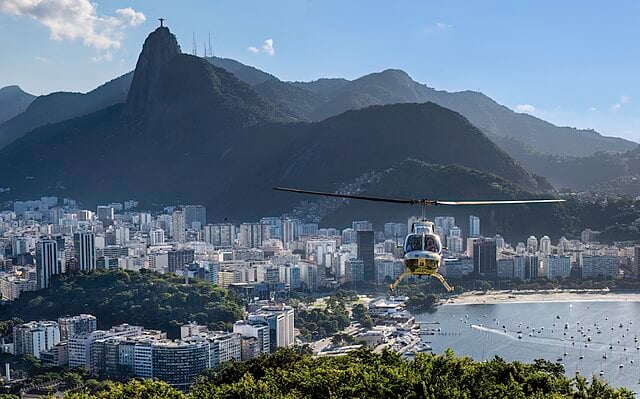
During these years of the Bush administration, world leaders are preparing to attend the 1992 Earth Summit in Rio de Janeiro and are negotiating a framework climate change treaty that would be put up for signature in Rio. The documentary zeroes in on a sense of suspense in Brazil as to whether President Bush would sign the framework treaty or even attend the summit. This suspense was palpable I remember as I was “tabling” for the Stockholm Environment Institute at the Earth Forum. A Brazilian group nearby was busy painting a banner that showed a footrace with the American president falling behind world leaders. The group was not confident about their English and asked me to help devise a caption, which I provided without hesitation.
It is in its Rio footage that the White House Effect documentary loses its way somewhat. It asks the question whether William Reilly, the EPA head was “humiliated” at Rio but becomes vague about what the American president did or did not do. In fact, President Bush does make it to Rio at the last minute. He signed the Convention on Biological Diversity and he signed the UN Framework Convention on Climate Change. At the time, the scope of the climate agreement was disappointing as it did not call for specific limits. It did, however, require nations to submit detailed inventories of greenhouse gases from human activities and to start a process for negotiating limits to emissions. The process to pursue limits has continued to this day including the 30th Conference of the Parties that concluded in Belem Brazil earlier this week.
The national inventories required in the original climate treaty and thereafter have been a force onto themselves. The process has helped industrial and developing nations build up expertise on the many sources of methane, nitrous oxide and carbon dioxide. Some countries’ inventories and supporting information surpass a thousand pages of tables and text. In the United States, the inventories have also grown more elaborate over the years and have shown a good amount of cooperation among federal agencies, EPA, USDA and the Department of Energy. The inventories also provide a resource for researchers, advocates and city planners to understand the relative importance of different sources and how activities and emissions factors change over time.
While the inventories have been a success over the past three decades, the effects of climate change disinformation have only grown in the decades since John Sununu’s 1991 meeting. False news is such a problem that the world representatives at the climate conference in Belem agreed to open for signing a “Declaration on Information Integrity on Climate Change.” Unsurprisingly, the United States did not sign the declaration or even send a delegation to the meeting. Even worse, the portal of national emissions inventories lacked a submission from the United States this year, the first intentional non-reporting in three decades. Future reports from the United States appear to be canceled.
I personally was not at the Belem meeting and have no direct experience of the atmosphere but know that, like all previous Conferences of the Parties, non-governmental organizations and creative signage were present in abundance. If I was making a new banner in the spirit of the one I helped with at the 1992 Earth Summit in Rio, the heads of state in jogging shorts would be replaced by American presidents. Close to the front I would place George Bush Sr., his son trailing well behind; the person in last place by a mile is all too obvious. ..and most nations are ahead of us. While The White House Effect did not give a complete view of George Bush’s climate legacy, it is a constructive, notable film that showed a point in time when scientists, politicians and the public were talking to each other about climate change in a way that has not yet been repeated.