The Why of the Journey
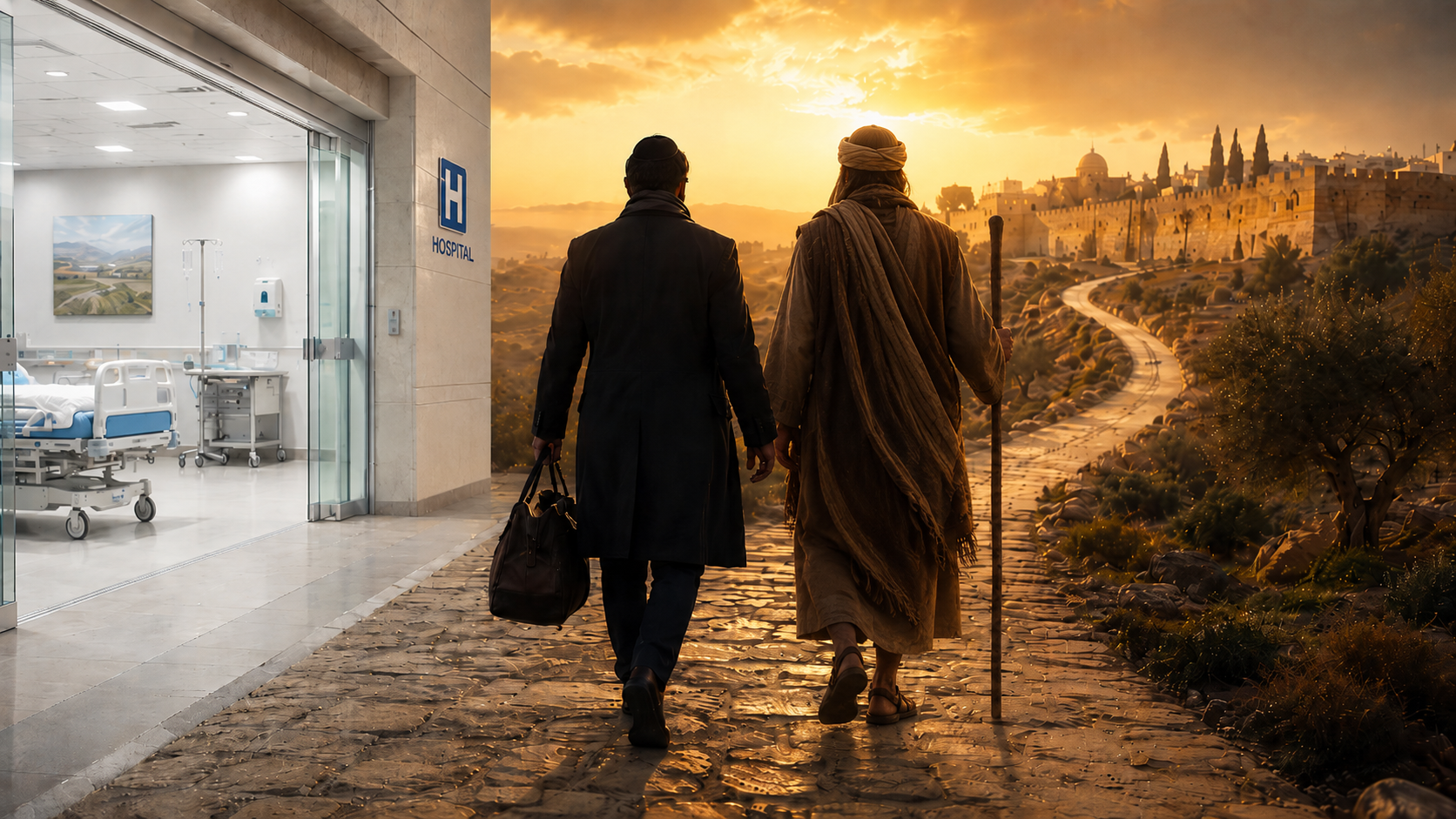
This week, I walked into a hospital room that did not feel anything like the hospital room I had spent several days in last week.
Last week, I spent several days in the maternity ward. It was a room full of blessing and joy, permeated with the energy of new life. I was also in a cemetery, and I wrote about the contrast between them.
This week, I went to say final prayers with someone in the hospital who is sadly nearing the end of life. Since then, he has been transferred to hospice. The family has accepted reality, and now they are trying to make him comfortable, at peace, and surrounded by love.
As I walked out, with a heavy heart from seeing a once vibrant person so helpless, I thought about what I wrote last week how a hospital is a place of life. The room did not feel alive at all. And of course, people also die in hospitals. I have stood at many, many hospital bedsides as a life was slipping away.
So what makes a hospital a place of life?
It’s not because everyone who goes there survives.
It’s because of WHY people go there. The ultimate reason why every person goes to a hospital is to preserve and extend life.
People go to a hospital because they are trying to heal. They go because they want treatment, strength, recovery, or at least a chance. So even when the outcome is not what we hoped for, the purpose of the place is still life.
A hospice could not be more different. Hospice is not about fighting for a cure. It’s about dignity, comfort and peace. It’s about helping a person and a family walk through the last chapter with gentleness.
Both are in medical settings, but there is a world of difference between them: Why you went there?
That word, why, has been sitting with me all week.
There is a line that has become especially powerful and even more famous since Oct. 7th: “He who has a why can bear almost any how.” It was made famous by Viktor Frankl, a Holocaust survivor, who watched how different people did, or didn’t, survive the terrible suffering of the camps.
These words became a mantra repeated in the Gaza tunnels by Hersh Goldberg-Polin, of blessed memory. Fellow hostage Or Levy said that it was those words that helped them survive.
Even when a person has a ‘why’, pain is still pain. Fear is still fear and the difficulties of life are still difficult. But the person is no longer only living through the challenge. He is living for something.
That alone will help him find the how.
This is exactly what happened in the story of this week’s Torah portion, when Moses sends twelve spies into the Land of Israel. They return and say that the land is too dangerous. The cities are fortified and the people are giants. There is no way we can conquer the land.
On the surface, it sounds like the spies are just giving a factual, military assessment of the challenges ahead. They looked at the odds and decided the conquest would be impossible. What’s wrong with that? Why does that evoke such a harsh punishment from G-d?
The Rebbe explains that their mistake was much deeper. The spies were not simple cowards who lacked faith in G-d. The Torah tells us they were great and holy leaders, handpicked by Moses.
Their problem was that they did not understand why the Jewish people needed to enter the Land of Israel in the first place.
In the desert, life was spiritual and miraculous. Manna fell from heaven and water came from a rock. Clouds of glory protected them while they learned Torah from Moses without distraction. They did not need to plow, plant, build, trade, govern, and deal with the messy details of ordinary life.
And now they were being told to enter the Land of Israel. Suddenly, Judaism would mean farming. Business. Cities. Armies. Taxes. Court systems. Fields. Markets. A real society with real responsibilities.
The spies could understand Judaism in the desert. They could understand a holy life separated from the world. But they could not understand why G-d would want His people to enter a physical land and build a functioning society.
They were missing the why.
And since they were missing the ‘why’, every ‘how’ became impossible.
How will we conquer the land? We cannot.
How will we live among powerful nations? We cannot.
How will we stay holy while dealing with money, land, politics, and business? We cannot.
Joshua and Caleb saw the same giants. They saw the same fortified cities and understood the same challenges. But they also understood the ‘why’. They understood that G-d does not want holiness to remain in heaven, removed from our reality.
This is one of the most central teachings of Chassidic philosophy. G-d created this world because He desired a home down here. Not above. Not in a secluded desert away from life. G-d wants us to find Him here. In the gym, in the office and in the dollar bill. In the kitchen, in the hospital and in the airport.
That in every ordinary place we go, we should remember why we are truly there.
This is also one of the beautiful meanings behind the custom of giving someone a dollar for charity before they travel, asking them to be our agent to give that dollar to charity when they arrive.
This is called making someone a “Shliach Mitzvah”, a messenger for a mitzvah. On a simple level, it embodies what our Sages teach that a person traveling to do a mitzvah has special protection. So when you give someone money to put in a charity box at their destination, you have made them your messenger for a mitzvah. Their trip now carries Divine protection.
But there is something deeper as well.
By making the person an agent for a Mitzvah, you haven’t only given him extra merit for a safe trip. You have just changed the “why” of his journey.
Suddenly, the person is not only flying to a graduation or family wedding. He is no longer just going on a business trip, or an enjoyable vacation. You have just imbued that journey with a new reason, a new ‘why’.
Somewhere in that destination, there is a dollar bill that needs to become a mitzvah. There is a place waiting to be touched by an act of goodness. There is a corner of the world that is waiting for this traveler to reveal G-d there.
The plane is the same plane. The suitcase is the same suitcase. And the traffic is the same traffic. But the journey is now different, because the why is now different.
This is one of the most important questions we can ask ourselves every day.
Why am I in this meeting? Why am I in this environment? Why am I in this difficult conversation? Why am I in this hospital room? Why am I here?
Sometimes we get to choose where we travel to, and sometimes we don’t get to choose the destination.
But we can always choose the why.
We do not always choose the hospital room, the financial pressure, the family situation, or the unexpected turn in the road.
But we can choose to believe that even here, there is something G-d wants from us. A prayer to say. A kindness to offer. A strength we need to discover or a light we need to shine.
The main thing is to remember that no place is empty of purpose.
And once I know that there is a why for my being here, the same place no longer feels the same.
It does not take away the pain of watching someone suffer. It does not make financial hardship easier. But it changes the journey, because now I know that even here, there is something G-d wants from me.
Just like a hospital is a place of life, even when people die there, because people go there seeking life, a business trip can become a holy journey, because a dollar of charity is waiting at the other end.
Ten spies saw a difficult land and asked, “How can we possibly do this?”
Joshua and Caleb saw the same land. But they also understood the ‘why’. And once they understood they had been sent by G-d, they were confident that “We can surely go up and take possession of it, for we can indeed overcome it.” (Num. 13:30)
This week, let us ask ourselves not only where we are, but why we are there.
Because once we know why we are here, every place can become a place of life. Every journey can become holy.
Good Shabbos,
Rabbi Yankie & Chana Denburg