The Wreath and the Knife
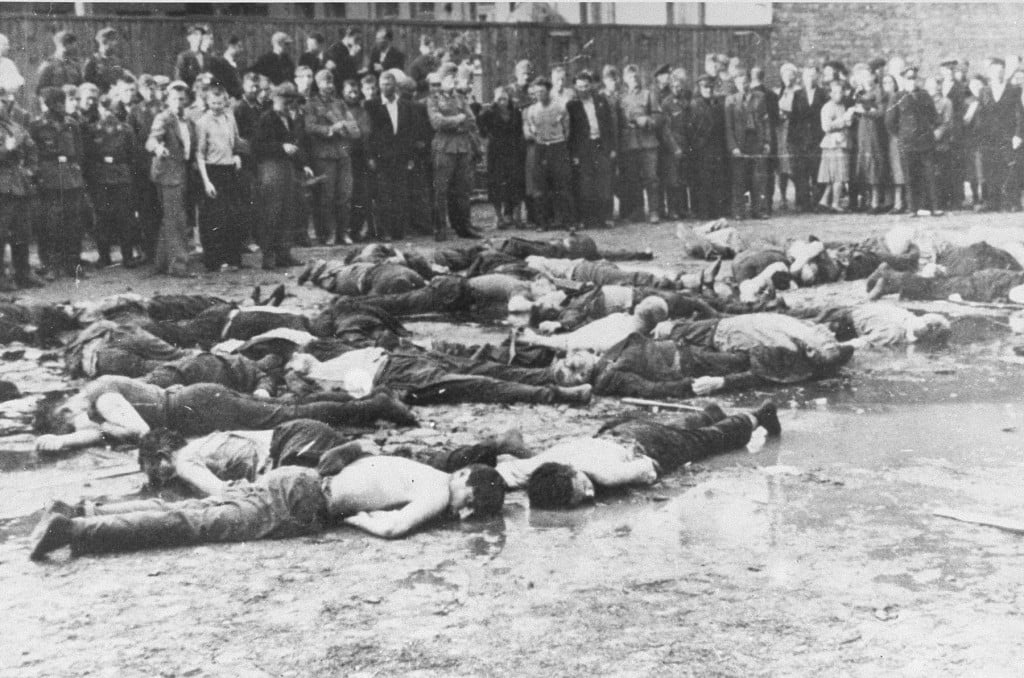
On June 27, 2026, the eighty-fifth anniversary of the Lietūkis Garage massacre will be marked in Kaunas and by Lithuanian diplomats in Israel and USA.
Expect the wreaths. Expect the candles, the bowed heads, the violin music, the brief and dignified statement. Expect a Lithuanian official, perhaps a diplomat, to speak of the Jews who “perished,” who were “lost,” whose world “vanished.” I have set out elsewhere, in What Lithuania Means When It Says “Vanished,” “Lost,” or “Perished”, what that vocabulary is built to hide.[1] The short version is that none of those words contains a killer. They are the grammar of a state that has learned to mourn the Jews it cannot bring itself to say were murdered by Lithuanians.
Watch closely this June, because the commemoration is the knife.
The same government that lays the wreath has, for years, honored the men who ran the state in whose name the killing was done. It will mourn the victims of the Provisional Government in the morning and keep the Provisional Government’s prime minister in the national pantheon in the afternoon. That is not an oversight. It is the design.
Begin with the courtyard.
On June 27, 1941, in central Kaunas, between fifty and sixty Jewish men were beaten to death in the open yard of the Lietūkis cooperative.[2]
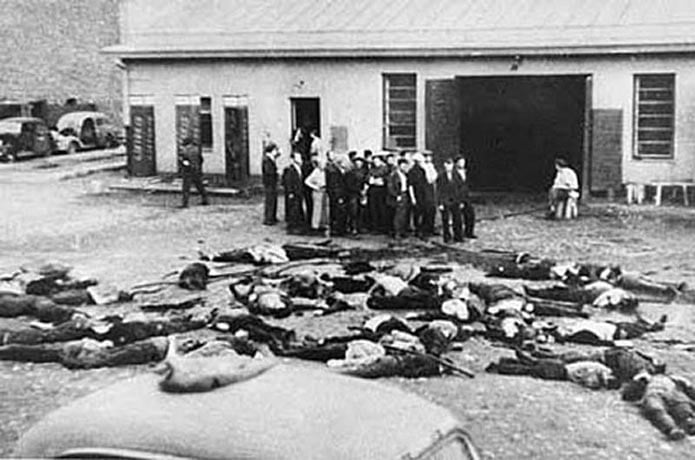
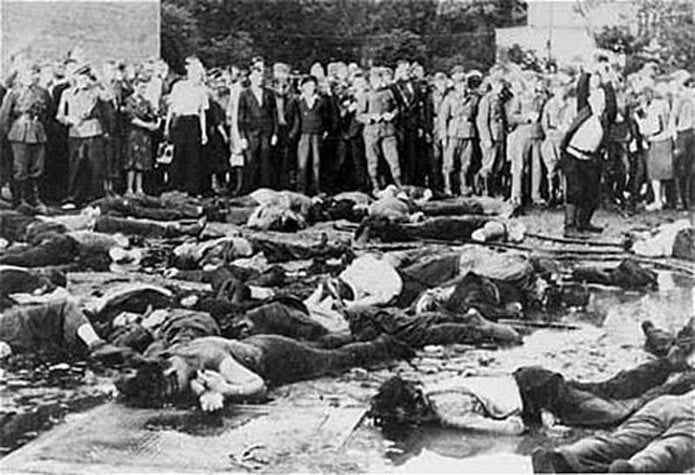
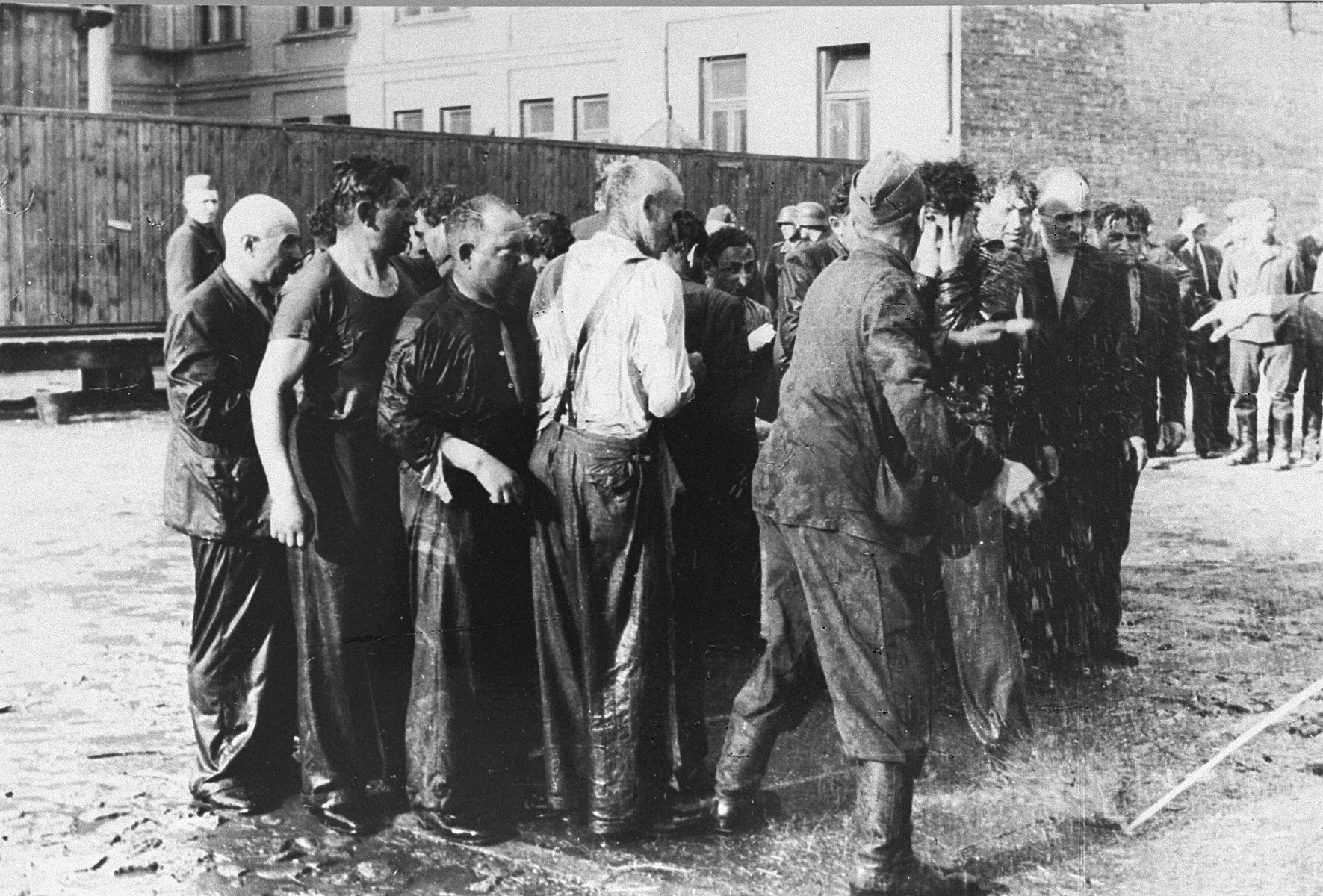
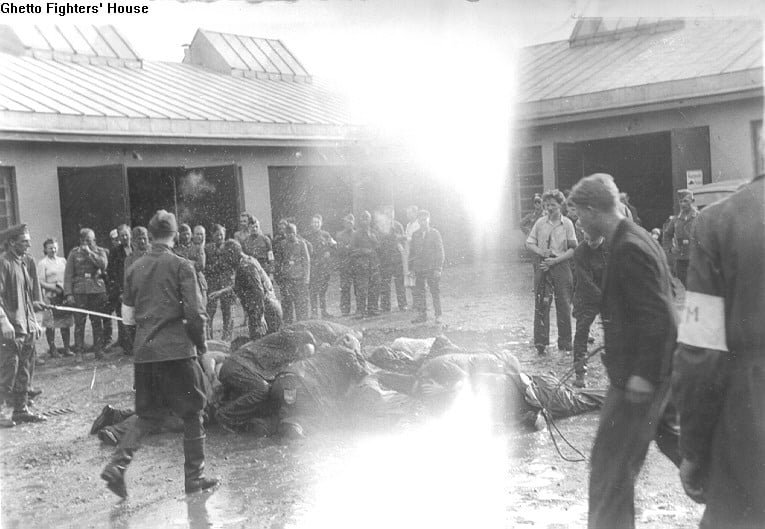
They were made to gather horse manure by hand, then handed hoses and ordered to wash the ground where they would die. They were murdered with crowbars and iron bars, the hoses driven into them until some drowned or suffocated. One young man worked down the line with a bar and then posed for the camera over the bodies.[3] Civilians watched and applauded. Women stood among them.
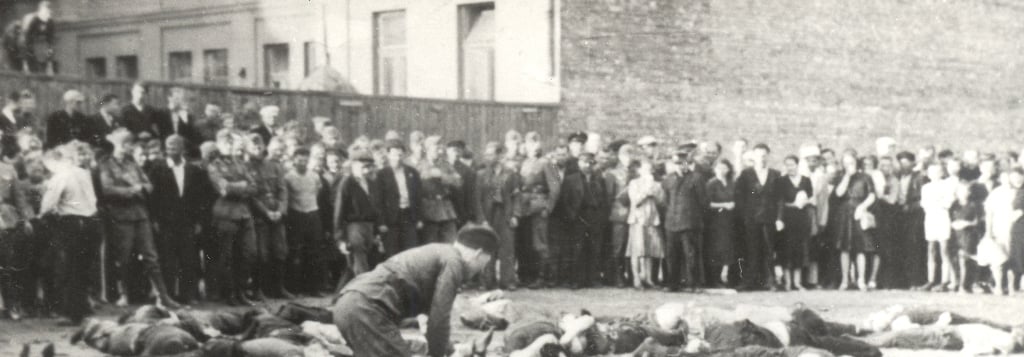
When it was finished, a man stood among the corpses and played the Lithuanian national anthem on an accordion.[4]
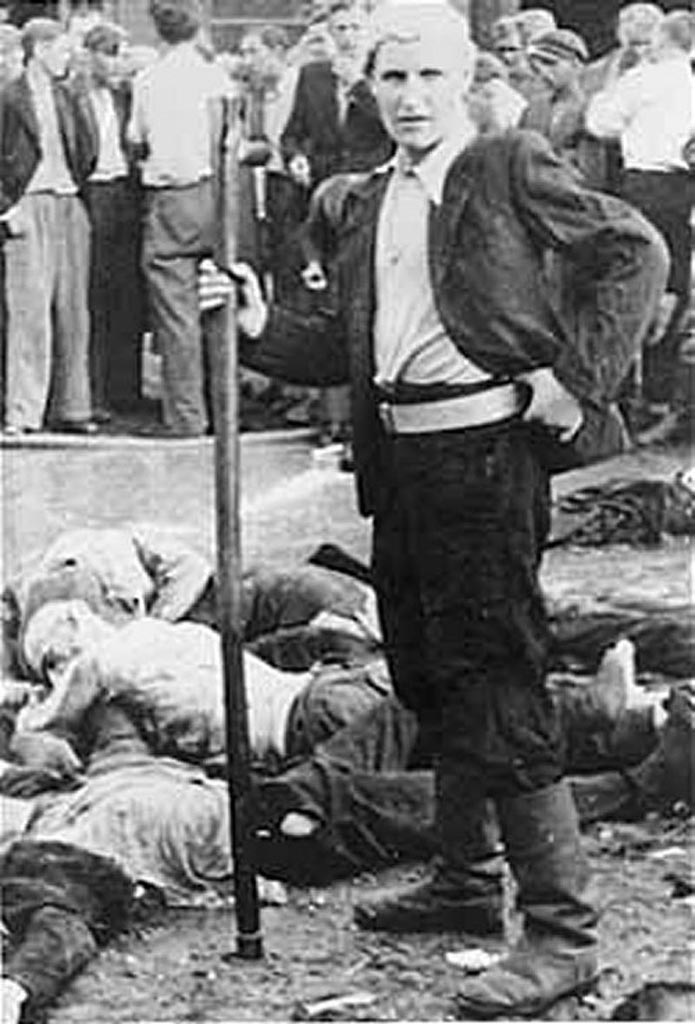
This singular event at the start of the Lithuanian Holocaust removes any deniability that all Lithuanians knew exactly what was happening and who was doing the murdering.
Among the dead was Jurgis Štromas, who had represented independent Lithuania in Berlin and served it as a senior official. His service bought him nothing. He died only as a Jew.[5] Patriotism to Lithuania and dedication to Lithuanians was rewarded by betrayal and murder.
While the bodies were still in the yard, the Provisional Government met. A minister reported the exceptionally cruel excesses at the Lietūkis garage. The cabinet did not order the killing stopped. It asked that Lithuanian partisans and civilians avoid public executions of Jews, and in the same minutes it preserved every other measure against the Jews.[6] The objection was to the audience, not the murder. A Lithuanian government three days old had already decided that dead Jews were simply an acceptable administrative matter.
The German Sixteenth Army kept its headquarters two hundred meters away and watched from the window. It had no order to halt the killing and did not halt it. It asked only that the murder be moved off the open street.[7] An occupier with guns who chose not to act is the proof that the local men with the bars were not under orders. Lithuanians who called out that this shamed Lithuania were silenced by other Lithuanians. Some Lithuanians hid Jews, warned Jews, were sickened by what they watched. That some refused is the evidence that the rest chose.
That is the crime. Here is what the Lithuanian state has made of it.
It has turned the dead into an export. The murdered Jews of Lithuania are a line in a brochure now, a museum opening, a ministry post about a “lost” world, a wreath photographed for an audience that will never read a trial transcript.[8] The Jews are useful again, this time as evidence of Lithuanian sensitivity. A country that has refused to punish even one man for Lietūkis or any other murder of a Jew in Lithuania presents itself to the West as the mournful guardian of the culture it destroyed.
At the site, the priorities are set in concrete. The massacre is marked by a modest stone, placed by the municipality in 2002, in a courtyard that now belongs to a school. It cannot be seen from the street. It remembers several dozen Jews who were brutally killed. It names not one of the Lithuanians who killed them.[9]
Now set that stone beside what the state built for the other side.
In 2009 the President of Lithuania awarded Juozas Ambrazevičius-Brazaitis, the head of the 1941 Provisional Government, the Grand Cross of the Order of Vytautas the Great, the Republic’s highest honor.[10] In May 2012 the Lithuanian state financed the return of his remains from the United States. An honor guard met the coffin at Vilnius airport. He was honored in the capital, escorted to a church in Kaunas, and entombed, with a reburial mass and four days of official events.
This is the man whose cabinet, on June 27, 1941, objected to the visibility of the Lietūkis murders and kept the measures against the Jews in force. Lithuania’s own International Commission found that his government made no public reference to the massacres taking place in Kaunas on its very doorstep, and made no attempt to interfere.[11] The state knew exactly who he was. It gave him a cross named for the same Vytautas the Great whose ancient charter of protection for the Jews the movement he led had declared revoked for all time. It met his coffin with soldiers.
So the arithmetic of Lithuanian memory is plain. The men beaten to death get a hidden stone with no killer named. The man who presided over the state that murdered them gets the highest honor the Republic can bestow and a soldier’s farewell. The victims are the marketing. The perpetrators are the heroes.
Understand, then, what the wreath on June 27 will mean.
It will not be mourning. It will be public relations laid on a grave. The official who bows his head over the Jews of Lietūkis will, in the same career, salute the government that watched them die and lift its leaders into the national pantheon. He will mourn the victim with one hand and decorate the murderer with the other, and he will expect the world, and the Jews, to thank him for the performance.
Do not thank him.
A state that crowns the killers and sells the corpses has earned no Jewish tear and no foreign handshake. It has earned contempt. When Lithuania’s representatives stand over that courtyard this summer and speak of a people who “vanished,” they will be lying with their heads bowed, and they will be doing it on purpose, over the bodies of men their nation beat to death and never once punished anyone for killing.
That is the commemoration. A wreath in one hand. The same knife, in the same back, eighty-five years on.
[1]Grant Arthur Gochin, “What Lithuania Means When It Says ‘Vanished,’ ‘Lost,’ or ‘Perished,’” Grant Gochin’s Substack, May 23, 2026, https://grantgochin.substack.com/p/what-lithuania-means-when-it-says
[2]Christoph Dieckmann, Deutsche Besatzungspolitik in Litauen 1941–1944, 2 vols. (Göttingen: Wallstein Verlag, 2011), 1:321.
[3]Dieckmann, Deutsche Besatzungspolitik, 1:322.
[4]Dieckmann, Deutsche Besatzungspolitik, 1:323.
[5]Leonidas Donskis, Loyalty, Dissent, and Betrayal: Modern Lithuania and East-Central European Moral Imagination (Amsterdam: Rodopi, 2005), 41.
[6]Dieckmann, Deutsche Besatzungspolitik, 1:323.
[7]Dieckmann, Deutsche Besatzungspolitik, 1:323–24.
[8]Gochin, “What Lithuania Means When It Says ‘Vanished.’”
[9]“Garage Massacre Memorial, Kaunas,” Memorial Museums (Stiftung Denkmal für die ermordeten Juden Europas), accessed June 13, 2026, https://memorialmuseums.eu/eng/denkmaeler/view/1463/Garage-Massacre-Memorial.
[10]“Juozas Ambrazevičius-Brazaitis’ Reburial Reignites Historic Debate on Lithuania’s 1941 Provisional Government,” 15min.lt (BNS), May 16, 2012, https://www.15min.lt/en/article/society/juozas-ambrazevicius-brazaitis-reburial-reignites-historic-debate-on-lithuania-s-1941-provisional-government-528-219084; Ofer Aderet, “Glorifying a Nazi Collaborator in Lithuania,” Haaretz, May 15, 2012.
[11]“Juozas Ambrazevičius-Brazaitis’ Reburial,” 15min.lt (BNS), May 16, 2012, quoting the statement of U.S. Ambassador Anne E. Derse citing the International Commission for the Evaluation of the Crimes of the Nazi and Soviet Occupation Regimes in Lithuania.