The Wrong Century for Understanding War
Four weeks into a war, we are already being told what it means.
This, in itself, should give us pause.
In a recent analysis in the New York Times, Yonatan Touval (https://www.nytimes.com/2026/03/29/opinion/israel-us-war-iran-literature.html) argues that the unfolding US-Israeli conflict with Iran reveals a profound failure of understanding. Our leaders, he suggests, possess extraordinary technological capabilities but lack the human insight necessary to grasp the deeper forces that shape war—memory, pride, humiliation, sacred narrative. They can see everything, he writes, but understand nothing.
It is an elegant argument. It is also premature—and, more importantly, anachronistic.
To diagnose failure four weeks into a complex military campaign is not analysis; it is projection. Wars—especially those involving multiple actors, asymmetrical capabilities, and global economic consequences—do not reveal their meaning on a compressed timeline. Early phases are often the least intelligible, not the most. What appears as miscalculation may, in time, reveal itself as strategic positioning. What looks like escalation may be containment by other means. To impose narrative closure at this stage is to mistake immediacy for insight.
But the deeper issue lies not in timing, but in framework.
Touval interprets the war through a familiar intellectual lens. He invokes Carl von Clausewitz, reminding us that war is not algebra but a human phenomenon shaped by passion and uncertainty. He turns to William Shakespeare and Leo Tolstoy to illustrate the enduring blindness of leaders who mistake calculation for understanding. These references carry weight. They signal depth, tradition, seriousness.
But they also carry an assumption—one that remains largely unexamined.
The assumption is that war, at its core, has not changed.
That the categories through which we understood war in the 19th century—human intention, narrative, honor, memory—remain not only relevant, but sufficient.
This assumption is precisely what must be questioned.
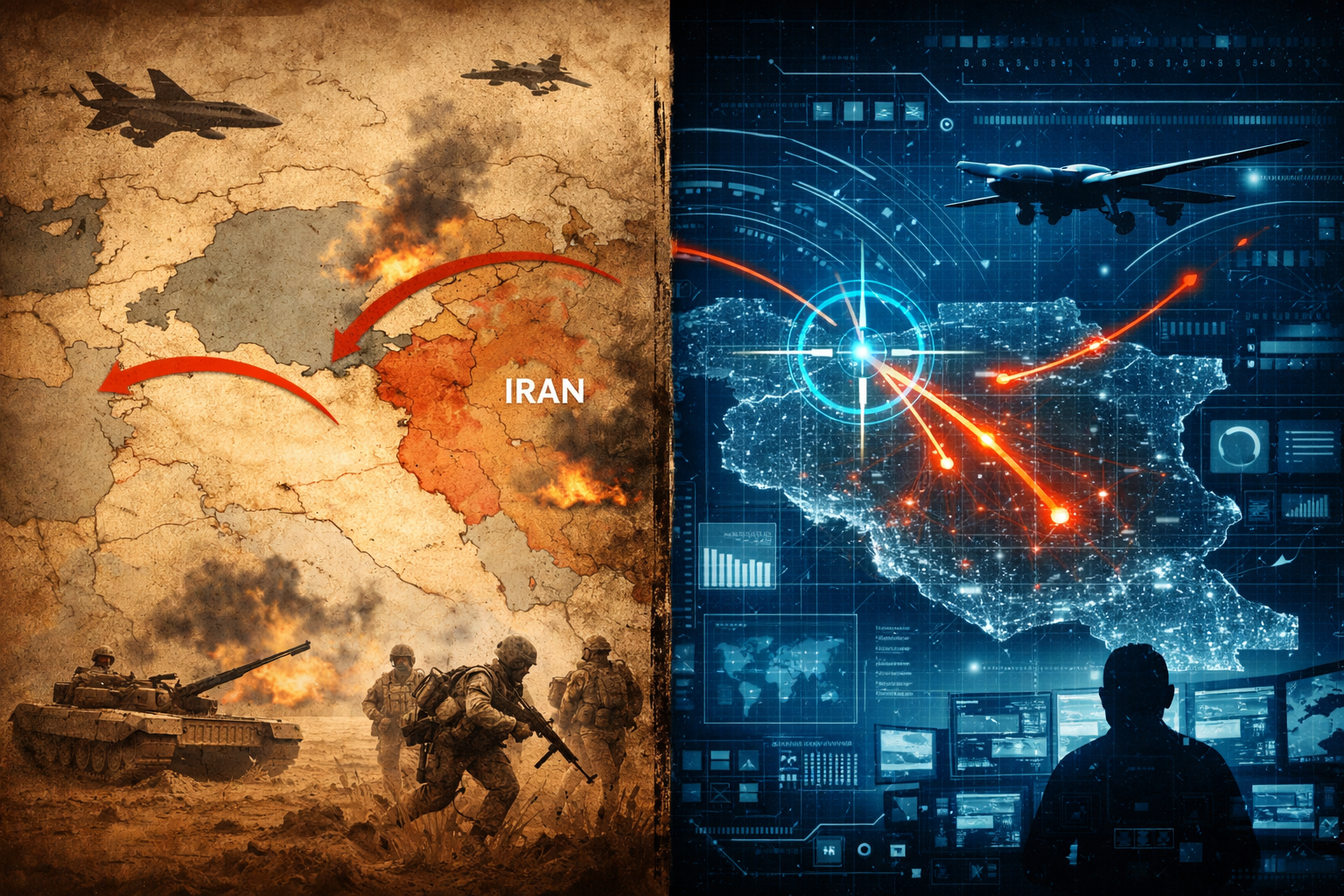
We are no longer operating within the same conditions that shaped Clausewitz’s reflections or Tolstoy’s narratives. The contemporary battlefield is not simply an extension of past wars with more advanced tools. It represents a structural transformation in how knowledge, decision, and action relate to one another.
When intelligence systems integrate vast streams of data in real time—signals, images, communications—when targeting is no longer the product of slow deliberation but of algorithmic synthesis, when operational timelines compress from days to minutes, the nature of decision-making changes. Not incrementally, but qualitatively.
Touval sees in this a dangerous illusion: the belief that mapping the battlefield equates to understanding the war. There is truth in that observation. But it is incomplete.
Because what he does not fully consider is that these systems may also enable something that earlier eras could not: a form of constrained, calibrated action that operates within a level of precision historically unavailable. The ability to distinguish, to isolate, to act without total war. To strike without mobilizing entire populations. To target without necessarily destroying.
This does not eliminate the human dimension of war. It reconfigures it.
To describe this transformation as “illiteracy” is to misunderstand what is taking place. It suggests that leaders have lost the capacity to read human realities, when in fact they are operating within a different architecture of perception and action—one that alters how those realities are encountered and acted upon.
The question, then, is not whether contemporary leaders fail to understand pride, humiliation, or memory. It is whether the frameworks we use to interpret war are adequate to a reality in which the relationship between knowledge and action has fundamentally shifted.
There is another problem with Touval’s argument.
It treats cultural understanding as if it were predictive.
History suggests otherwise.
Europe in 1914 was not led by illiterate men. Its leaders were educated, historically aware, steeped in literature and philosophy. That did not prevent catastrophe. Nor did cultural sophistication enable them to foresee how a conflict would unfold once set in motion. The same can be said of countless wars since.
To understand that a society possesses a strong narrative of resistance is not the same as being able to predict how that society will act under pressure. Cultural insight can illuminate possibilities. It does not eliminate uncertainty.
Nor does it resolve the central dilemma of strategy: that decisions must be made under conditions that cannot be fully understood in advance.
Touval is right about one thing: war is not reducible to technical calculation.
But it is equally true that war is not reducible to cultural interpretation.
It is precisely the tension between these domains—the measurable and the immeasurable, the visible and the opaque—that defines modern conflict.
What has changed is not that human beings no longer matter. It is that the systems through which we perceive, process, and act upon human realities have been transformed. Speed has increased. Distance has collapsed. Information has expanded beyond what any individual can fully comprehend.
In such a context, the danger is not only that leaders mistake information for understanding.
It is also that observers mistake familiar frameworks for adequacy.
There is a certain intellectual comfort in returning to Clausewitz, to Shakespeare, to Tolstoy—to the idea that, despite everything, war remains what it always was. That beneath the technology, the same human truths endure, waiting to be rediscovered.
But comfort is not the same as clarity.
We may, in fact, be confronting a form of conflict that does not fully fit the categories we have inherited. A form in which the compression of time, the integration of intelligence, and the dispersion of agency alter not only how wars are fought, but how they must be understood.
If that is the case, then the greatest risk is not that leaders cannot read the human dimension of war.
It is that we are still trying to read the present through the assumptions of the past.
And that, more than any failure of intelligence, may be what prevents us from seeing what is actually unfolding.