
I believe in independent, clear, and courageous journalism – especially where injustice is being silenced
The Yekaterinburg Killings: A Turning Point in Russia’s Relations with Azerbaijan
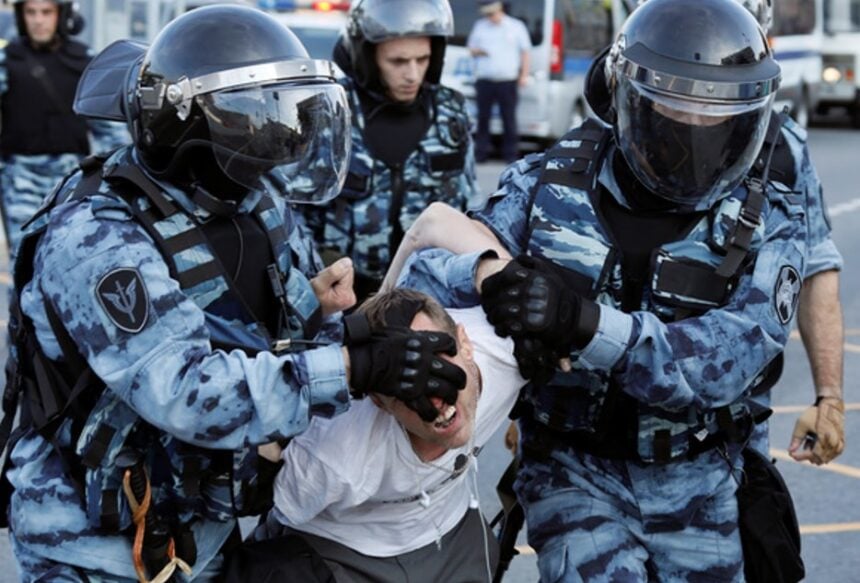
Police detain a man during the protest in Russia. Credit: Shamil Zhumatov
When the Federal Security Service (FSB) stormed a home in Yekaterinburg on June 27, killing two Azerbaijani brothers and detaining dozens more, the operation barely made international headlines. It should have. Because this incident isn’t just a local tragedy — it’s a glaring reflection of how Russia treats its supposed allies and how its imperial instincts are now devouring its own backyard.
The brothers — Ziyaddin and Huseyn Safarov — were well-known members of the city’s Azerbaijani community. They owned a local restaurant and had no known ties to extremism. Yet during a night raid, they were shot and killed by FSB forces under unclear circumstances. Eyewitnesses have alleged excessive force; some speak of torture. At least nine others remain in detention. The community is in shock.
Azerbaijan’s firm reaction
Baku, traditionally cautious in its dealings with Moscow, responded with rare directness. The Azerbaijani Foreign Ministry summoned the Russian chargé d’affaires, issued a formal protest, and demanded a transparent investigation and accountability. For a country that has carefully navigated the post-Soviet landscape, this marks a diplomatic line in the sand.
Azerbaijan’s Culture Ministry wrote on X that concerts, exhibitions, festivals and performances were canceled on account of “the demonstrative targeted and extrajudicial killings and acts of violence committed by Russian law enforcement agencies against Azerbaijanis on ethnic grounds in Yekaterinburg.”
Why? Because this isn’t the first time. Ethnic minorities — especially Muslims from the Caucasus and Central Asia — are often the first victims of Russia’s heavy-handed security apparatus. Under the guise of “anti-extremism” or “anti-crime” operations, entire communities are targeted, humiliated, and terrorized. The Safarov case is not an exception — it is part of a pattern.
The empire devours its own
Since the full-scale invasion of Ukraine, the Kremlin’s ideological machinery has gone into overdrive. What was once cloaked in post-Soviet nostalgia is now openly imperial: a glorification of Russian strength, a disdain for minorities, and a rejection of Western norms. In this worldview, loyalty to Moscow is demanded but never reciprocated.
Azerbaijan has not forgotten how Moscow delayed peacekeeping obligations in Nagorno-Karabakh, or partnered closely with Iran — a nation openly hostile to Baku. The Yekaterinburg killings are simply the latest proof that Moscow cannot be trusted, even by those who try to remain on good terms with it.
A turning point for post-Soviet states?
Russia’s former allies are watching. If Azerbaijani citizens can be killed by Russian agents without due process or justice, what does that mean for Kazakhs? Uzbeks? Russia’s neighbors are being forced to ask uncomfortable questions: Are we next? Is neutrality still safe? Can we rely on Moscow for anything other than coercion?
There was a time when the Kremlin used soft power — trade, diplomacy, cultural ties — to keep its sphere of influence intact. That time is gone. What remains is fear, surveillance, and force. And even that is beginning to crumble.
The silence is telling
It’s no surprise that most Western media have ignored this story. It doesn’t fit into the clean dichotomies of good vs. evil they like to apply to Russia. But if we are to understand the full scale of what Putin’s Russia has become — a violent, paranoid, and racially charged regime — we must listen to what happens beyond Moscow and beyond Ukraine.
What happened in Yekaterinburg is not just an internal Russian matter. It is a warning — to neighbors, to partners, and to the world — of how far the Kremlin is willing to go to assert control. And how cheap human life becomes when it stands in the way of power.
Related Topics
Related Posts