Researching Antisemitism. Building Allyship. Refusing Silence.
They Asked If I Was Jewish. I Said No.
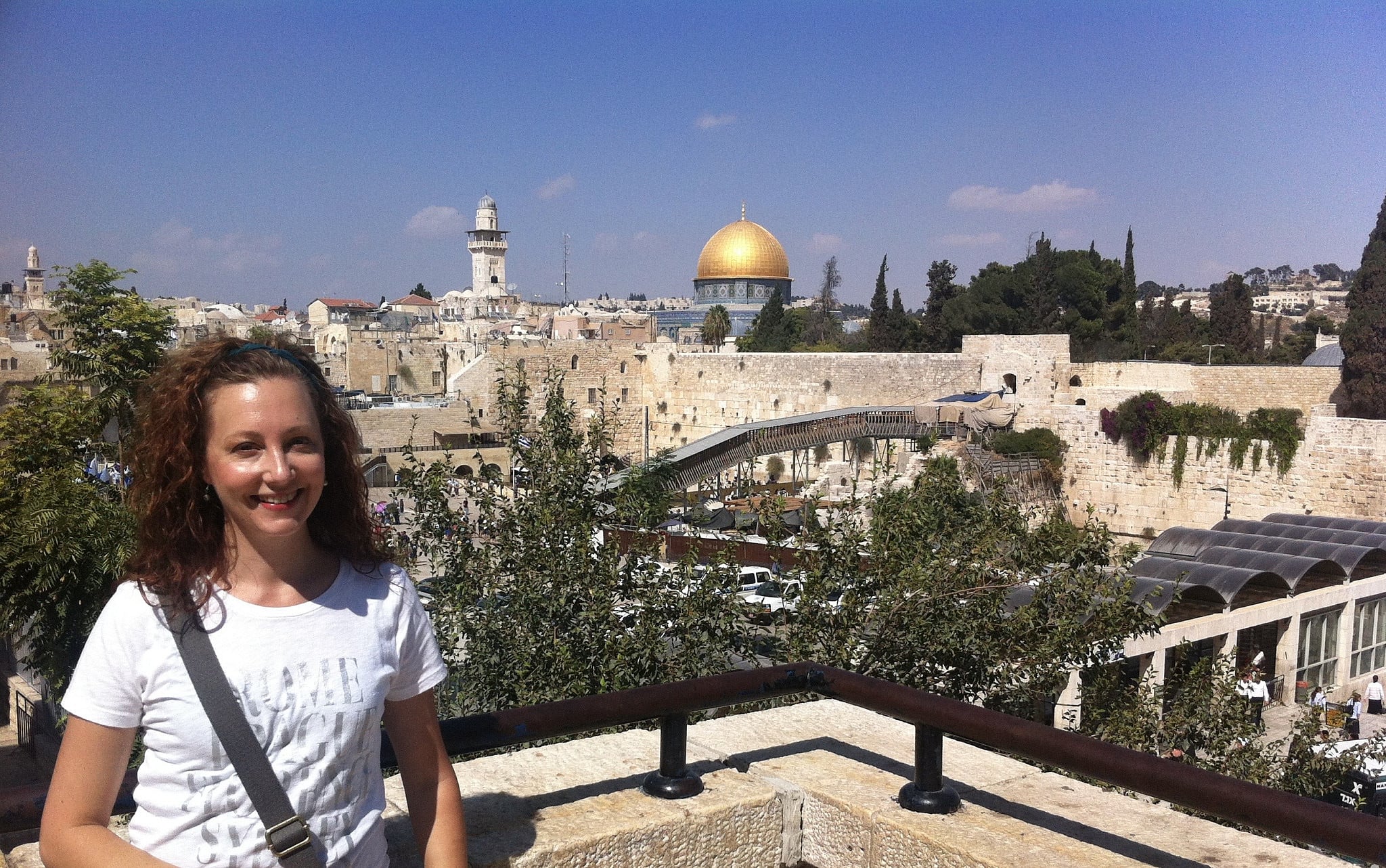
The author in Jerusalem, September, 2014.
I’m a Christian researching antisemitism, and I keep ending up in Jerusalem.
This last time it was after presenting survey research on theology, digital media, and antisemitism among young Christian men at a Contemporary Antisemitism Conference in Haifa. But Jerusalem is always where the questions catch up with me.
What led me here?
Maybe it was when I was 15 and was cast as Anne Frank’s mother, Edith Frank, in our high school play. I dyed my hair black for the role.
But it wasn’t only my hair color that changed.
It was something else, something that didn’t reverse when the stage lights went dark and we turned in our costumes. These people, except for Otto Frank, had not survived. They were gone. Murdered. For a brief moment, we brought them to life. But in the end, it didn’t matter how well we amplified their voices. We couldn’t change what had already happened to them, but I kept thinking about all the people across Europe who knew what was happening and said nothing.
That experience playing Edith Frank would switch on a new broadcast in my heart, one about a people whose lives were cut short during the Holocaust but whose story never was. The same hatred that murdered Anne Frank and her family also drove Jewish communities from their homes across the Middle East into Israel.
My upbringing had been tuned toward that frequency for some time. My Christian parents instilled in me a love and honor for Israel and the Jewish people from an early age. As a young reader interested in (and baffled by) stories about the Holocaust, I peppered my parents with questions: How did people in Europe allow this? Where were the “real” Christians?
During my first month long visit in 2013 Israel captured my heart in a way other lands have not. Being in Israel feels like home, and I never get tired of the way the ground still echoes with the past and present miracles of redemption, rescue, and hope.
I meet so many people in the States who don’t have the whole story about Israel. Go, I tell them. “You’ll find the parts that were left out for you here.”
When I tell people I research antisemitism and develop Holocaust programming, nine times out of ten the first question is:
Are you Jewish?
No, I say. And then I watch them try to work out why a Christian would spend her life on this.
It shouldn’t take being Jewish to care.
Antisemitism is not a Jewish problem to solve alone. A report released in the last few weeks by the J7 Largest Communities’ Task Force Against Antisemitism found that 2025 was the deadliest year for antisemitic attacks since 1994, with incidents in the United States having risen 131% since 2021. Jewish people across seven nations report hiding their identity in public and questioning whether they have a future in their home countries.
This demands non-Jewish investment, and Christian investment in particular.
Foundational figures of the Christian faith spread anti-Jewish rhetoric for centuries, rhetoric of which many Christians remain unaware. Both the Protestant and Catholic churches throughout Europe were largely silent during the Holocaust. This silence was lethal for Jews and hugely damaging to the Jewish-Christian relationship.
We carry that.
That weight is part of what motivates me to study and research in this field.
Last summer something shifted for me. It was night six of our ten-day Yad Vashem faculty seminar when the sirens went off across Israel in June 2025. We had spent nearly a week immersed in Holocaust history and education and then, early Friday morning, we woke to the news that Israel had struck Iran. Retaliation was coming, and no one knew exactly when or where. The alerts came at all hours after that and when I was offered a seat on a rescue flight out of the country, I hesitated.
Why should I leave when Israelis still had to endure the onslaught, the midnight runs to the bomb shelters, the uncertainty?
I stayed until the end of those twelve days.
During those sleepless nights in Jerusalem, something began to take shape. I came home and applied to the world’s only doctoral program in Antisemitism Studies at Gratz College.
Long before I knew how to name it, this calling to support and defend the Jewish people and Israel had already taken root, and it wasn’t only in me.
I attend a small church in Northern California that answered a call to action after October 7th. I brought education about antisemitism and Israel and the history of the church and the Holocaust. We held prayer meetings for the hostages and for our Jewish neighbors.
When we discovered in February 2025 that Shiri Bibas and her two children, Ariel and Kfir, had been murdered in captivity in Gaza, I asked if our church could hold a memorial service for the family and a prayer vigil for the hostages who were still held captive. It was short notice, but we invited the wider community.
We read from the Psalms and heard poetry written in the aftermath of October 7th. We watched the faces of the beautiful Bibas family move across a screen. We spoke the name of the oldest hostage, Shlomo Mantzur. As a child he had survived the Farhud, the pogrom that tore through Baghdad’s Jewish community in 1941, and he had lived a whole life before Hamas murdered him at ninety.
We sat together in silence.
That is how it looks when Christians show up: not with a position paper, not with a theology argument, but with presence.
With grief and a willingness to say: Your loss is our loss.
After 10/7 I committed to supporting the Jewish students at the local university as they faced antisemitism both on campus and off, as well as my Jewish neighbors. Whether helping them respond to incidents of antisemitism or talk through what was happening in Israel, my overarching goals remained: to honor their Jewish identity, assure them they were not alone, and encourage them to be proudly Jewish.
Through it all I learned much from these Jewish students and neighbors about resilience, creativity, compassion, and quiet strength.
This work is not happening in isolation. In the past month I traveled to Washington D.C. twice, first for a Christians United for Israel Summit and then for Israel on Campus Coalition’s National Leadership Summit as part of a faculty cohort with Academic Engagement Network, where I was reminded that many others have made the same commitment.
It isn’t always easy or popular. Father Stanisław Musiał, a Jesuit priest I studied in one of my doctoral classes on Holocaust memorialization in Poland, devoted his life to interreligious dialogue and the mitigation of antisemitism. He was criticized and isolated by peers for it. Christians should be clear-eyed about the cost, but it doesn’t change the obligation to do what is right.
To my fellow Christians: the Jewish people are our spiritual family. Jesus is Jewish. His disciples were Jewish. The early church was Jewish. When we turn away from the suffering of Jewish people, we are turning away from something that lives at the very root of our own faith. The history of Christianity includes centuries of those claiming to be followers of Jesus perpetuating that suffering.
We can choose differently now. “Love is when your heart wraps around something and won’t let go,” writes children’s author Rebecca Stead.
We can wrap our hearts around our Jewish neighbors. In the Biblical story of Ruth, Ruth chose to remain with Naomi and embrace her people as her own. Though Naomi urged her to leave, Ruth insisted: “Nothing but death itself will separate me from you, so help me God.”
Are we as Christians willing to suffer with and for our Jewish neighbors? The Christian church in Europe largely said no during the Holocaust, and that legacy should remind us that present inaction is not an option.
I have discovered several truths on this journey so far: First, there is grace for the courage this work requires. Second, even as I aim to be a blessing to my Jewish neighbors and friends, they have been that to me first.
Related Topics
Related Posts