
CEO of Time to Stand Up for Israel
They Don’t Want Peace, They Want No Israel
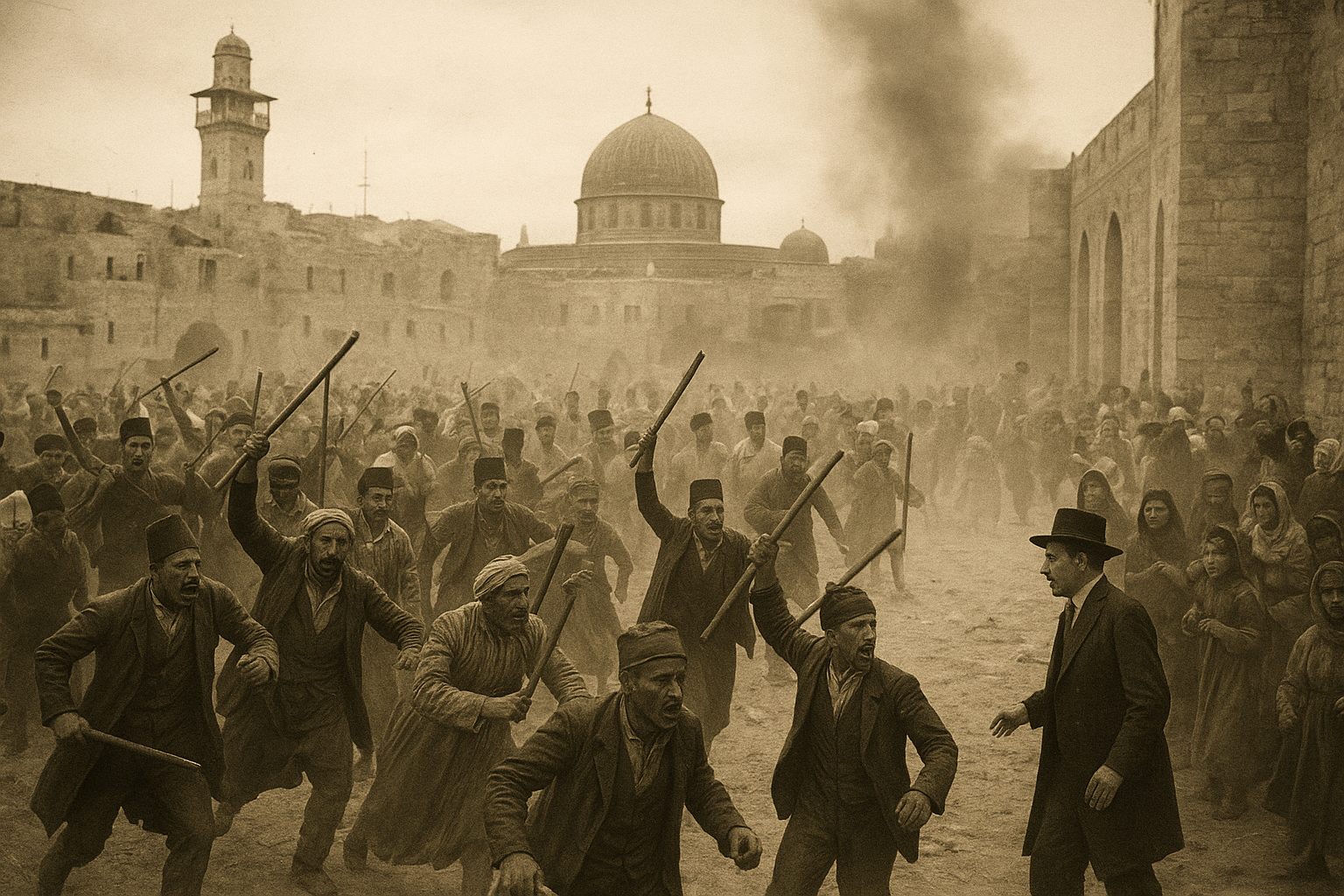
Photo Credits: Sabine Sterk (AI)
Hate Before, During, and After a State
History has a way of stripping away comfortable myths. When critics claim that Israel is the obstacle to peace, it helps to step back and look at the deeper pattern: opposition to Jewish sovereignty in the land now called Israel predates modern disputes about borders, settlements, or checkpoints. Long before there was a Palestinian state to lose, there was a determination, sometimes violent, to prevent the Jewish people from returning and rebuilding their national life in their ancestral homeland.
The violence that erupted in Jerusalem at the Nebi Musa festival in April 1920 shows this vividly. British-controlled Palestine had no Israeli state, no occupation infrastructure, and no modern settlement debate, yet crowds turned into murderous mobs and Jews in the Old City were killed, injured, and terrorized. That episode is not an isolated outburst of local anger; it is an early marker of a refusal to accept Jewish political restoration in the land.
The pattern continued. In 1929 the Hebron massacre claimed dozens of Jewish lives and destroyed a centuries-old Jewish community. Homes and synagogues were looted and desecrated; the violence was driven by rumors and an atmosphere of hostility rather than by contemporary arguments about land use or borders. Events like Hebron are painful historical facts that help explain why generations of Jews viewed the idea of secure sovereignty not as aggression but as survival.
Through the 1930s the conflict escalated into a broad, sustained uprising—the Arab Revolt of 1936–1939, which combined anti-colonial sentiment with organized, often violent rejection of Jewish communal and political claims. That revolt was not a negotiation over municipal rules; it was an attempt to roll back the very possibility of a Jewish national project in Palestine. The lessons were clear: coexistence requires partners willing to accept the other’s right to exist and to build, not only to contest it.
By 1947, the United Nations proposed a partition plan that would create both Jewish and Arab states. The Jewish leadership accepted the principle of partition; Arab leaders rejected it. That rejection helped set the stage for the war that followed Israel’s declaration of independence in 1948. The point is crucial: the conflict hardened not around the wording of borders but around whether Jewish self-determination in that homeland would be tolerated at all.
Fast forward to the 21st century: Israel has made difficult, sometimes unilateral moves toward compromise. The 2005 disengagement from Gaza: pulling out settlers and military positions was intended to change the facts on the ground, to create space for Palestinian self-government and economic development. In practice, the aftermath showed how fragile any peace is without a partner committed to renouncing violence and building institutions for peaceful prosperity. That disengagement did not produce a stable Palestinian polity at peace with Israel; instead, violent actors exploited the vacuum and turned Gaza into a launching ground for rockets and terror, again proving that political space alone does not guarantee peaceful outcomes.
It is right and necessary to call out extremist ideologies explicitly. Groups like Hamas have made their aims clear in words and in actions: they reject Israel’s legitimacy and have embraced war and terror as tools to achieve political ends. That reality cannot be ignored when assessing who seeks peace and who seeks Israel’s dissolution. At the same time, we must be careful not to confuse the politics of extremist parties and movements with the identity of an entire people. Many Palestinians, like many Israelis, want dignity, safety, and a future for their children. Equating all Palestinians with Hamas only deepens grievances and closes doors to the complexity that any real resolution will have to address.
So what is the proper response to the question embedded in this text? If the outcome seems predictable, must we still try? The answer is yes, but with clarity. Trying for peace is a moral and strategic imperative: pursuing diplomacy, development, and normalization matters. But truth matters too. Attempting peace without recognizing the historical continuity of rejectionist violence is naïve. Peace efforts must pair generosity with realism: readiness to make difficult concessions, coupled with measures to ensure security and a clear-eyed assessment of whether the other side’s leadership accepts the terms of coexistence.
Finally, it is worth remembering a fundamental point often lost in rhetorical battles: the Jewish connection to Judea, Samaria, Jerusalem and the broader Land of Israel is not a post-1948 invention. Archaeology, historical records, and continuous cultural memory all attest to deep historical roots. Likewise, modern political identities, Jewish, Palestinian, Arab, have evolved through the 20th century’s upheavals. Honest conversation about those identities and histories matters. It helps us see who is fighting for legitimate rights and who is fighting to erase another people’s existence.
If the world truly wants lasting peace, it must first confront the inconvenient facts of history and then insist that any viable partner demonstrate, through both words and deeds, a commitment to shared life rather than to eradication. Until then, defending the right of the Jewish people to a secure, sovereign homeland will remain not a provocation but a necessity.
Related Posts