
This Election Is Even More Fateful Than It Looks
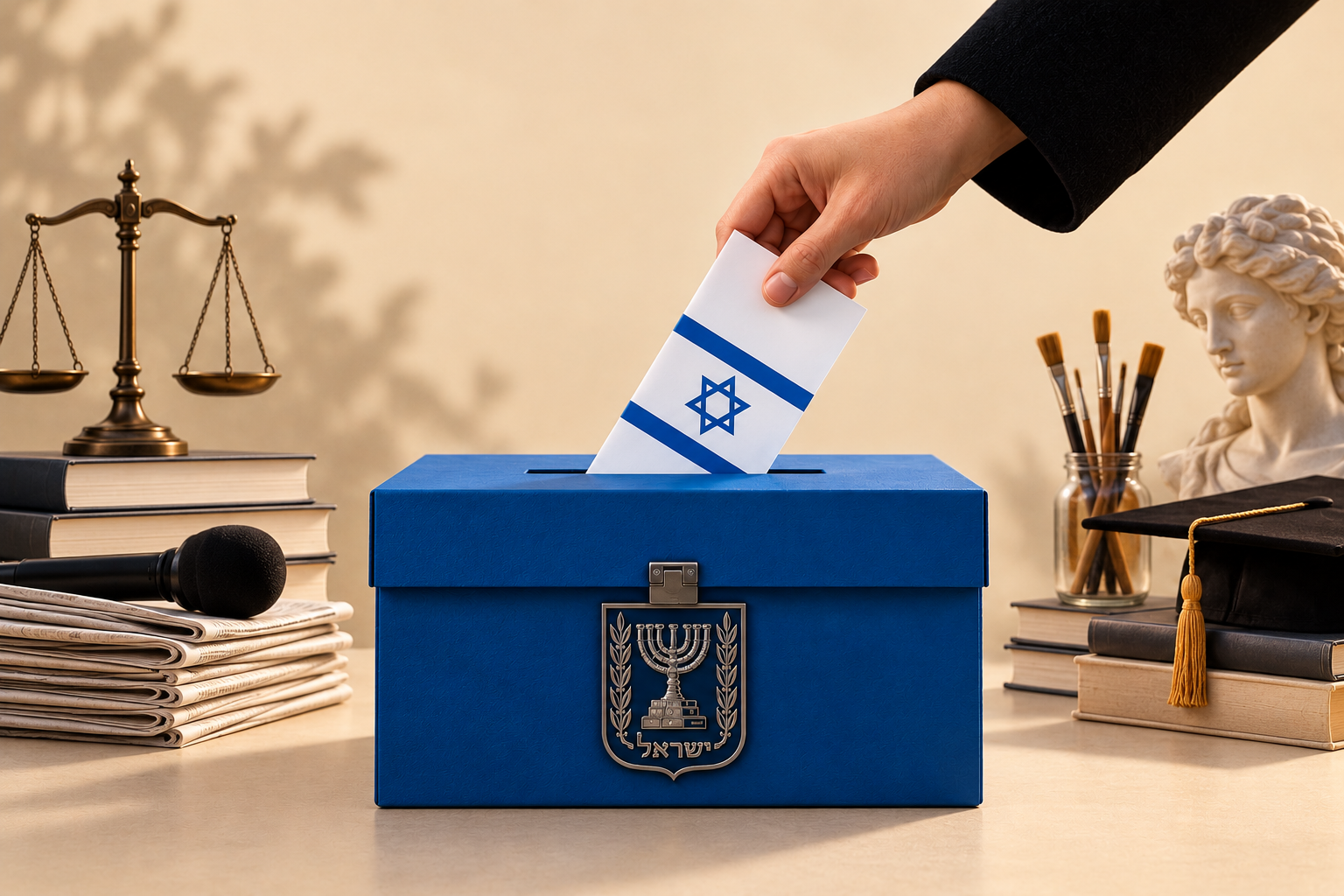
On Tuesday, October 27, Israelis will choose who governs them. They will not be choosing scientific truths, a cultural canon or the facts that journalists report. Those are settled elsewhere: in the laboratory, in criticism, in the newsroom. And yet this year’s ballot carries a question that appears in no party platform: Does winning an election give a government the authority to govern – or also the authority to decide what counts as good journalism, worthy art and sound judicial rulings?
Over the past few years, Israel has fought over nearly every major public institution. Justice Minister Yariv Levin sought to change the composition of the committee that selects judges and to curb judicial review. Communications Minister Shlomo Karhi advanced reforms to reshape the relationship between the government and the bodies that run and regulate broadcasting. Culture Minister Miki Zohar overhauled state support for the arts and the way creative prizes are awarded. Education Minister Yoav Kish demanded that university presidents pledge to refrain from political positions, threatening otherwise to advance a bill that would let the minister appoint the Council for Higher Education. Each fight unfolded in its own arena, in its own language, with its own arguments.
The judicial overhaul was sold as restoring “governability.” The media reforms were presented as increasing competition, though critics warned they would place broadcasting oversight in political hands. The cultural changes were framed as ensuring that public money reflects public values. The demand on the universities was cast as protecting their political neutrality. Beneath all of them ran the same argument: If the people are sovereign, and the government was elected by the people, why should institutions no one voted for operate by a different logic?
Majority rule is, of course, the foundation of democracy. But under the current government, that principle has been stretched far beyond the question of who makes decisions. It has turned from a theory of government into a theory of the entire public sphere. The questions familiar from politics – who was elected, who represents the public, which policy won a mandate – are now being asked about judges, journalists, researchers and prize committees.
A democratic society, however, is more than a system for allocating power. It is a society with many standards of judgment, in which not every institution is meant to do the same job. A court is not a miniature government; its task is to judge according to the law. A university is not a parliament; its task is to inquire. The press is not the state’s spokesperson; its task is to report, to expose and to criticize. Culture is not a referendum; its task is to create, to question and to unsettle. A government may set priorities and decide where to invest – that is precisely what elections are for. It may decide how much money goes to arts prizes and in which fields; it may not decide who wins them, or on the basis of which opinions. The authority to make policy is not the authority to replace legal, scholarly, journalistic or artistic judgment with a test of loyalty.
Israel’s cultural sphere illustrates this well. Early this year, the culture minister canceled dozens of state arts prizes, saying they had ignored artists “who hold views shared by most of the people.” The ministry later said it would restore them, but the principle stood: An artist’s opinions had become a criterion for recognition. When Naza, a Gaza documentary by Yuval Abraham and Rachel Szor – two of the makers of the Oscar-winning No Other Land – won a jury prize in Venice in September, Zohar asked the Interior Ministry to examine revoking their citizenship on suspicion of treason. Suspected crimes are for investigators and courts, not culture ministers. One may think the film is biased, even offensive, and say so loudly. That is criticism. Revoking citizenship is not criticism. It is punishment.
None of this requires censorship. It works through anticipation, and it is not hard to imagine how. A prize jury that saw what happened to the awards will choose cautiously. A filmmaker who saw what happened to Abraham and Szor will shape her next proposal accordingly. A newspaper that learned that criticism is read as an assault on governability will think twice. A researcher who saw what was demanded of university presidents will choose a safer topic. The institutions will go on functioning as usual. What is at risk is the ability to say something that does not serve those in power without fearing the price.
This is a question of freedom. A free society is not only one in which citizens choose their rulers. It is one in which people can investigate, report, create and judge even against the views of those rulers. When every field is measured by the same political yardstick, we are left with a one-dimensional view of a complex reality. Freedom also means being able to live in a society where politics is not the only language.
Until the election, and after it, Israelis will keep arguing about security, the economy, the cost of living and Gaza. But the fateful question concerns the limits of the power we entrust to those we elect: not only what each party promises to do if it wins, but what it believes victory entitles it to do. The current government has already given its answer.
Tomorrow we choose who governs. The truth, the culture and the facts are not on the ballot – and we should not let the winner act as if they were.