
CEO of Time to Stand Up for Israel
This Is Digital National Suicide
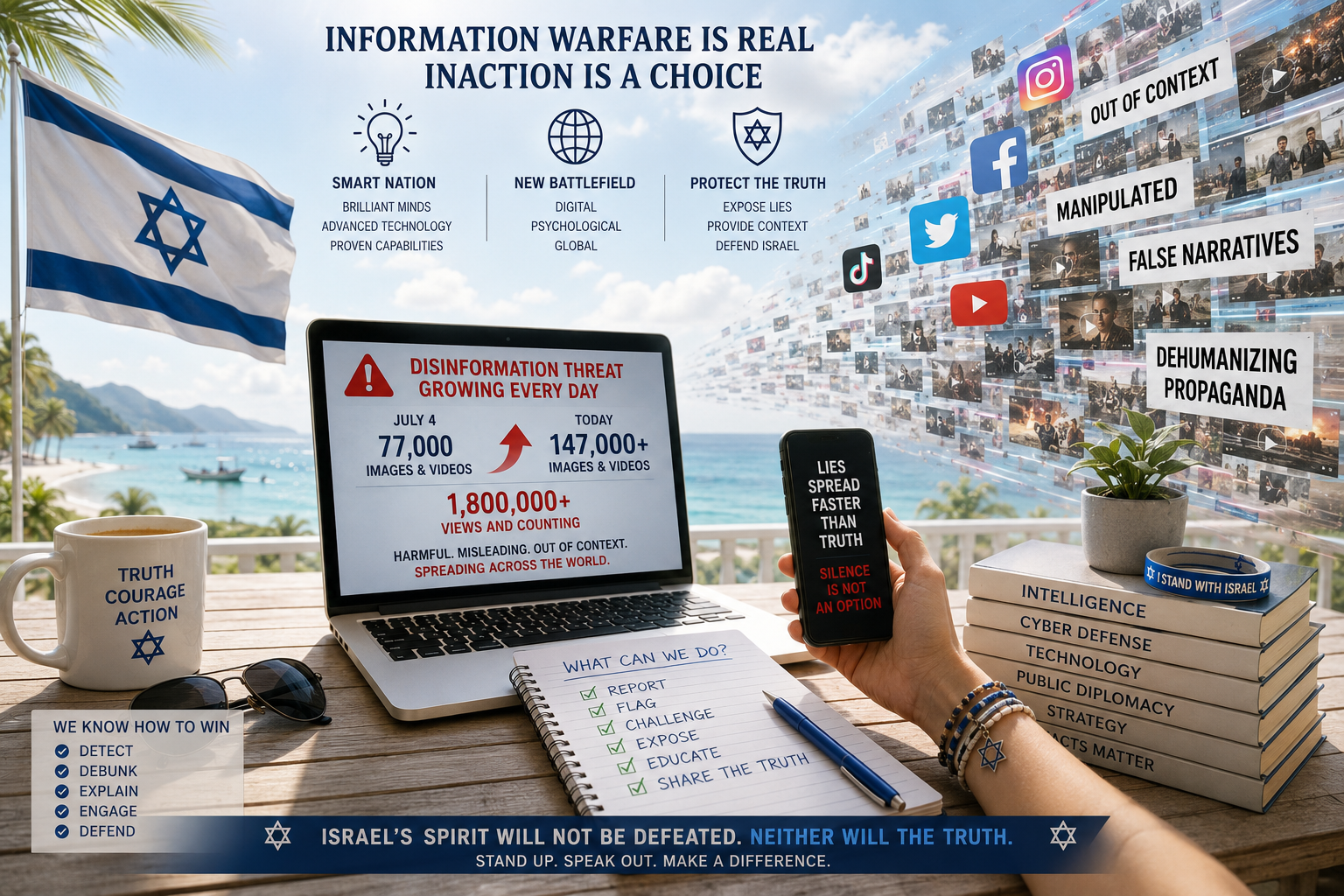
Photo Credits: Sabine Sterk (AI)
When Inaction Becomes the Greatest Mystery
I have never been someone who easily believes in conspiracy theories. I have always preferred facts over speculation and evidence over rumors. The same applies to religion. I have never believed in the traditional image of God as an all powerful being who controls everything. To me, that idea has always raised difficult questions. If an all knowing creator designed humanity, then surely that creator would have known humanity’s capacity for cruelty, violence, and destruction. That has always been one of the questions I could never reconcile.
What I do believe in is energy. Positive energy. Negative energy. The energy people leave behind through their actions, their kindness, their hatred, and their legacy. Whether science can fully explain it or not, I have often felt that some people leave an impression that survives them. That belief has always made more sense to me than the idea of an invisible force controlling every event on Earth.
Perhaps that is why I have never been attracted to grand conspiracy theories. They usually attempt to explain enormously complex events by pointing to one hidden organization pulling every string behind the scenes. Reality is normally far more complicated than that.
Yet sometimes reality becomes so difficult to understand that even someone like me begins asking uncomfortable questions.
At the moment I am on vacation in Thailand. Even while away, I continue advocating for Israel every single day. That is simply who I am. Distance does not diminish commitment.
On July 4, I discovered a website containing an enormous collection of highly damaging material relating to Israel. At that moment the website already hosted approximately 77,000 images and videos. Much of the material appeared designed to damage Israel’s international standing, often through footage presented without sufficient context.
I immediately sounded the alarm.
I contacted numerous people whom I believed had the influence, expertise, or connections to intervene. I assumed that a country famous for remarkable intelligence capabilities, groundbreaking cyber expertise, and daring operations would recognize the urgency of such a threat.
Nothing happened.
Not a meaningful response.
Not decisive action.
Nothing.
Today that same website reportedly contains roughly 147,000 pieces of content and has accumulated more than 1.8 million views.
Every additional visitor represents another opportunity for misinformation, selective presentation, and manipulated narratives to spread across the world. Whether every item on that website is inaccurate is almost beside the point. In the digital age, context determines understanding, and context is often the first casualty of information warfare.
This is what frustrates me most.
Israel has repeatedly demonstrated extraordinary capabilities in intelligence gathering, cybersecurity, technological innovation, and national defense. The country has earned a reputation for solving problems that many believed impossible.
That is precisely why this continued inaction feels so incomprehensible.
I am not suggesting that taking down a website is always simple. Legal jurisdictions differ. Servers can move. Content can be mirrored elsewhere. Digital platforms create complicated challenges.
But complete passivity is something entirely different.
If removing such a website is impossible, then where is the coordinated effort to challenge it publicly, expose manipulated content, provide verified context, or overwhelm misinformation with documented facts?
The battlefield of modern conflict is no longer limited to land, sea, and air.
It is digital.
It is psychological.
It is fought on social media feeds, search engines, websites, and smartphones.
Winning military battles while losing the information battle is a dangerous strategy.
This brings me back to conspiracy theories.
People often speak about the Illuminati as though a secret organization controls governments, economies, wars, and global events. Historically, there really was an organization called the Bavarian Illuminati during the eighteenth century. Modern claims, however, describe a hidden network controlling the world. Despite decades of speculation, no credible evidence has ever demonstrated that such a global organization exists.
That distinction matters.
I am not claiming the modern Illuminati is real.
I have no evidence for such a claim.
But I do understand why people become vulnerable to conspiracy theories.
When intelligent people repeatedly observe actions that appear irrational, delayed, or entirely absent, they naturally search for explanations.
Psychologists have long observed that conspiracy theories become attractive when institutions lose public trust or when events seem impossible to explain logically.
Perhaps that is exactly what is happening here.
When obvious threats appear to receive little attention, people begin wondering whether there are motives they cannot see.
Most of the time the explanation is probably far less dramatic.
Bureaucracy.
Poor coordination.
Institutional inertia.
Competing priorities.
Fear of political consequences.
Communication failures.
Any one of those could explain delayed responses.
Yet none of them makes the situation less alarming.
After more than a decade of advocating for Israel, I have repeatedly experienced how remarkably slow institutions can be when confronted with simple communication challenges.
Projects that could be completed in half an hour sometimes require months of discussions, approvals, committees, and hesitation.
Meanwhile, hostile narratives spread globally in real time.
The internet does not wait for meetings.
Algorithms do not pause for bureaucracy.
Public opinion is formed long before official responses arrive.
That is why I find this issue so deeply troubling.
Israel has some of the brightest minds in the world. It has built extraordinary technological companies, developed world leading cyber capabilities, and repeatedly surprised its adversaries with creativity and determination.
That same spirit should be visible in public diplomacy and digital advocacy.
Instead, too often, those working on the front lines of online advocacy feel abandoned while misinformation expands unchecked.
Perhaps there are explanations I simply do not know.
Perhaps important efforts are taking place behind the scenes.
I sincerely hope they are.
Because if they are not, then the greatest threat may not come from Israel’s enemies alone.
It may come from failing to recognize that information itself has become one of the most decisive battlefields of the twenty-first century.
I am not asking people to believe in secret organizations controlling the world.
I am asking something much simpler.
When obvious dangers continue growing while those capable of responding appear unwilling or unable to act, it is reasonable to ask difficult questions.
Not because conspiracy theories provide answers.
But because silence rarely does.
Related Topics
Related Posts