
A Midwestern Jewish Politico
This Is How Conflicts Are Prolonged
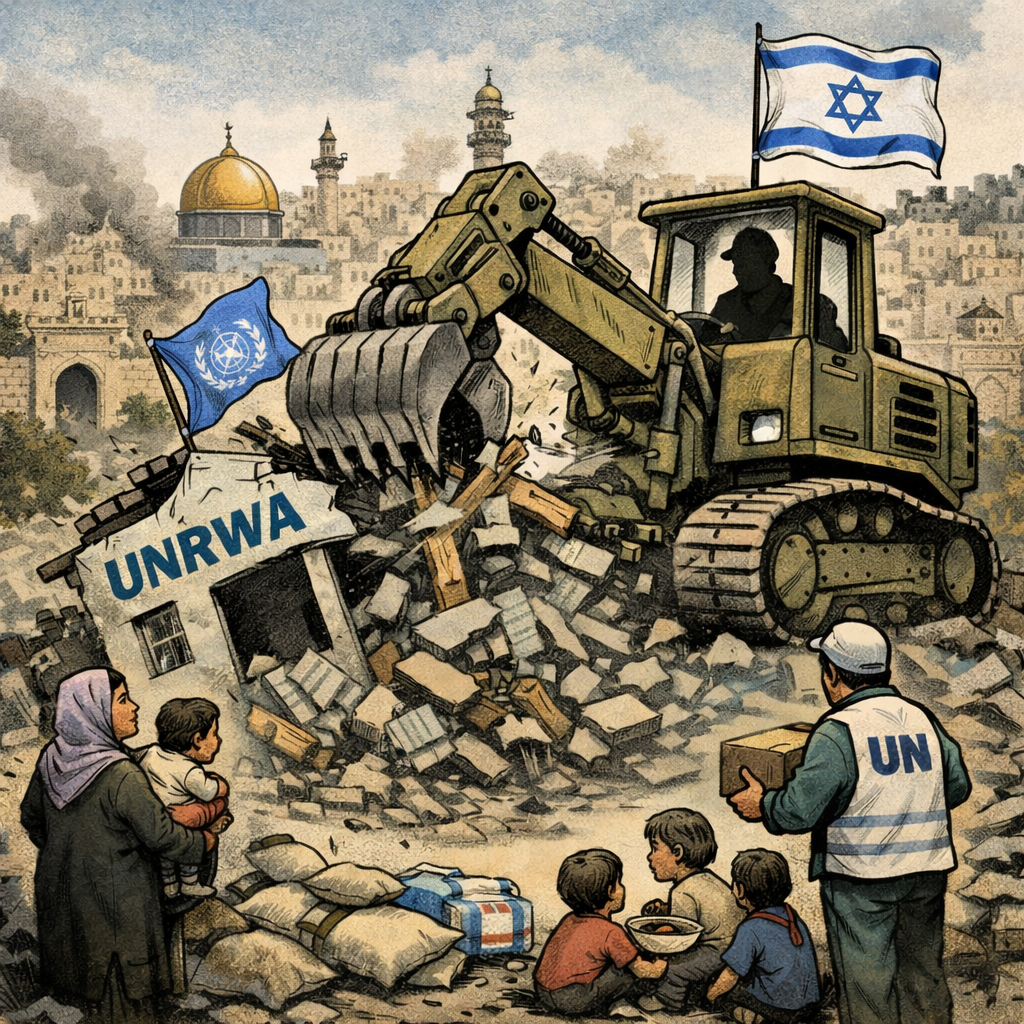
Bulldozing in East Jerusalem Political Cartoon - ChatGPT
There is a particular kind of political vandalism that doesn’t just destroy buildings. It corrodes credibility. Israel’s decision to demolish the UNRWA office in East Jerusalem falls squarely into that category. It is provocative, unnecessary, and deeply self-defeating. And once again, it leaves Israel’s government looking less like a serious actor interested in long-term security and more like a leadership class addicted to symbolic domination at any cost.
UNRWA is not a militant group. It is not a political wing of Hamas. It is not a secret terror hub hiding behind blue flags and acronyms. It is, quite simply, one of the few remaining institutions that provides basic relief to Palestinians who have been systematically stripped of economic stability, freedom of movement, and political agency. Clinics. Schools. Food aid. Employment. These are not abstract concepts. They are the difference between a society that can breathe and one that is permanently on the brink.
Demolishing a UNRWA office does not weaken extremism. It strengthens it.
When you remove stabilizing institutions from an already desperate population, you do not get moderation. You do not get gratitude. You do not get security. You get deeper poverty, deeper humiliation, and a vacuum that violent actors are more than happy to fill. History is painfully consistent on this point, even when governments refuse to learn from it.
The Israeli government knows this. Which makes the move even more disturbing.
If the argument is that UNRWA is imperfect, fine. That conversation is worth having. Large international agencies often are. Oversight matters. Reform matters. Accountability matters. But demolition is not reform. Bulldozers are not policy. And collective punishment disguised as “security” is not strategy. It is impulse.
What this action really signals is not strength, but indifference. Indifference to how Israel is perceived globally. Indifference to the suffering of ordinary Palestinians who are not militants, not ideologues, not interested in becoming martyrs for anyone’s cause. And perhaps most dangerously, indifference to the basic logic of conflict resolution, which requires reducing desperation, not amplifying it.
Every time Israel’s government takes a step like this, it undercuts its own legitimate claims to wanting peace. You cannot say you seek stability while actively dismantling institutions that prevent total social collapse. You cannot claim to care about preventing terrorism while pushing more people into conditions where radicalization thrives. And you cannot keep insisting that the world “understand Israel’s security needs” while repeatedly engaging in actions that make those needs harder to defend.
For those of us who want Israel to exist, to thrive, and to be safe, this is infuriating. Because it hands Israel’s critics exactly what they want, a clear, visual, undeniable example of power being used not to protect life, but to grind it down. It erodes moral standing. It alienates allies. And it reinforces the narrative that Israel’s current leadership has no real interest in coexistence, only control.
UNRWA’s work in Gaza and the West Bank is not charity theater. It is conflict mitigation. It is the slow, unglamorous labor of keeping people fed, educated, and medically treated so that despair does not metastasize into rage. Spitting in the face of that work is not only cruel, it is strategically reckless.
If Israel wants lasting peace, it cannot bulldoze its way there. Every demolished office, every symbolic act of humiliation, every move that deepens poverty and hopelessness pushes peace further out of reach. And at some point, even Israel’s most sympathetic friends are left asking a hard question: if your actions consistently sabotage peace, do you actually want it at all?
Related Topics
Related Posts