
CFO | Empower Society for Good I Author
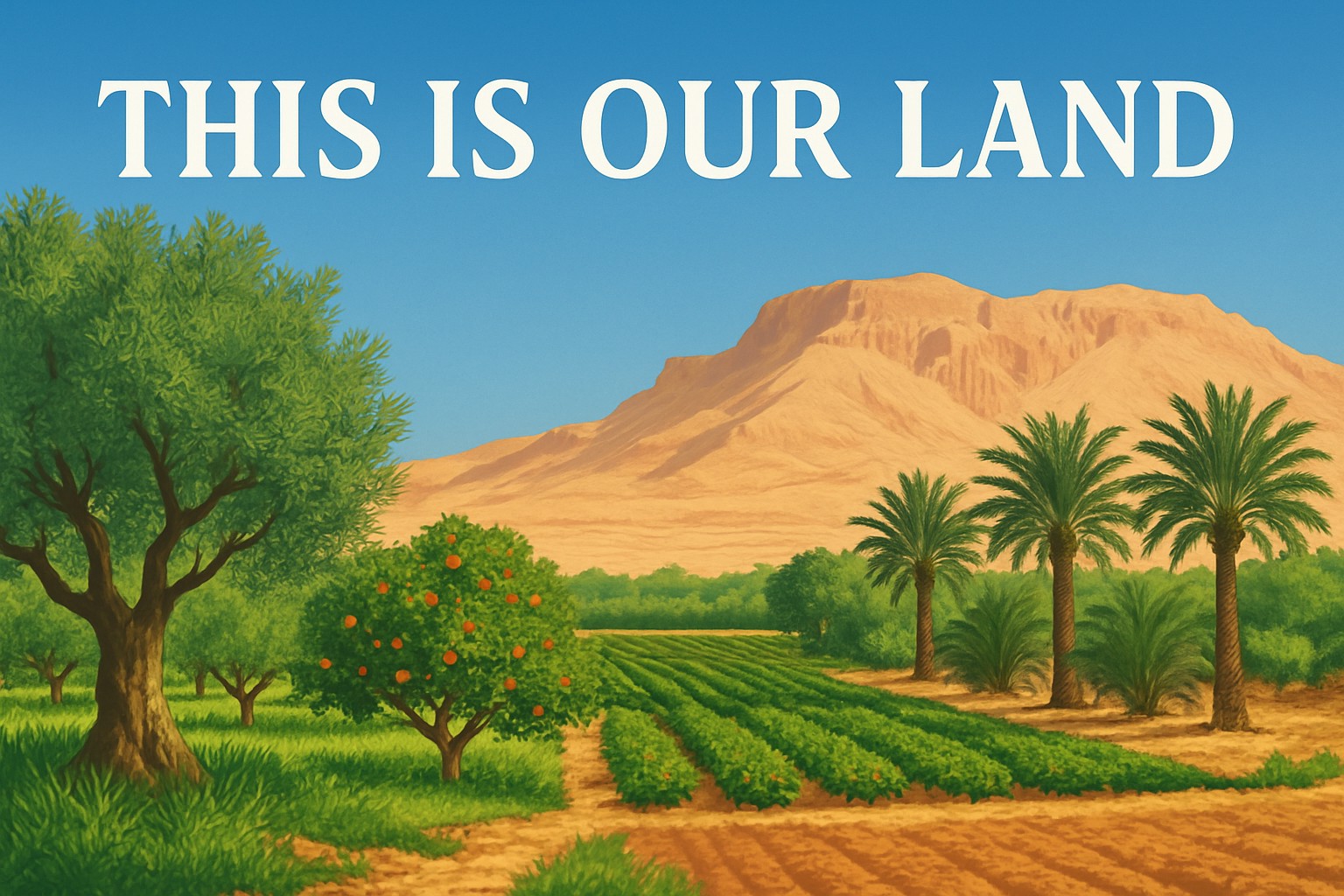
This is our Land
The Psychology of Lies, the Truth of Israel
Why do distorted slogans — “From the river to the sea, Palestine will be free” — spread faster and louder than historical truth? Why do crowds chant erasure while ignoring 3,000 years of memory?
The answer lies in a strange but powerful meeting point: modern psychology, timeless Torah, and the moral clarity of Rabbi Jonathan Sacks.
A Eureka Moment Across Time
Both B. F. Skinner (1904–1990), the American psychologist, and Rabbi Jonathan Sacks (1948–2020), the British Chief Rabbi, are no longer alive. Yet when you bring their thoughts together and apply them to today’s distortion of history about Israel, you get a striking Eureka moment: psychology, Torah, and moral clarity converge.
Skinner explains how lies spread — through reinforcement and group conditioning. Rabbi Sacks warns why lies destroy — because civilizations fall when they abandon truth. The Torah, in Ki Tavo, gives us the antidote: ritualized truth-telling, affirming the Jewish people’s eternal covenant with the Land of Israel.
The Power of Conditioning
Skinner, the father of modern behaviourism, taught:
“A person does not act upon the world, the world acts upon him.” — B. F. Skinner
His insight explains how entire populations can be conditioned to believe lies. Nazi Germany was perhaps the most terrifying example. Through relentless propaganda, repetition of lies, and punishments for dissent, ordinary Germans were shaped to believe the unbelievable: that Jews were parasites and enemies to be eliminated. This was Skinner’s theory applied at scale — conditioning a society to accept evil.
Rabbi Sacks saw this pattern clearly. He warned:
“The hate that begins with Jews never ends with Jews.” — Rabbi Jonathan Sacks
What began in 1930s Germany did not stop with antisemitism. It engulfed the world in war.
And today, after October 7th, 2023, when Hamas unleashed unspeakable atrocities — murder, rape, kidnapping, and terror on an unimaginable scale — we expected the world to rally in horror and support. Instead, we got excuses, equivocations, and in many places, open celebration of violence. We got antisemitism on the streets of London, Paris, and New York. We have universities where Jewish students were told to stay home “for their safety.” We got a tidal wave of lies, justifications, and denial.
Once again, we see Skinner’s theory proved: slogans repeated, lies rewarded, dissent punished. And once again, Rabbi Sacks’ warning echoes — hatred of Jews metastasizes into hatred that poisons entire civilizations.
The Torah’s Eternal Testimony (Ki Tavo)
The opening of Ki Tavo (Deuteronomy 26) describes a remarkable ritual. When the Israelites entered the Land, each farmer was commanded to bring the first fruits of his harvest to the Temple in Jerusalem. But this was not just an agricultural act of thanksgiving. The farmer had to recite a declaration of identity and history before God:
“And it shall be, when you come into the land which the Lord your God gives you for an inheritance, and possess it, and dwell therein…” (Deut. 26:1)
This is followed by the famous passage “Arami Oved Avi” — “My father was a wandering Aramean.” In a few short lines, the Torah compresses the entire drama of the Jewish people: Jacob wandering, descent into Egypt, slavery, oppression, God’s redemption, and the gift of the Land of Israel.
This ritual does three profound things:
- It ties history to land. The farmer does not thank God in abstract terms. He holds the fruits of his soil in his hand, standing on the very ground promised to his ancestors, and declares: “God gave us this land.” Jewish history is inseparable from the Land of Israel.
- It turns history into memory. By requiring every farmer to recite this story aloud, the Torah ensures that the Jewish people’s collective memory is reinforced through ritual. Just as Skinner noted that reinforcement shapes behaviour, the Torah provides divine reinforcement to shape identity.
- It defines Jewish identity. This is not just personal gratitude. It is national consciousness: “We were strangers, we were enslaved, God redeemed us, and He gave us this land.” To be a Jew is to carry this story forward, linking past, present, and future.
Centuries later, the rabbis placed this text at the heart of the Passover Haggadah, making it the backbone of the Maggid section. Every Jewish family, in every generation, recites these words on Seder night.
Rabbi Jonathan Sacks explained why:
“The Haggadah does not quote the book of Exodus to tell the story of the Exodus. Instead, it chooses Deuteronomy 26. Why? Because it is not history but memory. History is someone else’s story about the past. Memory is my story — who I am and why I am here. The Haggadah is not about what happened then. It is about who we are now.”
This is why Ki Tavo is so powerful. It transforms historical events into personal and collective identity, ensuring that no generation of Jews can ever separate themselves from the land and the covenant.
To deny the Jewish people’s rights to Israel is therefore not only to deny political sovereignty. It is to deny the very text we have recited at our holiest table across the generations. It is to deny history, God, religion, and identity itself.
From Hebrew Memory to Arabic Slogans
Now contrast this eternal declaration with what is chanted today in Arabic: “Min al-nahr ila al-bahr, Filastin takun hurra” — “From the river to the sea, Palestine will be free.”
The difference could not be sharper:
- Arami Oved Avi is ancient ritual, sanctified by God, embedded in Torah, and passed from parent to child for over 3,000 years.
- From the river to the sea is a modern political slogan, born in the 20th century, aimed not at memory but at erasure — the erasure of Jewish identity, history, and existence.
One is a truth reinforced through ritual. The other is a lie reinforced through propaganda.
Rabbi Sacks: Truth, Lies, and Moral Responsibility
Rabbi Sacks often warned of the danger of repeated lies:
“When truth is sacrificed to expedience, when lies are dressed in the garb of high ideals, then the foundations of freedom begin to crumble.”
What we are witnessing in the slogans of Free Palestine is not debate but the suppression of truth. It is the conditioning of useful idiots who believe they are standing for justice, while repeating distortions that erase Jewish history and excuse terror.
And Rabbi Sacks reminded us that Jewish survival itself rests on memory:
“History becomes memory when it is enshrined in ritual. Memory becomes identity when it is passed on to children. That is why, more than any other people, Jews survived.”
This is precisely why Arami Oved Avi at the Seder is so powerful. While the world forgets or distorts, the Jewish people remember — and in remembering, we survive.
Changing the Mindset
How, then, do we change the mindset of those who follow distortions? Here Skinner helps again: behaviour changes only when reinforcement changes.
- Make truth rewarding — celebrate and strengthen those who speak honestly about Israel’s history.
- Expose the cost of distortion — show the hypocrisy of those who cry for “freedom” while justifying Hamas and ignoring human rights.
- Harness story and emotion — facts matter, but people are moved by stories. Tell Israel’s story of resilience, faith, and covenant with passion.
- Anchor in covenant — like every Jew at the Seder, declare with pride: God gave us this land, and with-it moral responsibility.
Conclusion: Ritual vs. Slogans
Both Skinner and Rabbi Sacks are gone, but when we apply their ideas today, we get a Eureka moment. Skinner shows how lies spread; Rabbi Sacks explains why lies destroy; the Torah gives us the antidote — ritualized truth that ties identity to land and God.
That is why no Arabic slogan can erase Arami Oved Avi.
That is why no distortion can sever the Jewish bond to Israel.
And that is why to deny our rights to the land is to deny history, God, and the very essence of Jewish identity.
I would be remiss if I did not share these thoughts.
Ki Tavo – The Bible: The Greatest Book of Zionism
Parshat Ki Tavo is one of the most Zionist passages in the entire Torah. It begins with the words: “When you come into the land that the Lord your God gives you as an inheritance…” From that point on, everything revolves around the Land of Israel. The first fruits, the tithes, the blessings and curses — all of them only come alive once the Jewish people are home, settled in their land, working its soil and building their future.
This is not politics. This is the Torah itself.
And yet, here lies the hypocrisy of our age. The same world that quotes the Bible for morality and justice denies its central truth — the eternal bond between the Jewish people and the Land of Israel. They praise the Exodus but deny the destination. They celebrate the prophets but erase their promise. They claim to honour the Bible while dismissing its clearest message: Eretz Yisrael is the inheritance of Am Yisrael.
Ki Tavo dismantles that denial. It teaches that gratitude itself is bound to the land. When a farmer brings his bikkurim — the first fruits — to Jerusalem, he recites: We were slaves, God redeemed us, and now we stand here, in this land, bringing its fruits. Without the land, there are no fruits. Without gratitude, there is no covenant. Judaism without Israel is incomplete.
In the desert, food fell from heaven. In Israel, it comes through sweat and soil. Agriculture becomes holy, a partnership between God and the farmer. The rain may fall, but the farmer must sow. The crops may grow, but he must share with the Levite, the orphan, the widow, and the stranger. The land itself becomes a covenant in physical form.
This is why the blessings and curses are so central. They are not random punishments. They are the moral conditions of life in Israel. If we live with justice, the land yields abundance and security. If we abandon our mission, peace and prosperity will reign; the soil itself will testify with famine, drought, and exile.
Possession of the land is tied to responsibility. There is no greater living proof of this than the revival of the land, from desert and swamps into fertile fields, and today, into hi-tech, medical breakthroughs, and agri-innovation that blesses the world. Israel’s renewal is the covenant written not only in the Bible but in the very soil and science of our time.
And this is why Ki Tavo is the antidote to today’s denial. The land is not a bargaining chip or a political invention. It is covenant, destiny, and the very heart of Judaism. You cannot claim to honour the Bible while denying its promise. You cannot preach justice while erasing Jewish rights to the land.
The parsha ends with Moshe’s warning: even after miracles, the people still risk blindness. So it is today. The nations are blind to truth, and we risk taking Israel for granted. Ki Tavo calls us to open our eyes: the greatest miracle is already here.
The Land of Israel transforms wandering into rootedness, survival into flourishing, and memory into destiny. It is where covenant, gratitude, justice, and future converge. Our task is to bring our first fruits, our faith, and our gratitude — and in return, the Land yields blessing, abundance, and hope for generations to come.
Ki Tavo reminds us that the Bible is — and always will be — the greatest book of Zionism.
Further reading – sharing my reflection on
When Protests Replace Principles
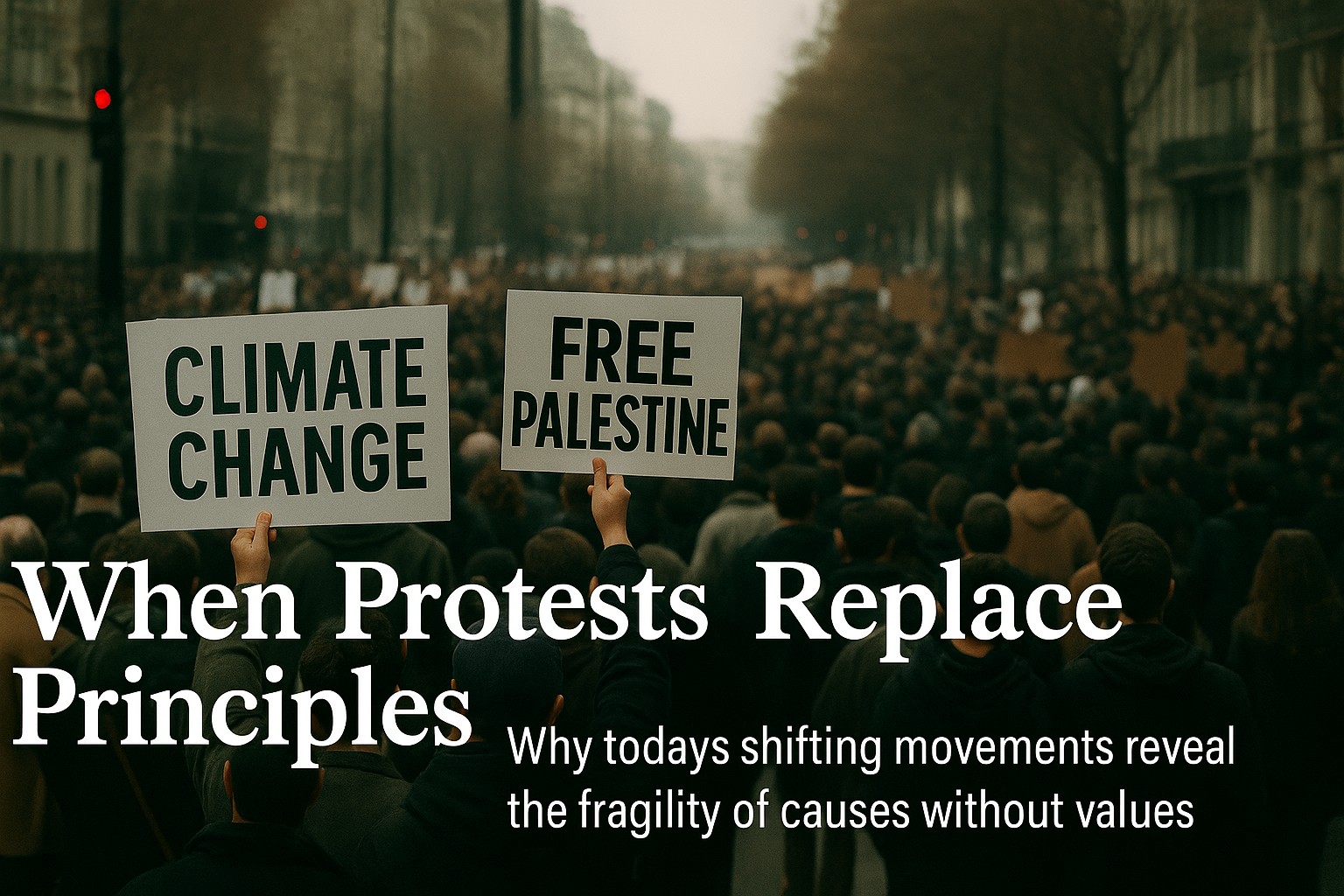
Why did climate change and ESG fall from the headlines so quickly?
Why do “Free Palestine” slogans now dominate the same streets that once echoed with calls for Net Zero?
In my latest blog, I explore how society drifts with protests and herd mentalities, and why only enduring values—not shifting slogans—can build a good society.
Read and subscribe here: https://upgradingesg.substack.com/p/when-protests-replace-principles
Related Topics
Related Posts