This Is Supposed to Be the Room
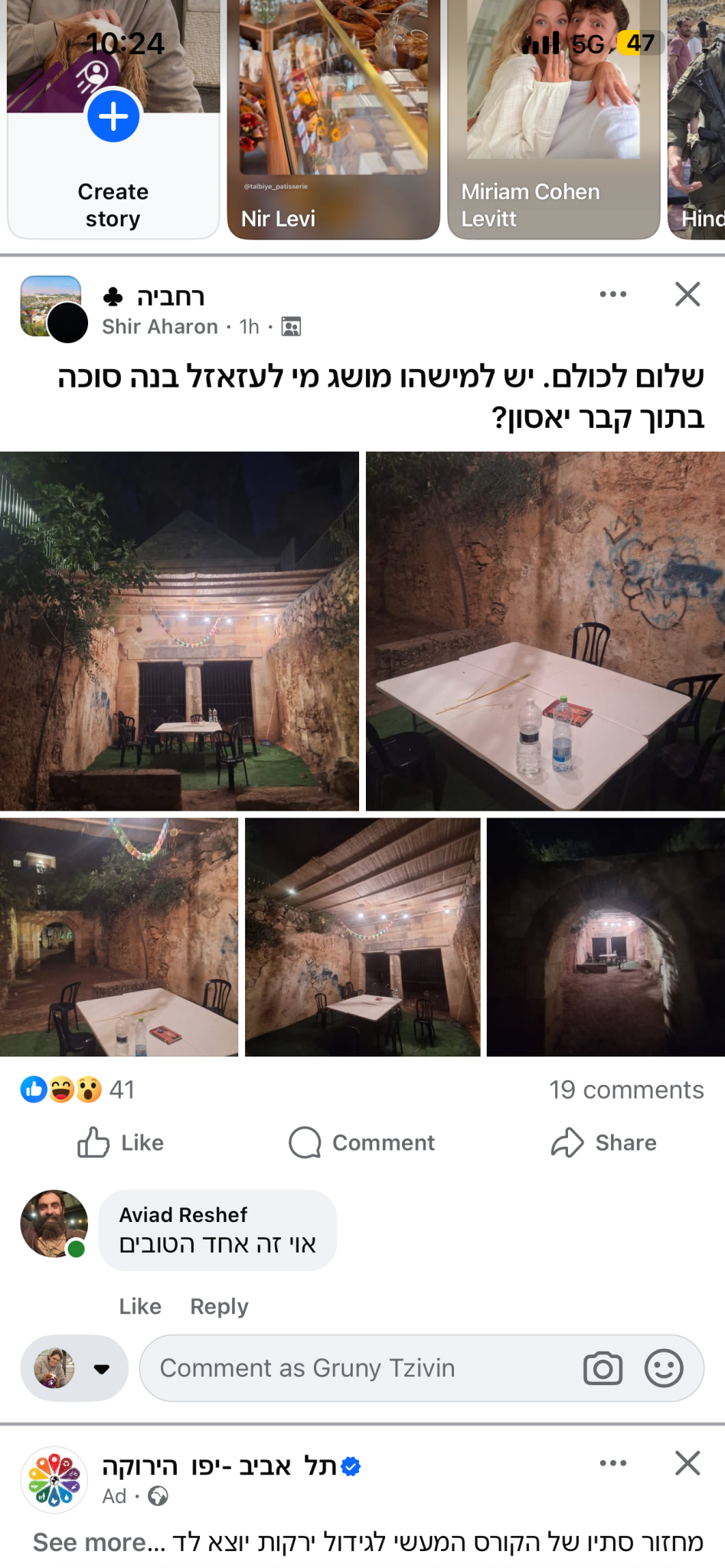
Yesterday, I saw a post on Facebook asking who the hell had built a sukkah inside an ancient burial cave.
I laughed.
To be fair, so did almost everyone else.
The pictures were objectively funny. Ancient Jerusalem stone. A table and some plastic chairs. Schach overhead. Little lights strung up. It looked like thousands of years of Jewish history had collided with an Israeli hardware store.
Then I looked again.
Wait.
I know that sukkah.
More specifically, I know the people who built that sukkah.
So naturally, I sent the post to my friend.
She laughed too.
Apparently, without even trying, her family’s sukkah had become a minor Facebook attraction.
People commented. People made jokes. Nobody seemed particularly scandalized. It was one of those wonderfully Israeli things that makes you shrug and think: Of course. Where else?
And then today, somebody complained.
The police came. The sukkah was dismantled.
My friend’s three-year-old cried.
He had helped build that sukkah. It was his sukkah. He is three, so he wasn’t particularly interested in questions of municipal regulations, pedestrian access, archaeology, public space, or whatever else the adults involved may have been discussing.
He knew that he had built a sukkah with his family.
And now someone had taken it down.
That’s when I stopped laughing.
To be clear, I don’t know all the legalities involved here. Maybe you aren’t allowed to build a sukkah there. Maybe there are rules about access. Maybe ancient burial caves have zoning regulations.
This is Jerusalem. I would not be remotely surprised to discover that somewhere there is a government office devoted exclusively to determining where you may place your schach.
Apparently, the explanation given was that the sukkah was obstructing passage.
Fine.
Except that after dismantling it, they left the pieces there.
So now the pieces of the sukkah are obstructing the passage.
Success.
And maybe that’s why this tiny story has gotten under my skin so much.
Because this is Israel.
I don’t mean that in the “Israel is a Jewish country, therefore religious Jews get to do whatever they want” sense.
They don’t.
I grew up in Crown Heights, arguably the religious center of the Chabad world. Jewish life wasn’t something that happened around me. It was the rhythm of my childhood. Shabbat, Yom Tov, sukkahs, kosher food, the Jewish calendar—none of it needed an explanation.
Most of the people closest to me today are religious. I live in Jerusalem. Religious Jewish life isn’t something foreign to me or something I’m observing from the outside.
But I also know that not everyone in Israel lives that way.
And that’s okay.
A Jewish state doesn’t mean that every Jew has to practice Judaism the same way. It doesn’t mean everyone has to keep Shabbat or eat kosher or believe the same things.
Living together requires compromise.
There are even holiday complaints I completely understand.
If you’re blasting music until two in the morning because it’s a chag and you’re happy, your neighbor with a sleeping baby is still allowed to want to kill you.
Chag sameach. Turn it down.
But a sukkah?
A sukkah feels different here.
In Israel, sukkahs are everywhere.
Religious families build them. Secular families build them. Hotels build them. Cafés build them.
Even restaurants that serve pork build sukkahs.
Which may actually be the most Israeli sentence I have ever written.
For one week, the physical landscape of this country changes.
Balconies become sukkahs. Courtyards become sukkahs. Parking spaces become sukkahs. Restaurants spill into sukkahs. Every available patch of Jerusalem seems to acquire bamboo poles, fabric walls and decorations made by somebody’s child in gan.
You don’t have to be religious to know what week it is.
And I love that.
I love living somewhere where the Jewish calendar doesn’t need an explanation.
I grew up in New York. There, Jewish life exists inside a larger world that wasn’t designed around it.
So you figure it out.
You explain why you can’t come in on a certain day. You arrange your schedule around Shabbat and Yom Tov. You explain to a teacher why your child won’t be in school. You negotiate.
Jews have been doing this forever. We became very good at making Jewish life fit into places that weren’t built around Jewish life.
There’s an old joke about a Jew in New York who gets cited for putting up an illegal structure.
It’s his sukkah.
He goes before a judge, who sternly orders him to remove the illegal structure within seven days.
The man happily agrees.
Problem solved.
I’ve always loved that joke.
It’s a diaspora joke.
It’s funny because that’s what we’ve always done. We figured it out. We found the loophole. We found the space. We made it work.
And perhaps that’s why watching a sukkah get dismantled in Jerusalem bothered me more than I expected it to.
Because we spend so much time in this country arguing about what a Jewish state is supposed to mean.
Who serves.
Who learns.
Who works.
Who prays where.
What happens on Shabbat.
How religious the public space should be.
How secular it should be.
Who is imposing on whom.
Who gets to decide.
We can fight about Judaism so passionately that sometimes I wonder whether we leave ourselves enough space simply to live it.
And maybe this particular sukkah really couldn’t stay where it was.
Maybe there was a perfectly reasonable rule.
Maybe somebody genuinely couldn’t get through.
I can accept that.
What bothers me is something harder to articulate.
It’s the instinct to look at somebody else’s sukkah and see a problem that needs to be reported.
I don’t want every difference between us to become another front in the endless war over what Israel is supposed to look like.
I want an Israeli who drives on Shabbat and an Israeli who keeps every halacha of Shabbat to be able to live on the same street without seeing the other as a threat.
I want someone’s sukkah to be allowed to just be a sukkah.
And I want a three-year-old in Jerusalem to grow up believing that building one is the most ordinary thing in the world.
Because it should be.
In New York, we became very good at finding room for Judaism.
But I live in Jerusalem now.
I don’t want us to have to find room for Judaism here.
This is supposed to be the room.