This Shavuot, make a macaroni soup with milk
I’ve found a new recipe for Shavuot this year, macaroni soup with milk, I’m sure it’ll be a new favourite. It reminded me of my own Bessarabian bobe (yiddish for grandmother) who used to make her own cheese. Nowadays I make my own labeneh (Israeli soft cheese).
I have Elka Roizman in Chernovtsy, Ukraine to thank for the suggestion. Her testimony about life growing up in Romania before the war, includes a list of the dairy foods she remembers eating on Shavuot including cottage cheese puddings and dumplings, macaroni soup with milk, and cheesecake. It’s just one of hundreds of oral histories available on the Centropa website which paint a vivid picture of the life of European Jews.
As part of my work at the Rothschild Foundation Hanadiv Europe, I’m surrounded by fascinating personal stories like Elka’s. All too often though, these testimonials along with inspiring heritage projects and intriguing historical documents are solely in the hands of academics and archivists. One of our goals is to make these underused resources more accessible to a wider audience because used well, these treasures can also help bring Jewish educational resources to life.
Jewish educators have a tough gig. Think of them as magicians who pull all sorts of topics out of their magic hats; religion, culture, camp, family traditions, Israel, food, schools, the Shoah. Perhaps, the one big trick they could use better is their own local Jewish heritage. One’s heart skips a beat when reading about the advertisements that Viennese parents placed in a UK newspaper in the hope of saving their children or listening to old religious folk songs gathered in Ukraine in the early twentieth century by Semyon Ansky. Nowadays, European Jews are looking for positive narratives for Jewish life rooted where they live. American and Israeli Jews may visit European sites of Jewish interest to learn about their ancestors’ past but for European Jews, their past is on their doorstep.
Jewish educational journeys such as Birthright and March of the Living give participants a feeling of connection to a global Jewish family, one focused in Israel and the other on the memory of the Holocaust. From another angle, many European Jewish museums sometimes focus their exhibitions on a universalistic message, highlighting the contribution of Jews to wider society. These are narratives often developed to draw the attention of tourists and not always attuned to local communities.
I would argue that local Jewish heritage should be amongst the first things Jewish educators pull out of their magic hats. There is plenty of material available that connects local Jewish communities to their past and present, but educators need help to adapt this rich content to their different audiences.
We need trained Jewish educators in Europe who know how to access and use Jewish artefacts in their work to offer context, meaning and purpose to their message. Communities that can help their Jewish educators develop innovative ways to incorporate Jewish heritage material into their bag of tricks, will help deliver excellent educational outcomes.
Last year at Shavuot, my colleague Sally Berkovic wrote Ten Other Commandments: Between Place and Man and number 9 was “Thou shalt integrate a broad understanding of Jewish heritage into the contemporary Jewish educational landscape”. For this Shavuot, I’m helping things along with my 10 commandments for how European Jewish communities can use their local Jewish heritage to bolster their Jewish education:
- Thou shalt inspire all your educators: Make sure everyone on your educational team understands the power of using Jewish heritage in their teaching. Don’t just rely on your teachers, but also think about your rabbis, youth leaders, programme coordinators and museum guides. Check out how Centropa trains teachers to use photos and documents in the classroom. Perhaps your local museum or archive can help educators to work with your Jewish community.
- Map out your Jewish Heritage assets: There will be more than you think. Your local art museum probably has classical pieces depicting biblical scenes and exploring local cemeteries can be a great place for informal Jewish education. In this Shavuot walk in Budapest, you can learn about the entrepreneurial Teleki women who took on a variety of business to sustain their families.
- Make use of the academic work that is accessible: Track the journeys made by Jewish books from Europe across the world and identify experts in your community who can make the materials come alive and engaging.
- Allocate time for local Jewish history: There are clever ways to integrate local Jewish history into a curriculum bursting with general Jewish history and Hebrew. Check out the great primary resource packs available from the National Library of Israel or their blog which features stories like the one about Berlin–born Edith Gerson-Kiwi, a pioneer of Israeli musicology.
- Be creative, collaborative and learn from others: Imitation is the sincerest form of flattery so check out what other communities are doing well and see if you can adapt it for your community. How about this walking tour about the Jews of London or a Teen Digital Takeover Day.
- Encourage writing about Jewish Heritage: Make sure local journalists and bloggers are aware of your fantastic local Jewish heritage and write about it such as “Gli spazi dell’ebraismo urbano – Roma” (Italian but easy to read with Google translate)
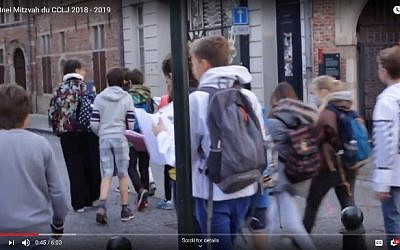
Teens exploring a neighbourhood as part of their Bar/Bat Mitzvah year at the Centre Culturel Laic Juif in Brussels. - Incorporate Jewish Heritage into Bar/Bat Mitzvah programmes: Show your teens how to preserve memorabilia or interview older members of their family.
- Use Jewish heritage to illustrate different Jewish topics: Sometimes it’s the presentation that matters – like in this lesson plan shaped as a Talmud page and sometimes in the content, like this teacher talking about Sukkot based on a 1916 picture from Poland.
- Take the long view: For European Jews, the past has had periods of intense suffering but through thousands of years, Jewish communities, families, individuals have flourished in Europe. Check out what 1700 years of Jewish life looks like in in German-speaking lands or 1000 years of Jewish life in Poland.
- Give your community a unique sense of identity: Rather than focus on helping tourists learn about the history of Jewish life in your country, think about how your members can gain a better understanding of their roots and unique sense of belonging as Jews in your country. Here is a Jewish ethical perspective of healthcare workers put at risk during the Covid-19 pandemic. Discover a local hero like Sarah Schenirer, who founded the Bais Yaakov movement in Poland to advance education for religious girls.
“Thou shalt not treat every old, derelict synagogue as sacrosanct.” Europe is not only a travel destination. It is a place where Jews lived and still live. Investments in Jewish heritage education should use the place to anchor and focus the experiences of the people. European Jews should be the custodians of their own Jewish story and Jewish heritage has a central role to play in supporting Jewish life. We just need to ensure there are trained professionals who know how to celebrate local Jewish heritage and bring these magical stories to life.