
Throwing Stones from a Glass House: The West’s Double Standard on Israel
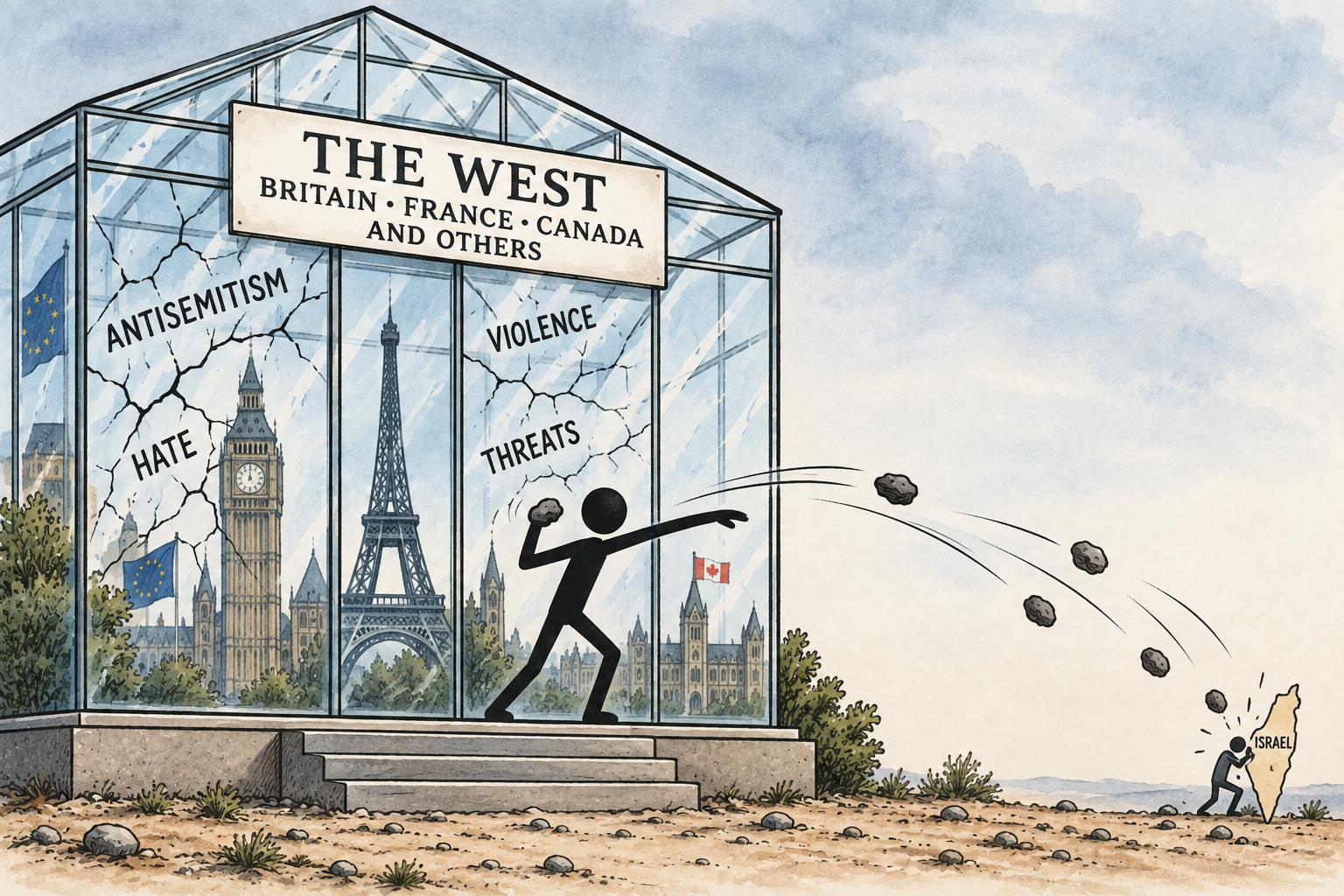
This week, British Foreign Secretary Ed Miliband announced that Britain would ban imports from Israeli settlements in the West Bank, joining France and Canada in taking action. The governments cited international law and settlement expansion, but also what they described as “unprecedented levels of settler violence” and Israel’s failure to hold perpetrators accountable.
Miliband, who began his announcement by describing himself as a “proud British Jew,” has every right to condemn violence against Palestinians, as do France and Canada. And on the basic point, I agree with them. Palestinians are entitled to protection from Jews who attack them, and Israel has done a poor job of investigating and prosecuting the perpetrators.
Some of Israel’s failures cannot simply be blamed on the difficulty of the job. National Security Minister Itamar Ben-Gvir, whose ministry oversees the police, has a long history of inflammatory rhetoric toward Palestinians, while senior Israeli security officials have accused him and people around him of obstructing efforts to investigate and arrest violent Jewish extremists. Other members of the governing coalition have encouraged settlement expansion and sometimes displayed a tolerance toward Jewish extremists that they would never extend to Palestinian terrorists.
But European governments might bring some humility to their judgment of Israel, because they have been remarkably unsuccessful at protecting Jews from violence in their own countries.
Consider Britain’s failure in battling antisemitic violence. The Community Security Trust recorded 3,700 antisemitic incidents in 2025, its second-highest annual total ever. These included 170 assaults and four incidents of extreme violence. The situation worsened in the first half of 2026, when CST recorded 135 assaults plus one incident of extreme violence—the highest six-month total for physical attacks it has ever recorded and an 82 percent increase in assaults over the same period of 2025.
Miliband is well aware of this crisis, and he spoke about the murder at Heaton Park Synagogue, attacks in Golders Green and Jewish children requiring guards at school, when he announced the boycott measures against Israeli settlements. He announced an additional £250 million for Jewish community security and declared that “holding British Jews responsible for the actions of the Israeli Government is antisemitism, plain and simple.” Britain is clearly trying to protect its Jewish population, but despite those efforts and substantial resources, antisemitic violence continues to rise.
France has experienced a similar crisis. Its government recorded 1,320 antisemitic acts in 2025. Jews constitute less than one percent of the French population but were the targets of 53 percent of all recorded anti-religious incidents. Physical antisemitic violence actually increased, from 106 attacks in 2024 to 126 in 2025.
Canada, which joined Britain and France in taking action against settlement trade, is confronting an unprecedented antisemitism problem of its own. B’nai Brith Canada recorded 6,800 antisemitic incidents in 2025, the highest number in the 44-year history of its audit and nearly two and a half times the number recorded before October 7. Canadian synagogues, schools and other Jewish institutions have faced shootings, arson, vandalism and threats.
And the problem extends across Europe. Germany, Belgium, Austria and other countries have experienced dramatic increases in antisemitic incidents since October 7. Germany recorded 6,236 antisemitic crimes in 2024, compared with 2,641 in 2022. Belgium went from 57 to 277 recorded incidents over the same period. The European Union Agency for Fundamental Rights found that 96 percent of Jewish respondents in its most recent Europe-wide survey had encountered antisemitism during the preceding year.
These statistics cannot simply be compared with West Bank figures: different countries record hate crimes differently, and settler attacks can be considerably more severe. Nor do they excuse settler violence against Palestinians. But they demonstrate something important nonetheless: even wealthy, peaceful democracies with sophisticated police forces have found it extraordinarily difficult to protect a small minority from persistent violence.
There is also an enormous difference between the circumstances in which these governments and Israel are trying to prevent violence. The Jews of Britain, France and Canada pose no violent threat to the societies around them. There is no Jewish terrorist infrastructure in London, Paris or Toronto. British police do not have to protect Jews from antisemitic attacks while simultaneously preventing Jewish suicide bombings, shootings and terrorist cells directed at the rest of the British population.
Israel faces precisely that kind of two-sided security problem in the West Bank.
In 2024 alone, the Shin Bet reported thwarting 1,040 significant planned terrorist attacks in the West Bank and Jerusalem, including hundreds of shootings and bombings. Israelis also remember the Second Intifada, when suicide bombers deliberately targeted buses, restaurants and cafés. And after October 7, the possibility that territory relinquished by Israel could become a base for attacks against Israelis is frighteningly real.
None of this excuses a settler who attacks an innocent Palestinian. Palestinian terrorism no more justifies Jewish terrorism than IRA terrorism justified loyalist attacks on innocent Catholics during the Troubles.
But Northern Ireland is instructive for another reason. For decades Britain—with professional police, an army, functioning democratic institutions and the resources of a modern state—struggled to contain violence between two populations engaged in a bitter national conflict. More than 3,000 people died, most of them civilians. Republican terrorism did not excuse loyalist terrorism, and loyalist terrorism did not excuse abuses by British security forces. But no serious account of Northern Ireland would evaluate Britain’s success in preventing violence while simply removing the IRA from the story.
Yet discussions of settler violence frequently do something similar with Palestinian terrorism.
Maj. Gen. Avi Bluth, the IDF commander responsible for the West Bank, certainly does not dismiss violence by Jewish extremists. He has described them as a “violent group of lawbreakers” who harm Palestinians uninvolved in terrorism, interfere with the IDF’s mission and undermine Israel’s security. He has reportedly gone so far as to call the phenomenon “Jewish terrorism.”
More recently, Bluth explained the operational problem directly. Settler violence, he warned, could be “one match that could ignite everything in an instant,” adding that “the IDF’s attention is constantly being diverted to such incidents instead of thwarting Palestinian terrorism.”
Those are not the words of an army that regards violence against Palestinians as acceptable. The reality is more complicated than either “Israel sanctions settler terrorism” or “Israel is doing everything it can.” Israel has political figures such as Ben-Gvir who have contributed to the problem, security officials such as Bluth who regard Jewish extremism as a threat, inadequate law enforcement, and security forces simultaneously trying to suppress Palestinian terrorism and Jewish violence in the midst of an ongoing national conflict.
History suggests that this is an extraordinarily difficult task. Northern Ireland is one example. The partition of India, Bosnia and other communal conflicts offer far more terrible ones. The circumstances are very different, and I am not equating them. The narrower lesson is that when territorial and national conflicts turn violent, civilian violence becomes extraordinarily difficult for governments to contain.
There is one more question European governments should consider. Their own statistics show that antisemitism rises dramatically when conflict involving Israel dominates political and media discourse. In Britain, 53 percent of the antisemitic incidents recorded by CST in 2025 referenced or were linked to Israel, Palestine, October 7 or the subsequent war. Before October 7, that proportion was dramatically lower.
That does not mean criticism of Israel causes antisemitism. It certainly does not mean European governments should remain silent about Israeli policies they oppose. Antisemites, not Ed Miliband, are responsible when Jews are attacked.
But political leaders should recognize the environment in which their words are heard. When criticism moves from particular Israeli policies to sweeping portrayals of Israel as uniquely criminal; when violent settlers become simply “settlers,” and settlers become Israelis; or when Jews thousands of miles away are expected to answer for the actions of an Israeli government they did not elect, legitimate political criticism can become intertwined with something much uglier.
Of course, Israel should arrest and prosecute Jews who attack innocent Palestinians. It should do far more to protect Palestinian civilians. And Israeli leaders who encourage extremism or interfere with law enforcement deserve condemnation.
But Britain, France and Canada have struggled to protect peaceful Jewish minorities from escalating violence under circumstances vastly less difficult than those Israel confronts in the West Bank. Their own experience should give them some appreciation of how difficult preventing violence can be. Britain’s experience in Northern Ireland should give it an appreciation of how much harder the task becomes in the midst of an active national conflict.
Israel deserves criticism when it fails. It does not deserve to have the extraordinary security environment in which those failures occur edited out of the story.
And governments that have been unable to stop the growing violence against Jews in London, Paris, Toronto and elsewhere might approach Israel’s failures with a little less self-righteousness.