
"I'm the spokesman for the OK Boomer generation"
Tibet, the CIA, and the Price of American Realpolitik.
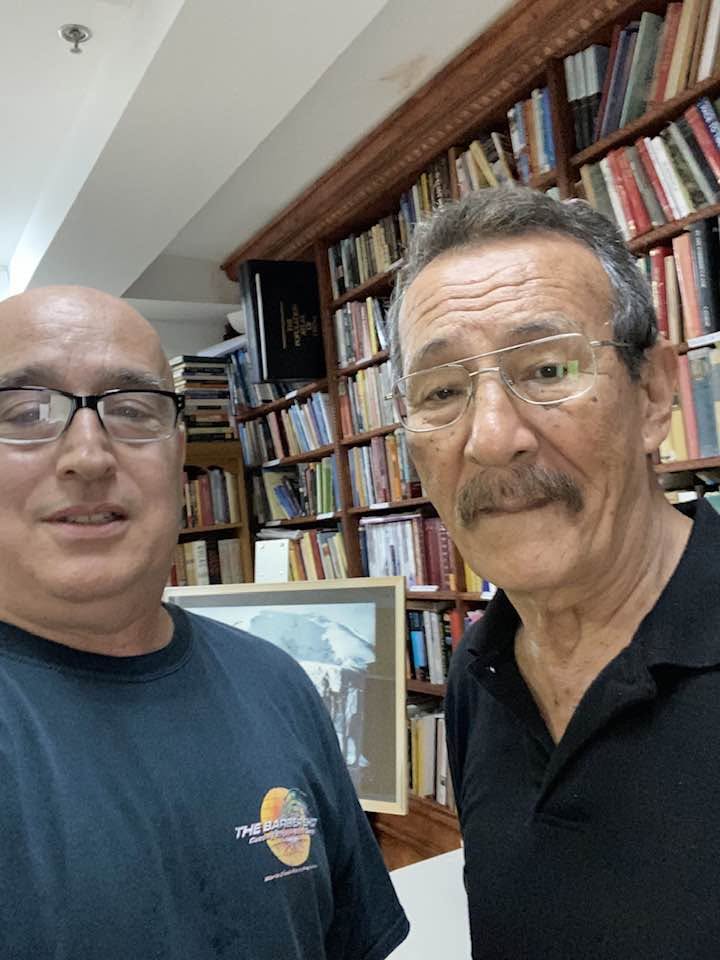
Photo: Tony Senatore and Jamyang Norbu: all rights reserved
When I think back to my years at Columbia University, from 2013 to 2017, one of the things I appreciate most is how profoundly the experience changed the way I look at the world. I entered Columbia with certain political assumptions and perspectives. I left with a much greater appreciation for the complexity of history, political institutions, and the competing interests that shape human affairs.
I studied sociology, but the education extended well beyond the classroom. I was exposed to ideas and historical interpretations that challenged some of my existing beliefs. I learned that understanding a political event requires considerably more than accepting the version presented by whichever government, political movement, or media outlet happens to share our worldview.
One of the most valuable lessons I took away was the importance of looking beneath the surface of political narratives. Who benefits? What are the underlying interests? Are governments acting according to the principles they publicly proclaim, or are those principles being subordinated to other objectives?
My interest in Tibet developed through my studies at Columbia, particularly through Professor Gray Tuttle, whose scholarship and teaching introduced me to the complicated historical relationship between Tibet and China. I became interested in understanding not only China’s historical claims to Tibet, but also the Tibetan people’s distinctive cultural identity, religious traditions, and experience with political independence.
That interest eventually extended beyond the classroom.
After graduating, I learned more about Jamyang Norbu through Professor Tuttle. Norbu is a prominent Tibetan writer, historian, and advocate of Tibetan independence. He was also connected to the Tibetan resistance movement and has devoted much of his life to preserving and documenting Tibetan history and culture.
I eventually had the opportunity to meet him.
Jamyang had established a library in Queens through his High Asia Research Center, an effort to preserve Tibetan history and culture and make it accessible to others. I wanted to contribute something meaningful to that endeavor, so I donated two items: a dramyin, a traditional Tibetan stringed instrument, and Will Durant’s The Story of Civilization, the entire eleven-volume series.
I thought those particular gifts were fitting. The dramyin represented the preservation of a distinctive cultural tradition, while Durant’s work represented the importance of understanding civilization through its history, philosophy, religion, and intellectual achievements.
It was a small gesture, but one that meant something to me. It connected the intellectual curiosity I had developed at Columbia with a person whose life and work were directly connected to the history I had been studying.
Meeting Jamyang Norbu also reinforced the idea that history isn’t simply something we read about in books. It is something people experience, sometimes at enormous personal cost. Preserving a language, a religious tradition, a musical instrument, or a historical record can become an important part of preserving a people’s identity.
A particularly fascinating example of the political complexities surrounding Tibet is the history of the CIA, the Tibetan resistance, and the eventual abandonment of American support during the Cold War.
During the 1950s, following China’s military intervention in Tibet, the CIA began supporting Tibetan resistance movements. This was not merely diplomatic encouragement. The United States provided weapons, money, intelligence assistance, and military training to Tibetan guerrillas. Some Tibetan recruits were secretly transported to the United States and trained at Camp Hale in Colorado. Others operated from bases in Nepal, conducting guerrilla activities and gathering intelligence inside Tibet.
The operation was extensive. At its height, the CIA supported approximately 1,800 Tibetan resistance fighters. The objective was to weaken China’s Communist government, disrupt its control over Tibet, and maintain the possibility of Tibetan autonomy under the Dalai Lama.
However, a larger geopolitical consideration drove American involvement: the Cold War.
Washington was attempting to contain the expansion of Communist influence throughout Asia. Tibet presented an opportunity to challenge Beijing without engaging in direct military confrontation with China. Supporting Tibetan resistance therefore fit within a broader American strategy of containing communism.
But this raises an important question: Was the United States genuinely committed to Tibetan independence, or was Tibet simply useful to American foreign policy?
The answer becomes considerably clearer when we examine what happened next.
By the late 1960s, the international political landscape was changing. The relationship between the Soviet Union and China had deteriorated, creating an opportunity for Washington to exploit their differences. President Richard Nixon and his national security adviser, Henry Kissinger, recognized the strategic value of establishing a relationship with Beijing.
In 1972, Nixon traveled to China and met with Mao Zedong. It was a historic diplomatic opening that fundamentally altered the balance of international relations.
Unfortunately for Tibetans who had spent years fighting with American assistance, their cause had become an obstacle to Washington’s new strategic ambitions.
The Nixon administration began dismantling the CIA’s Tibetan paramilitary program. In 1971, the guerrilla force was reduced from approximately 1,800 to 300 fighters. The remaining operation was subsequently wound down, and by 1974, the Tibetan guerrillas in Nepal were disarmed.
The American government’s own declassified diplomatic records make the reasoning remarkably clear. Nixon, Kissinger, the National Security Council, the State Department, and the CIA concluded that the Tibetan operation was ineffective and could interfere with improved relations with China.
Think about the implications.
Tibetan fighters had risked their lives, believing the world’s most powerful democracy supported their struggle. When American strategic interests changed, that support diminished and ultimately disappeared.
The United States had found a more important geopolitical relationship. Tibet was no longer worth the diplomatic price.
This is not an argument that American rapprochement with China was necessarily a mistake. There were legitimate strategic reasons for improving relations between Washington and Beijing, particularly given the deteriorating relationship between China and the Soviet Union.
But it does demonstrate the distinction between supporting a people’s aspirations and supporting a political movement because it happens to advance one’s own national interests.
There is an important distinction here that should not be overlooked. The United States never made an unconditional commitment to Tibetan independence. Its support for the resistance was largely an instrument of Cold War policy. When the strategic value of that operation diminished, so did Washington’s commitment.
That distinction is worth remembering whenever we hear governments speak about freedom, democracy, sovereignty, and self-determination.
Think about the Tibetan experience through the lens of sociology and political thought. China justified its actions through historical claims of territorial sovereignty and the promise of modernization. The United States justified its involvement through opposition to Communist expansion and support for Tibetan autonomy. Yet neither government’s stated objectives completely explain the consequences for the Tibetan people.
One government asserted its authority over Tibet. Another supported resistance until its strategic calculations changed. And the people caught between these competing interests were left to live with the consequences.
This is precisely why I believe a genuine university education should teach us to question, investigate, compare, and think independently. It should not simply provide us with a collection of accepted opinions or political conclusions.
It should make us uncomfortable enough to reconsider what we think we know.
I don’t believe that learning history requires us to automatically accept the American, Chinese, or Tibetan version of events. In fact, it requires quite the opposite. We should be willing to examine all three, distinguish documented facts from political interpretations, and reach our own conclusions.
My years at Columbia were among the most intellectually rewarding experiences of my life. The opportunity to study with professors such as Gray Tuttle, explore unfamiliar histories, and eventually meet people like Jamyang Norbu made the experience much more meaningful than simply earning a degree.
And perhaps that is the point I want to make.
A university education should give us more than knowledge. It should give us the intellectual independence to question the very institutions and governments that claim to represent our interests. It should encourage us to look beyond our immediate political loyalties and recognize that history is rarely as straightforward as we would like it to be.
Sometimes, the most important history lessons are not about who won or lost a particular conflict. They are about understanding why powerful nations make the decisions they do, and recognizing who ultimately pays the price.
Tibet reminds us that in international politics, principles and interests do not always travel together.
And that is a lesson I am grateful to have taken away from Columbia University.
Related Topics
Related Posts