
Tisha B’Av – One Day of Crying is Not Enough
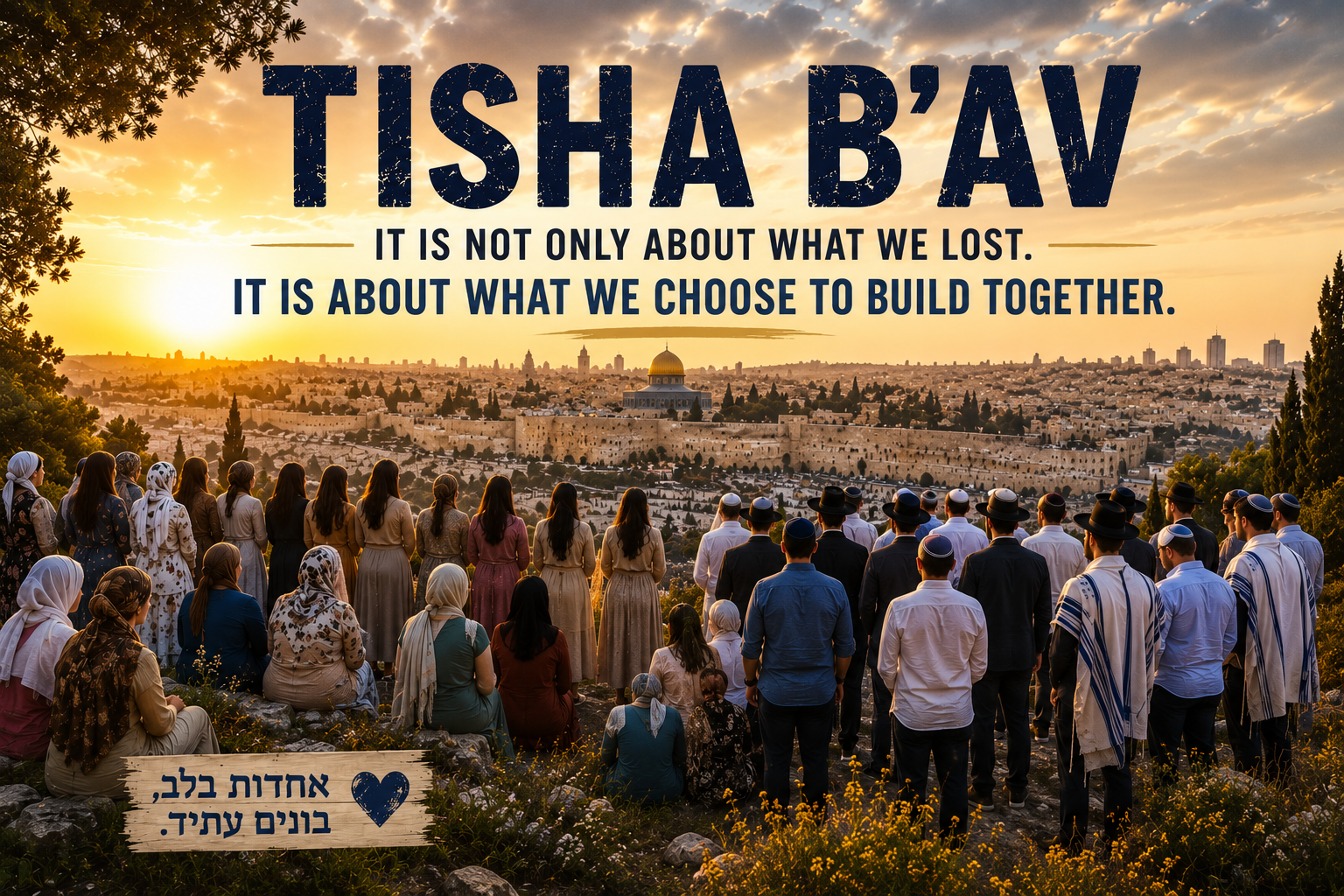
There is something profoundly right about Tisha B’Av. It is the one day each year when we stop as a people, fast, mourn and force ourselves to remember the immense suffering that has marked Jewish history. We recall the destruction of the Temples, our exile from the Land of Israel, the horrors of the ghettos and the pogroms, the sheer horror of the Holocaust, and the recent October 7 massacre. We do so not because these are distant historical events, but because they remain part of the story that defines us as a nation. Yet I cannot escape the feeling that something is missing from the way we observe the day.
Do we truly remember, or have we become so accustomed to the language of mourning that it has become almost ceremonial? We speak of destruction, of exile and of tragedy, but often as though these belong to another people in another age. Tisha B’Av is not simply about what happened to our ancestors. It is about understanding why those events happened, what they reveal about us as a people, and whether we have learned anything from them. If we leave the synagogue having shed a tear but return to exactly the same behaviour the following morning, then I wonder whether we have honoured the memory of our past or simply observed another religious ritual.
That question feels especially important as Israel approaches another election. Elections should be moments when ideas compete vigorously, but too often they become occasions when Jews question the legitimacy, motives or even the Jewish identity of other Jews. We seem increasingly willing to attribute the worst possible intentions to those who disagree with us, forgetting that long after the election is over, we remain one people with one shared future. If Tisha B’Av has anything to teach us, surely it is that internal division has consequences far beyond winning or losing the political argument of the day.
The Jewish people are remarkably small. Throughout history we have lived in a world where many have hated us simply because we are Jews, because of our faith or because of our homeland. That reality has never disappeared. What is far harder to understand is why, knowing our history better than anyone else, we sometimes choose to fight one another with a bitterness that seems entirely disproportionate. We can disagree passionately about politics, religion and the future of Israel, but when disagreement becomes contempt, we begin to weaken ourselves in ways that history repeatedly warns us against.
None of this is to deny that wrongdoing exists. Corruption must be confronted, injustice challenged and abuses of power exposed, even when they are committed by our own. Tisha B’Av is not a call to ignore uncomfortable truths in the name of artificial unity. Rather, it calls us to examine the spirit in which we confront those truths. There is a profound difference between holding one another to account because we care about the future of the Jewish people and attacking one another in ways that erode the trust on which every society ultimately depends.
The destruction of Jerusalem’s Temples is therefore much more than a historical event. It is an enduring warning that even a nation blessed with faith, learning and remarkable resilience can undermine itself from within. Our Sages taught that the Second Temple fell because of sinat chinam, baseless hatred. Whether we understand that literally or as a moral lesson, its relevance today is difficult to ignore. Civilisations rarely collapse overnight. They weaken gradually as suspicion replaces trust, as shared purpose gives way to factionalism and as people begin to see their opponents as enemies rather than members of the same family.
That is why unity can never be reduced to a political slogan or an aspiration reserved for times of crisis. It is woven into Judaism itself. We see it in the Haggadah, where every child, however different, remains part of the same conversation. We proclaim it each day in the Shema as one people standing before one G-d. Throughout Jewish tradition, our covenant has always been both individual and collective. We are judged not only by how faithfully we serve G-d ourselves, but by how responsibly we treat one another.
For that reason, I do not believe Tisha B’Av can be a day that we observe before putting it neatly behind us until the High Holy Days invite us to reflect again. If its message lasts only until we break the fast, we have missed its purpose entirely. It should shape the way we speak, the way we disagree and the assumptions we make about our fellow Jews throughout the year. It should remind us to give one another the benefit of the doubt before rushing to condemnation, to argue with conviction without abandoning respect and to remember that our common identity is infinitely more important than the political or ideological labels that divide us.
Perhaps that is the true challenge of Tisha B’Av. Not simply to mourn what previous generations lost, but to ensure that we are not creating the conditions for future generations to mourn us. The destruction of the Temples belongs to history, but the choice between unity and division belongs to us, every single day of the year. If Tisha B’Av changes the way we live during the other 364 days, then perhaps we have finally begun to understand what this most painful day in the Jewish calendar has always been trying to teach us.
I have to step up to this challenge. We all have to step up to this challenge. I wish you all an easy fast.