
"These fragments I have shored against my ruins"
Tiszaeszlár: Europe’s First Modern Blood-libel Trial
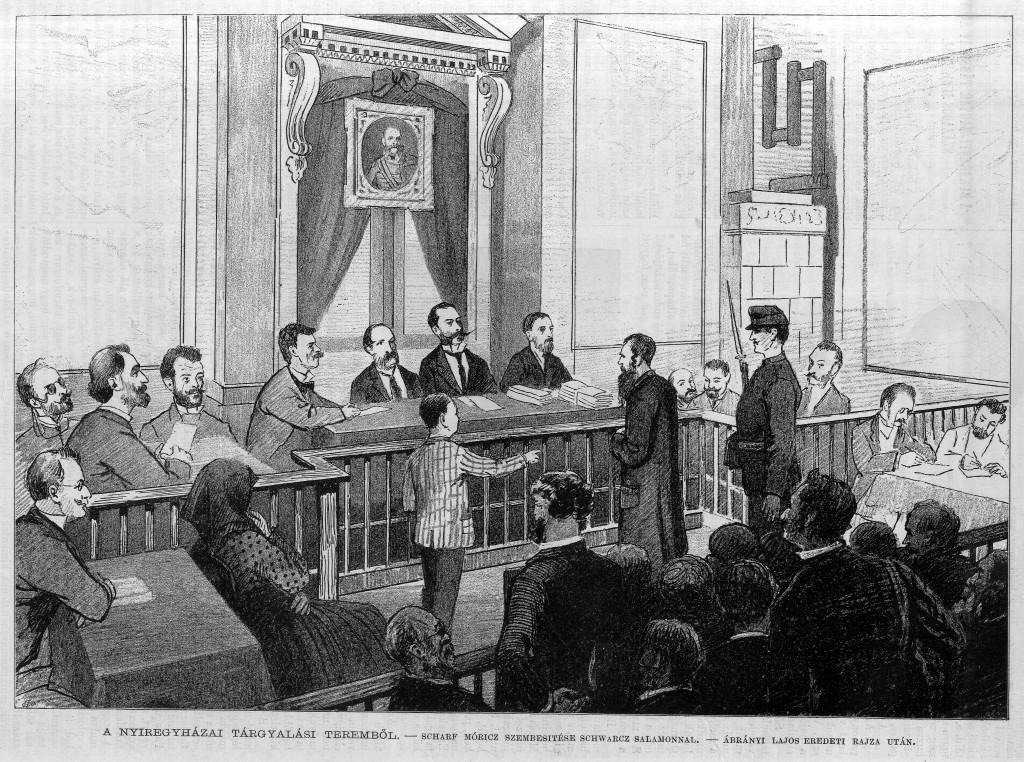
The Trial of the Tiszaeszlár Affair in 1883 (Vasárnapi Újság 1883 No. 28 - Public domain)
On a summer morning in 1883, Hungary proved its modernity. After sixteen months of fevered accusations, coerced testimonies, and national hysteria, a rural county court acquitted every Jewish defendant in what had become Europe’s first modern ritual-murder trial.
And yet, within days, the country was in flames.
Riots swept through towns from Bratislava to the Transdanubian countryside; martial law was declared in multiple counties; mobs attacked Jewish homes and shops; soldiers fired into crowds. By autumn, Hungary had produced something Europe had never seen before: an explicitly antisemitic political party, born directly from the agitation surrounding the case.
The acquittal was framed as a victory but in retrospect, it looks more like a warning — one that Europe failed to hear. Tiszaeszlár did not close a chapter of medieval superstition; it opened the door to a new, political form of antisemitism that would spread across the continent in the decades to come. Long before Dreyfus, long before Kishinev, a missing girl in a small Hungarian village revealed how fragile “modernity” truly was.
Eszter Solymosi left home on 1 April 1882 to buy paint for her mother and never returned. In most years, her disappearance would have been absorbed into the quiet, unremarkable tragedies of rural life, as young girls went missing with unsettling regularity in Szabolcs County: some ran away, some drowned, some simply vanished into the anonymity of poverty. At first, Eszter’s case appeared no different. Search parties combed the riverbanks, the fields, the surrounding villages but nothing pointed towards a crime, and certainly nothing towards the Jews.
The transformation of a missing-person case came not from evidence but from agitation. Two men — Géza Ónody, the village’s representative in Parliament, and Győző Istóczy, already notorious for his antisemitic crusades — saw in the uncertainty an opportunity. They began circulating the claim that Eszter had been murdered by local Jews for ritual purposes, drawing not on local knowledge but on the repertoire of blood-libel fantasies then circulating across Central and Eastern Europe. The Russian pogroms of 1881 had revived these narratives; Hungary, despite its self-image as a modernising state, proved receptive to them.
Eszter’s mother and aunt, overwhelmed by grief and surrounded by rumour, eventually adopted the accusation themselves. Their shift is often described as irrational, but it was entirely predictable. In moments of fear, the boundary between private loss and public myth collapses quickly. Once the accusation was spoken aloud, the local judge — already inclined to believe in ritual murder — opened a formal investigation.
The discovery of a drowned female body in the Tisza River on 18 June might have ended the affair. The corpse was dressed in Eszter’s clothes, and many villagers believed it to be hers. But the examining authorities declared that the body was not Eszter’s, a decision that only deepened the sense of conspiracy.
By the time Budapest newspapers began reporting on the case, it had already outgrown the village. The disappearance of a single girl had become a stage on which Hungary’s anxieties about modernity, identity, and social change were performing themselves. What had begun as a local tragedy was now a national referendum on who belonged, who was feared, and who could be sacrificed to restore a sense of order.
To understand why the Tiszaeszlár accusation ignited so quickly, it is necessary to look beyond the village and into the broader landscape of Hungary in the early 1880s. The country liked to imagine itself as a model of Central European progress: politically emancipated, economically modernising, culturally confident. The Austro-Hungarian Compromise of 1867 had ushered in a period of rapid development. Budapest was transforming into a metropolis; Jewish emancipation had been codified; liberalism was the dominant political language of the elite.
Beneath this self-image, however, the country was unsettled. Modernisation had created winners and losers, and the pace of change outstripped society’s ability to absorb it. The Jewish community — especially in Budapest and other urban centres — had become highly visible in commerce, the professions, and the press. Their success was often held up as evidence of Hungary’s progress, but it also made them a convenient symbol for those who felt left behind.
The situation grew more volatile after the assassination of Tsar Alexander II in 1881, which triggered a wave of pogroms across the Russian Empire. Thousands of Jews fled westward, many passing through Hungary. While most of them never intended to settle here, Hungary was only their route to the Western world or Palestine, their emergence intensified the fear of a “Jewish invasion”.
Their arrival overlapped with a much longer demographic shift: since Galicia’s incorporation into the Habsburg monarchy in 1772, chronic overpopulation, poverty, and limited economic opportunity had pushed tens of thousands of Jews southward into northeastern Hungary. The expansion of the railway network in the mid‑19th century made movement between Galicia and Hungarian cities like Miskolc, Debrecen, and Budapest far easier, accelerating a migration that had already been reshaping the region for decades.
Many of these migrants settled in rural areas and small towns, transforming the country’s Jewish population from roughly 83,000 in 1787 to more than 900,000 by 1910. Most were Orthodox or Hasidic, wore traditional clothing, spoke Yiddish as their primary language, and did not initially adopt Hungarian cultural norms. They were visibly different from the assimilated, Hungarian‑speaking Jews who had spent decades integrating into national life. Their presence unsettled local populations, who saw in them a reminder of the “foreignness” they had been encouraged to forget — and a convenient target for anxiety that had little to do with them.
This convergence — rapid modernisation, economic resentment, visible Jewish success, and the sudden arrival of Eastern refugees — created a climate in which old prejudices could be revived with surprising ease. The blood libel did not return because Hungary was medieval or uniquely superstitious, but because, like much of Europe, it was modernising unevenly. In moments of instability, the oldest myths often feel like the most reliable explanations.
The accusation against the Jews of Tiszaeszlár did not emerge from a vacuum but from a society caught between aspiration and fear, eager to see itself as enlightened, yet, deeply susceptible to narratives that promised clarity in moments of uncertainty. In that sense, the case was not an aberration but a symptom: a sign that the country’s confidence in its own progress was far more fragile than it appeared.
Blood libels – alongside those of well poisoning and host desecration – became a major theme of the persecution of Jews in Europe in the medieval period, from as early as the 12th century. While the latter two mostly disappeared in Western and Central Europe by the end of the Middle Ages, ritual‑murder accusations re‑emerged in the 19th century and have never fully vanished.
In Eastern Europe, the pattern unfolded later and differently. Blood‑libel accusations began spreading to Poland in the 16th century and to Lithuania and Romania by the 18th, before finally reaching the Russian Empire in the 19th, where the first wave of pogroms broke out in April 1881, just after Easter.
These false accusations claiming that Jews kill gentile children in order to use their blood in performing their religious rituals were considered anachronistic, retrograde and most of all, unsubstantiated by many in modern Europe, thus their re-emergence and the answers given to them had serious effects on societies.
Blood libels follow a recognisable structure; a set of recurring elements that surface whenever a society is strained and searching for a narrative capable of converting anxiety into certainty. The details change; the underlying mechanics do not. What happened in Tiszaeszlár followed a pattern rehearsed for centuries.
The first element is subconscious prejudice: a dormant, inherited belief that Jews are capable of ritual murder. It rarely operates at the level of explicit conviction. Instead, it resides in the realm of communal memory and inherited suspicion, waiting for a moment of activation. In Hungary, as in much of Central Europe, this knowledge had lain largely dormant for centuries, but it had never disappeared.
The second element is collective agitation, what Mikhail Bakhtin might describe as a carnivalesque atmosphere. Most blood libels in Europe erupted around Easter, when the Christian calendar itself encouraged emotional intensity. The Passion narrative, the rituals of mourning and accusation, the symbolic re-enactment of the crucifixion; all contributed to an environment in which old myths could be revived with alarming ease. In 1882, the timing was perfect: Eszter disappeared just days before Passover and Easter, when the boundary between religious memory and contemporary fear was already thin.
The third element is pseudo-scholarship: the centuries-old literature purporting to document Jewish ritual murder. Written by priests, polemicists, and self-appointed experts, these texts provided a ready-made vocabulary for interpreting events. They offered “explanations”, diagrams, testimonies, and fabricated ethnography. In moments of uncertainty, they supplied the illusion of knowledge.
Yet, these three elements alone are insufficient. They require an activating figure; someone capable of linking subconscious prejudice, collective agitation, and pseudo-scholarship into a coherent accusation. In Tiszaeszlár, that role was played by men such as Ónody, Istóczy, and Judge Bary. They were not merely opportunists; they were interpreters. They translated fear into narrative, rumour into evidence, and uncertainty into indictment. Without them, the case might have remained a local tragedy. With them, it became a national crisis.
Tiszaeszlár followed this pattern with almost clinical precision. This structure endures because it reveals something uncomfortable: blood libels do not depend on ignorance alone. They depend on a society’s willingness to let old stories explain new fears; on individuals who know how to turn anxiety into accusation; and on the absence of a counter-narrative strong enough to interrupt the process.
By the time the trial opened in Nyíregyháza in June 1883, the case had already ceased to be about Eszter Solymosi. It had become a referendum on what kind of country Hungary believed itself to be. The courtroom was not merely a legal space; it was a stage on which two competing visions of the nation were performing themselves.
The Tiszaeszlár affair, as the first modern blood-libel prosecution in Central Europe, led to widespread questioning of the compatibility of the trial of a blood libel case and a modern, civilised culture. The case had already grown beyond itself, becoming a symbol even before the lawsuit was filed. In the House of Representatives, the liberal majority clashed with the emerging antisemitic movement led by Győző Istóczy, and newspapers tried to point out new aspects, adding their own version of events. The stakes were on the one hand the immigration of the Jews and their successful assimilation (in the worst case, the “reversal” of emancipation), but behind all this there was the question of how the country’s civilisation and development would continue to develop in the future.
For the liberal establishment, the trial offered an opportunity to demonstrate that Hungary belonged to the modern world. The country had spent the previous decade celebrating its progress; its new capital, its expanding press, its emancipated Jewish community. A blood-libel prosecution threatened that self-image. A conviction would have marked Hungary as backward and superstitious, unfit for the company of “civilised” nations. An acquittal, by contrast, promised reassurance that reason still governed public life.
For the emerging antisemitic movement, the trial meant something entirely different: a chance to prove that the state was unwilling to defend Christian society against an alleged internal threat. Ónody and Istóczy had already framed the case as a test of national loyalty. In their telling, the Jews were not simply defendants; they were symbols of a deeper corruption, protected by a liberal elite that had lost touch with the “real” Hungary.
Inside the courtroom, the prosecution’s case collapsed almost immediately. Testimonies extracted from children under pressure unravelled; forensic evidence contradicted itself; the alleged ritual details bore no resemblance to Jewish practice. Judge Bary’s investigative methods, shaped by his own convictions, could not withstand scrutiny. By the time the verdict was delivered on 3 August, acquittal was inevitable.
The reaction was revealing. Liberals hailed the verdict as a triumph of reason over superstition, proof that the country belonged among the enlightened nations of the West; newspapers celebrated the rule of law; politicians spoke of progress; Jewish communities, exhausted by sixteen months of fear, exhaled in relief.
While the acquittal and release of the accused was considered as a victory of common sense and a modern, progressive Hungary by many, outside the courtroom, however, the verdict landed differently. For those who had already accepted the accusation as truth, acquittal did not signify innocence but conspiracy. If the courts would not punish the Jews, then the public would. The gap between legal judgment and popular belief — between what could be proven and what felt true — became the fault line along which the country fractured.
Considering the aftermath — the domestic riots, the strengthening of antisemitic sentiments and consequent founding of Europe’s first antisemitic party, and the spread of similar accusations and pogroms across Europe — the acquittal retrospectively proved a Pyrrhic victory.
The trial had been framed as a test of Hungary’s modernity. In the end, it revealed something far more unsettling: that a modern legal system can deliver a rational verdict, and a society can still choose myth over evidence.
The acquittal did not resolve the case but detonated it.
Related Topics
Related Posts