
To infinity and beyond: The wisdom of Toy Story
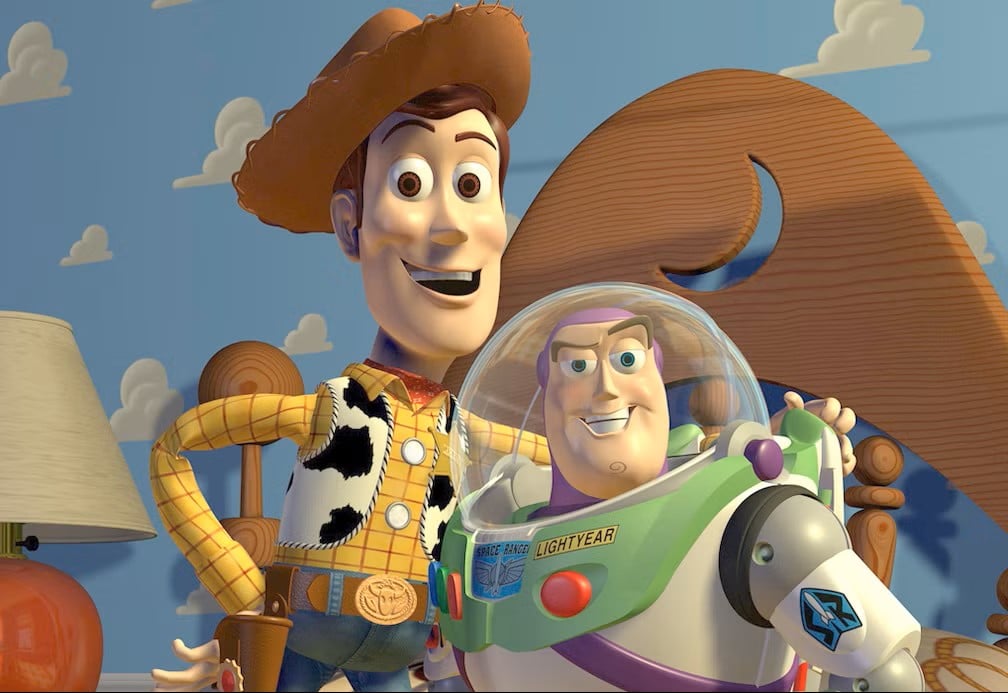
This Father’s Day arrives with the most wonderful gift: a new “Toy Story” movie.
“Toy Story 5” opened in theaters this weekend, sixteen years after I took my five-year-old son, Joseph, to see “Toy Story 3”. At the time, Joseph loved all things “Toy Story.” He walked in Buzz Lightyear light-up shoes, slept in Woody pajamas beneath Buzz Lightyear sheets, and surrounded himself with Woody, Buzz, Rex, Slinky Dog, Mr. Potato Head, and his soul tater-mate, Mrs. Potato Head. For him, “Toy Story” was a way of life.
For me, Toy Story 3 became something else entirely. While most people saw a movie about Andy growing up and leaving his childhood behind, I found myself watching from the perspective of the toys. I empathized with Woody and Buzz waiting on the shelf, hoping to be noticed, yearning to be played with one more time.
As the movie unfolded, I felt a lump in my throat. Then the floodgates opened. I wept behind my glasses. What kept me from audibly sobbing was that we were at a crowded cineplex and I did not want to bother the people around us. At one point, I wished my 3-D glasses came with windshield wipers.
What moved me was not so much growing up as growing apart.
Just a few days before we saw the third installment in 2010, Joseph altered our school drop-off routine. For years, my wife or I would walk him to school, remove his knapsack, hang up his coat, and receive a hug and a kiss before he entered the classroom.
Then one morning, he ran inside MDS without looking back.
No hug. No kiss.
I knew this growth was natural and that more changes were on the horizon. His first steps toward independence required me to begin letting go. But even welcomed growth carries loss.
Looking back, it was only the beginning.
The five-year-old in Buzz Lightyear sneakers is now 21-year-old college student at the University of Maryland. And his younger brother recently graduated from SAR High School. Our sons are no longer little boys reaching automatically for my hand at the corner. They are young men with ideas, ambitions, friendships, obligations, and paths of their own to tread.
And yet, when I close my eyes, I can still feel their small hands inside mine as we crossed the street.
For most of parenthood, change announces itself through firsts: a first word, a first step, a first day of school, a first time driving alone, and the first move-in day at college.
But the end of childhood often arrives through lasts that we do not recognize while they are happening. The last time a child asks to be carried. The last bedtime story. The last time everyone lives together under one roof and assumes that this is simply what life will be forever.
It is not always clear when these moments are taking place. We move through the routines of family life without realizing that some of our most precious rituals are quietly disappearing before our eyes. Until one day, you wake up as empty nesters.
Parenting young children gives us the illusion that love and usefulness are the same thing. Our kids need us for almost everything: food, clothing, transportation, reassurance, entertainment, protection, and the location of the toy sitting directly in front of them.
Then, gradually, they learn to do these things without us. Our children choose what to tell us, when to call, how long to stay, and how much of their inner lives to reveal.
We begin as protectors and playmates. Then we become chauffeurs, coaches, homework consultants, disciplinarians, and sometimes, as hard as it is to believe, embarrassments.
There are years when our advice is requested, years when it is tolerated, and years when it appears to violate some fundamental principle of adolescent self-government.
Eventually, one hopes, we become advisers. Perhaps even confidants.
But the transition is not automatic.
In 2010, I worried that parents were like beloved toys their children would eventually outgrow. There was truth in that concern. My sons no longer need me to tie their shoes or make “special hot chocolate” on Shabbat morning.
But I no longer believe that children simply outgrow their parents. They reassign us. My challenge is to accept each new assignment instead of clinging to the old one.
Last year when my older son was home during winter break, I told him to be home by a certain time. With as much politeness as he could muster, he reminded me that he lives in an apartment on campus several hundred miles away and normally sets his own schedule.
He was right. The child whose schedule I once controlled was now a young man setting his own. My role had changed again, regardless of whether I was ready for this parental reorientation.
Woody’s greatest struggle throughout the “Toy Story” films is not simply that children grow up. It is that his entire identity has been built around being needed by a child. When that need changes, he must determine whether he still has value and purpose.
Parents confront a similar question: Who are we when our children no longer need us in the ways that once organized our lives as much as theirs?
Our task is to remain present without standing in their way. To offer guidance without insisting that they follow it. To let them know that we are available without requiring them to prove that we are still necessary.
Sixteen years ago, I cried at “Toy Story 3” because I saw myself as Woody and Buzz, fearing that the child I loved would leave me behind.
Today, I understand that fatherhood is not about remaining indispensable. It is about knowing when to hold our children’s hands, when to release them, and how to remain close once they are walking on their own.
Letting go, I have learned, is more than one moment at a graduation ceremony. It is a bittersweet practice unfolding over several years.
This Father’s Day, I find myself thinking less about what my sons once needed from me and more about what kind of father I hope to be now.
With gratitude to my wife and to G-d, I am deeply proud of the men my sons have become, and I love them both to infinity and beyond.