
‘To My Beloved Marylka’: A Jewish Child’s Blessing to the Sister Who Saved Her

A hidden child’s First Communion card revealed a private message between two Jewish sisters hiding as Catholic girls.
The card is small enough to lose. It has been folded, softened, stained by time or water or hands. Its die-cut edges are worn to felt. On the front is a First Communion image: Jesus with the chalice, framed by the swooping lines of Art Nouveau, the kind of card pressed by the thousands into the hands of Polish children on the day they first took the host. A small hole at the top suggests it once hung somewhere. On a wall. Over a bed. Near enough to see every day.
For seventy years it lived in my mother-in-law’s bedroom drawer, among the rosary prayers and holy cards of a Catholic girlhood. Edna called them the paraphernalia of the faith that saved her life. When I began cataloguing her collection, I assumed this card was like the others: a blessing given to her. A kindness extended to a Jewish child by people who never knew who she really was. The nuns who taught her. The classmates who loved her. The Pope who decorated her. Sister Joanna, whoever she was, who gave a twelve-year-old a keepsake of the Queen of Poland. All of them blessing a girl who, on paper, did not exist.
Then I turned the card over.
“This was not a blessing given to the hidden child. It was a blessing written by her.”
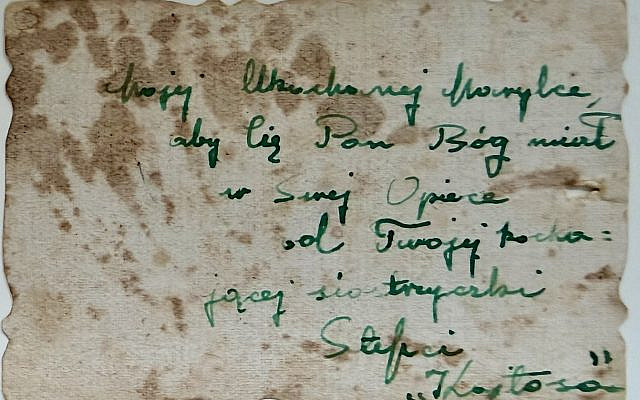
The reverse, in Stefcia’s hand. Green ink, Polish, wartime. Brill family collection.
Green ink. Polish. A child’s careful, looping hand:
Mojej ukochanej Marylce — aby Cię Pan Bóg miał w Swej opiece. Od Twojej kochającej siostrzyczki, Stefci — “Kajtusi.”
To my beloved Marylka: may the Lord God keep you in His care. From your loving little sister, Stefcia. And then, in quotation marks, a code name. Softened, if the letters read as I believe they do, into its tender Polish diminutive: Kajtuś. Not the hard nom de guerre the Home Army knew, but the storybook form of it, the wizard-boy’s name from Janusz Korczak’s Kajtuś Czarodziej.
Every other object in that drawer seemed to run in one direction: toward Edna. This card ran the other way. Stefcia wrote it. My mother-in-law, the hidden child, the girl the world was blessing in ignorance, had written a blessing of her own. And she gave it to the one person on earth who knew exactly who she was.
Because Marylka was not a classmate. Marylka was not a convent friend. Marylka was Miriam.
“Marylka was Miriam: the older sister who saved Edna’s life, and the one person who knew who she really was.”
Miriam was Edna’s older sister. She was the one who pulled five-year-old Edna out of the rubble when the first bombs fell on a birthday party in Warsaw. She was the one who shielded her on the Aryan side. She was the one who, when a Gestapo officer pressed a gun to her head at Aleja Szucha 25 and ordered her to sing to prove she was Polish, sang note-perfect and walked out with a bargain that saved them both.
But Miriam could not be Miriam on the Aryan side any more than Edna could be Edna. Miriam became Marysia. Marylka. A Polish Catholic name, a piece of armor with a dead girl’s baptism record behind it.
So look at what this card actually is: two Jewish sisters, hidden inside Catholic names, blessing each other through the language that kept them alive. Marylka was Miriam. Stefcia was Edna. The God invoked on the card was the God of their disguise. Even in tenderness, the cover held.
The signature held the same double life. Stefcia was the Catholic orphan. Kajtek, or Kajtuś, was the nine-year-old courier and soldier of the Polish Home Army. The quotation marks around the code name matter. They make the name both secret and declared, both childlike and dangerous.
They had learned the first law of hidden children so completely that it governed even their love: never, ever admit who you are. Not aloud. Not on paper. Not even to each other.
Except for one word.
Siostrzyczka. Little sister.
“Everything else on the card was armor. ‘Little sister’ was the one name Edna never had to fake.”
The names were armor. The Lord God was armor. But little sister was not a disguise. It was the one thing on the card that was true in both of their lives, in every language, under every name. Marysia and Stefcia were fictions. Kajtek was a mask. The little sister was real. In four syllables of Polish diminutive, Edna signed the only name she never had to fake.
I keep thinking about that signature, the code name in quotation marks, as if the child knew the name required them. She used it once more that we know of, in November 1946, in the Vatican itself. While Pope Pius XII prepared to bless a Catholic war hero he did not know was a Jewish child, she slipped a penknife from her pocket and carved KAJTEK into the door molding.
The secret name, left on the world in her own hand. Twice, then. Once scratched into Vatican wood, where no one would know whose it was. And once written in green ink, where one person would.
Miriam survived the war. The war never released her. She endured what no young girl should ever have to survive, and she carried it across a sea and into a new country and through a marriage and into the years when she was finally, officially, safe. In Tel Aviv, long after the danger had ended, the wounds the war left behind won the longer battle. She had saved her little sister. In the end, she could not save herself.
Somewhere along the way, we do not know when or how, the card returned to Edna. The blessing she had written for her sister came home to the drawer and stayed there, beside the holy cards and the Pope’s photograph, for the rest of her life.
Edna carried Miriam in other ways, too. She wore a small gold profile on a necklace: a granddaughter named Mia, M for Miriam, a child’s face answering a sister’s absence. She carried her twice. Once in gold, against her skin, where the world could not see it. Once in green ink, in her own child’s handwriting, in a drawer she opened who knows how many times across seventy years.
I used to think of that card as a prayer that had not been enough.
Perhaps that is wrong. Perhaps the prayer was enough for exactly what a prayer can do. May the Lord God keep you in His care. A hidden Jewish child asked the God of her disguise to protect the sister who had protected her, and Miriam did walk out of Aleja Szucha. She did survive Wola and the camps and the war that murdered nearly everyone else they loved. The blessing held as long as blessings hold. What came after was not the failure of a little sister’s prayer. It was the price of everything the prayer had been written inside of.
There is a photograph of the two of them from the Israel years: arm in arm outside a white house, summer dresses, squinting into the light, mid-laugh. Two young women who look like any two sisters anywhere in the world. That, of course, is the whole point. Everything it cost to stand in that ordinary sunlight is written on the back of a Communion card in a drawer an ocean away.
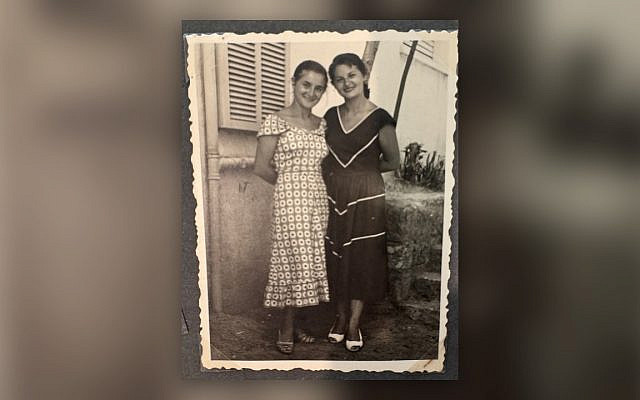
Edna, left, in the light dress, and Miriam — Marylka and her little sister — Israel, early 1950s. Brill family collection.
Every artifact Edna kept tells the same story from a different angle: the kindness she received was real, and it was given to a girl who did not exist. This card is the exception and the proof. The kindness did not only flow toward the hidden child. She learned the blessing so well that she could give it, in the language of her armor, in the name of her cover, to the truest person she had.
“ To my beloved Marylka. From your little sister.” The armor is what history sees. The love is what the drawer kept.
–
Janet Bond Brill, PhD, is the author of Little Edna’s War, based on her mother-in-law’s Holocaust testimony, published on January 27, 2026, on International Holocaust Remembrance Day. Order Now.