
CFO | Empower Society for Good I Author
To See Jerusalem: Simchat Torah, Assassination, and the Soul of Civilisation
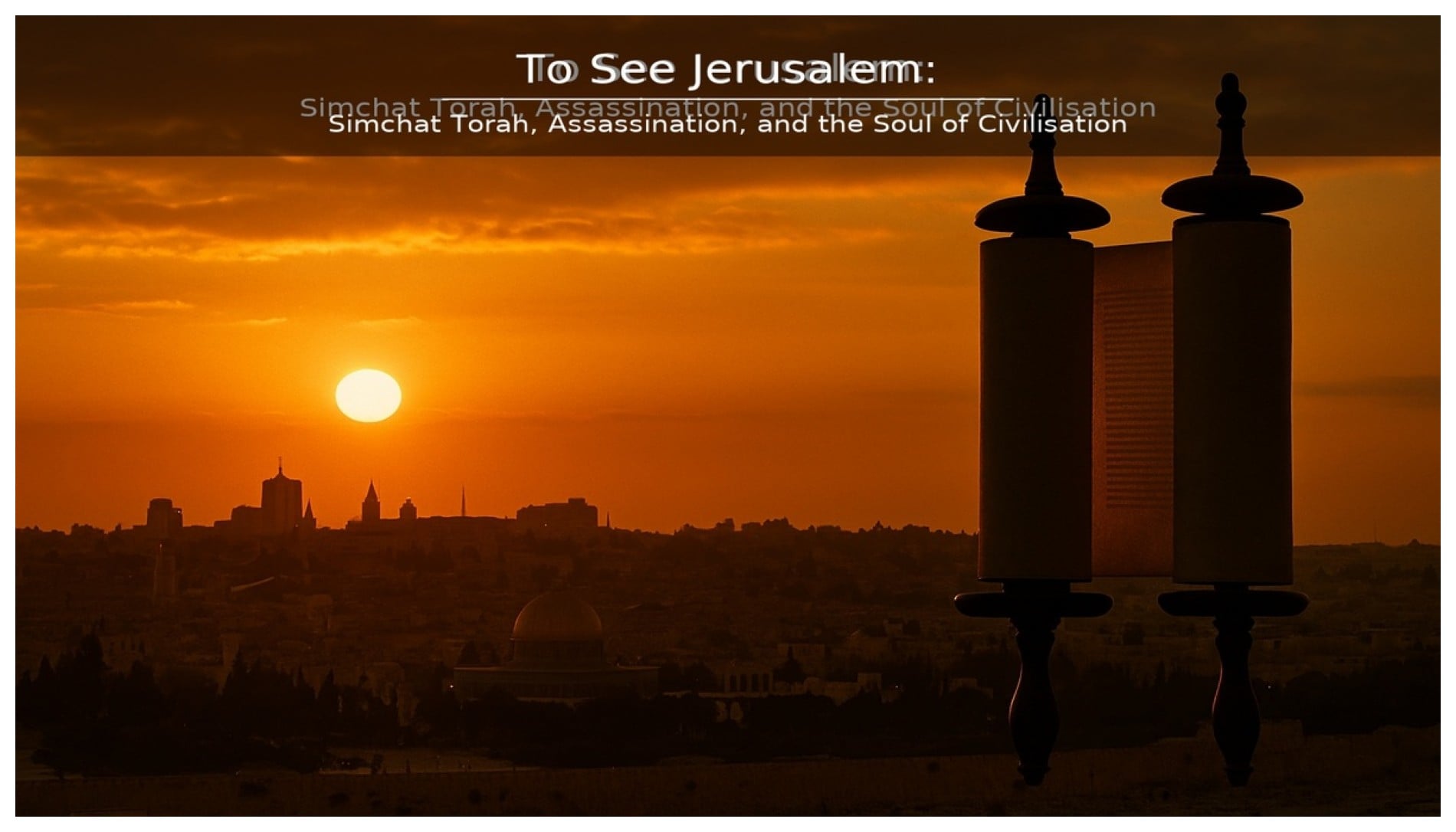
(AI-generated.)
A Journey from Assassination and War Toward Moral Clarity, Faith, and the Future of Civilization
There are moments when civilisation itself trembles — when the line between good and evil blurs, and humanity loses its moral compass.
Assassinations, terror, and ideological hatred have always tested societies, but rarely has the struggle for moral clarity felt as urgent as it does today.
The West once stood for freedom and truth, yet today those very ideals are under assault — not only from physical enemies, but from within.
We see crowds marching on the anniversary of October 7, chanting slogans that glorify terror while ignoring the suffering of Israeli victims.
As a Jew, I cannot watch these scenes without deep anguish.
It is not only the physical threat that is disturbing — it is the moral sickness that allows people to justify or celebrate evil in the name of “justice.”
Violence, as history has shown us, never heals. It corrodes.
The assassination of Lincoln, the murder of Kennedy, the silencing of Martin Luther King Jr., and Archduke Ferdinand’s in 1914 — each moment marked the unraveling of moral order, not its renewal.
Yet the leaders we reflect upon — Lincoln, King, and others — drew their deepest inspiration from Moses and the Bible.
They saw in Scripture a vision of moral law and human dignity that transcended politics and power.
Their strength flowed from the same well of truth that shaped Western civilisation — the belief that man is created in the image of God, and that freedom must be grounded in faith and righteousness.
From Moses gazing across the Jordan to Dr King’s final words on the eve of his death, there runs a single thread of faith and vision — a call to choose life, conscience, and civilization over hate.
To “see Jerusalem,” as Lincoln once wished in his final words, is not simply to behold a city of stone, but to glimpse the possibility of a world guided by truth and divine purpose.
That vision — moral, spiritual, and profoundly human — is what this essay seeks to explore.
Part 1: Assassination and Its Cost
I’ll admit — I had never heard of Charlie Kirk prior to his assassination.
But as the news broke, it made me reflect on the moral consequences of violence.
Assassinations — whether of Lincoln, Kennedy, Martin Luther King Jr., or Archduke Franz Ferdinand — have never healed societies.
They only deepen division, destroy trust, and leave civilizations wounded.
Lincoln’s final wish to see Jerusalem, King’s mountaintop vision, and Kennedy’s admiration for Israel reveal something profound: leaders guided by moral clarity can illuminate the path for their nations, but when violence silences them, that light dims — sometimes for generations.
The great leaders of history did not invent moral vision; they inherited it from Moses and the Bible.
Their courage was shaped by the eternal truths of justice, mercy, and human dignity first revealed through the Torah.
World War I began with the assassination of Archduke Franz Ferdinand in June 1914, showing how one violent act can unravel an entire continent, leaving millions dead and moral foundations shattered.
History proves that assassination does not renew society; it corrodes it.
Part 2: How the West Can Save Itself
The West is at a crossroads. As Melanie Phillips writes in The Builder’s Stone, the erosion of Judeo-Christian foundations has created a moral and spiritual vacuum, leaving society adrift.In her view, Western civilization can only survive by returning to these roots — embracing truth, ethics, and responsibility, and forming a “coalition for civilization” that upholds these values.
Charlie Kirk’s message echoes this imperative: freedom, faith, and responsibility are inseparable.The moral clarity he advocated — even amid controversy — reminds us that societies cannot thrive when they abandon enduring principles.
Josh Hammer, in his forthcoming book Israel and Civilization, extends this vision, describing a movement underpinned by Kirk’s ideas: one that sees the West not merely as a collection of nations, but as a moral project rooted in enduring truths.The movement calls for renewed commitment to justice, history, and faith — a necessary framework if Western civilization hopes to endure.
If the West hopes to survive and flourish, it must recognize that it is in a moral war: not against one nation or ideology, but against relativism, nihilism, and the erosion of ethical anchors.
Reclaiming Judeo-Christian principles, valuing family, and protecting truth are not optional; they are survival strategies.
Part 3: Spiritual Guidance from Parashat Zot HaBerachah
This moral and spiritual struggle finds its highest expression in Parashat Zot HaBerachah, which we read on Simchat Torah. Moses’ final blessing to the tribes of Israel before his death. Standing on Mount Nebo, he looks across the Jordan to the Promised Land — a vision he will see but never enter. It is the culmination of a life of faith, struggle, and moral leadership.
Just one week earlier, in Ha’azinu, Moses sang his final song — calling heaven and earth as witnesses, warning Israel not to forget its moral foundations.
Together, Ha’azinu and Zot HaBerachah form a symphony of truth and blessing — a call to remember that power must serve purpose, and freedom must serve faith.
The leaders we reflect upon — Lincoln, Kennedy, and King — each carried echoes of that Mosaic vision. Their words of moral courage and human dignity were rooted in the Bible’s eternal truths: that justice must flow like water, that liberty is sacred, and that righteousness exalts a nation.
Western civilization can learn from Zot HaBerachah: it must not abandon its spiritual inheritance. Just as Israel was blessed with a mission to uphold ethical and divine values in the world, the West must recognize that its survival depends on faith, clarity, and courage in the face of moral chaos.
Misplaced morals and compassion cannot guide. Assassination cannot teach. Power without principle leads only to ruin.
Civilization, like Moses’ people, must choose the path of wisdom, ethics, and enduring values if it hopes to see its own “Jerusalem” — a society redeemed, purposeful, and resilient.
Part 4: Zot HaBerachah, Simchat Torah, and the Reality of War
On October 7, 2023, the secular date coincided with the holiday of Simchat Torah, when the Torah portion Zot HaBerachah is read — the closing words of the Torah and the completion of Moses’ mission.
It is a moment of reflection, of moral clarity, and of seeing the covenant and purpose of Israel as enduring and unshakable.
That day, the world witnessed a horrific reality: Hamas terror, brutality, and rape — crimes that, shockingly, some sought to justify or excuse.
Even the assassination of figures like Charlie Kirk, a man advocating moral clarity and the defense of Western values, was defended by certain voices.
The lesson is stark and undeniable: this is a real war.
Not just a geopolitical conflict, but a war of civilizations, values, and truth — a war over the soul of humanity, over whether moral order, compassion, and faith will endure in an age of chaos.
The Moral Sickness of Our Time
What sickens me most is to see crowds marching under the banner of “justice” while celebrating murder, war, and the death of Jews.
On the anniversary of October 7, the very day that marks the massacre of Israeli civilians — families, children, and the elderly — protesters in Western capitals filled the streets not to mourn, but to glorify the killers.
They waved flags of a terror organization, chanted for the elimination of Israel, and ignored the grotesque crimes of Hamas — a group that burned families alive, raped women, mutilated bodies, and still holds innocent hostages in underground tunnels.
That such demonstrations could take place in free societies, under the language of “liberation,” is a moral collapse of staggering proportions.
As a Jew, as a human being, I find this unbearable.
The sight of people cheering the destruction of Israel and denying the humanity of its victims is not a political expression — it is a spiritual sickness.
It reveals how far much of the West has drifted from moral clarity.
A civilization that cannot condemn evil, that cannot tell the difference between murderers and their victims, between defense and barbarity, between civilization and terror — that civilization is in peril.
The war we face today is not only fought with rockets and guns; it is a war for truth, conscience, and the soul of humanity itself.
As Zot HaBerachah concludes, Moses ascends Mount Nebo.
He looks out over the Promised Land, knowing he will not enter it, yet content that his people will carry forward the mission.
It is not a story of defeat but of transcendence — of faith strong enough to see what lies beyond one’s own lifetime.
Centuries later, Dr. Martin Luther King Jr. stood before a nation divided and said:
“I’ve been to the mountaintop. And I’ve looked over, and I’ve seen the Promised Land.
I may not get there with you. But I want you to know tonight that we, as a people, will get to the Promised Land.”
What makes King’s words even more prophetic is that he spoke them on the last night of his life — April 3, 1968 — just hours before his assassination.
Like Moses, King stood on his own Mount Nebo, gazing toward a vision of moral redemption that he would not live to see.
His message remains timeless: civilization endures not through power, but through moral clarity, faith, and courage.
Today, as Israel defends itself and the West faces moral confusion, we are again called to the mountaintop — to see beyond fear and politics, to envision the Jerusalem of peace, justice, and divine purpose.
To “see Jerusalem,” as Lincoln once wished, is to perceive the ultimate civilization — where ethics guide strength, truth conquers hate, and humanity walks humbly with God.
That vision, from Mount Nebo to Memphis, from Moses to Martin Luther King, must become the soul of our civilization once more.
The Vision of Jerusalem — For All Nations
There is an essential distinction between Judaism and Islam, one that defines the moral and spiritual vision of Jerusalem.
Judaism does not seek to conquer the world in God’s name — it seeks to inspire it.
In Jewish prayer, we ask that all nations may call upon God, each in their own way, and that peace and justice will fill the earth.
That is Jerusalem — not as an empire, but as a moral center.
It is a city that prays not for uniformity, but for unity; not for submission, but for sanctity.
In every Amidah prayer, Jews turn toward Jerusalem and ask for a time when “all humanity will form a single fellowship to do Your will with a full heart.”
This is the vision of Jerusalem today — and the hope for its future:
A city that calls the world not to one religion, but to one God of justice, mercy, and truth.
Where the nations, as Isaiah foretold, “will beat their swords into plowshares,” and the House of the Lord will stand as a light to all peoples.
Author’s Reflection — The Soul of Israel
From Jerusalem, I see that both Moses and Dr. King looked beyond themselves — they saw a future built not on vengeance or victimhood, but on vision and virtue.
Each, in their own generation, pointed us toward a moral horizon where justice and compassion meet under God’s gaze.
To “see Jerusalem” is not only to behold a city, but to glimpse the possibility of civilization redeemed — where courage replaces cynicism, and faith rekindles hope.
As we stand in the shadow of violence and the noise of confusion, the call of Mount Nebo still echoes:
Hold fast to faith, walk humbly with the truth, and never stop yearning to see Jerusalem.
Related Topics