To the Claims Conference: I am not a Holocaust survivor
REVISED CLARIFICATION: Since the original publication of this article, it has come to my attention that the Claims Conference wanted me to make some corrections. Corrections will appear in Bold and Underlined.
To the Claims Conference,
I am writing this letter not out of anger, but out of genuine concern—and with respect for the vital work you do.
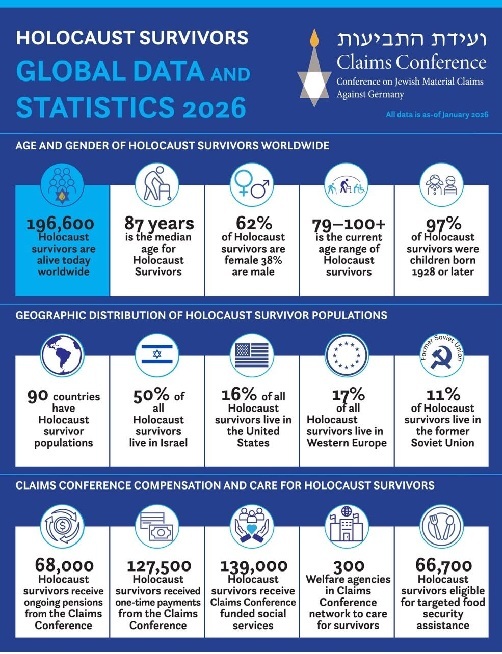
Recently, you shared data on social media titled “Holocaust Survivors – Global Data and Statistics.” This information is important. More than eighty years after the end of the Holocaust, the number of living survivors continues to decline, and most of those remaining were children during the Shoah. They are, quite literally, the youngest of the final witnesses.
Because of that reality, accuracy matters deeply. In an era when Holocaust denial and distortion persist, we must be especially careful to get the facts right.
My concern centers on one specific data point in your graphic: the statement that the current age range of Holocaust survivors is “79–100+.” I previously wrote to you twice to point out what appears to be an error. A person who is 79 or 80 years old today was born in 1946 or 1947—after the war had ended. By definition, such an individual could not be considered a Holocaust Survivor.
The Claims Conference said this only applies to persons conceived in January or February 1945 (their argument would extend to May 1945, the last month of the War). That means they still would have been born after the War. This does not make their argument stronger.
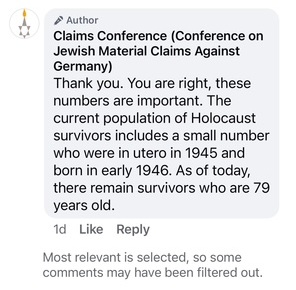
Your response to my second inquiry troubled me more than the original post. You wrote:
“Thank you. You are right, these numbers are important. The current population of Holocaust survivors includes a small number who were in utero in 1945 and born early 1946. As of today, there remain survivors who are 79 years old.”
Taken at face value, this suggests that individuals born after the war are now being classified as Holocaust survivors. A 79-year-old today would have been conceived in 1946—a full year after the war ended. On what basis, then, are they included as Holocaust Survivors?
The Claims Conference wrote: “Our definitions are determined through negotiations with Germany for the specific purpose of compensation. In addition to our definition, the Israeli government began to use a wider criterion as of 2012, recognizing those who were born more than nine months—up to 300 days—after the liberation or flight of their mother.”
This clarification does not negate my argument. In fact, even with approval by both Israel and Germany, it establishes a troubling precedent. Scholarly experts and clinical researchers do not- support such an expansion of the definition, as reflected in the research cited in the following paragraph.
Clinical and historical studies have long defined Holocaust survivors as those who lived through the war years themselves, including babies who were born during the war. I am not aware of any recognized research that extends this definition to those born after the war, even in Displaced Persons camps.
Over the years, the definition of “Holocaust survivor” has indeed broadened. Some scholars include prewar Jewish refugees—a position with which I personally disagree, though I acknowledge that serious arguments have been made. But even those expanded definitions have never included people born after the war.
Claims Conference- “Not conceived, but born after, yes – this is the definition of “in utero at liberation” for Claims Conference purposes. And, in Israel, this definition is even wider (based on the definition correction given above).” Totally illogical from the experts. Someone born after the Holocaust, whether conceived before May 1945 or not, did not suffer through the horrors perpetuated by Nazi Germany. To say so, again, sets a terrible precedent, which is what my article addresses.
Your response appears to go further still, implying that children conceived or born to survivors after the war may also be considered survivors. There is important research—pioneered by Dr. Rachel Yehuda and others—demonstrating that children of survivors can exhibit epigenetic changes resulting from their parents’ trauma. These findings are significant and deserve attention. Yet none of this research has ever claimed that members of the so-called Second Generation are themselves Holocaust survivors.
To conflate these categories is not a matter of semantics. Labeling the Second Generation as Holocaust survivors diminishes the meaning of survival itself and, in doing so, risks obscuring the magnitude of what our parents and other survivors actually endured.
I say this clearly and personally:
I am not a Holocaust survivor.
Words matter. Definitions matter. And data—especially data used to educate the public—must be precise.
I respectfully urge you to correct your published figures and to reaffirm a clear and historically grounded definition of who is, and is not, a Holocaust survivor.
Respectfully submitted,
Saul Chapnick