Today, 60,000 Voices for Zionism Marched Up Fifth Avenue
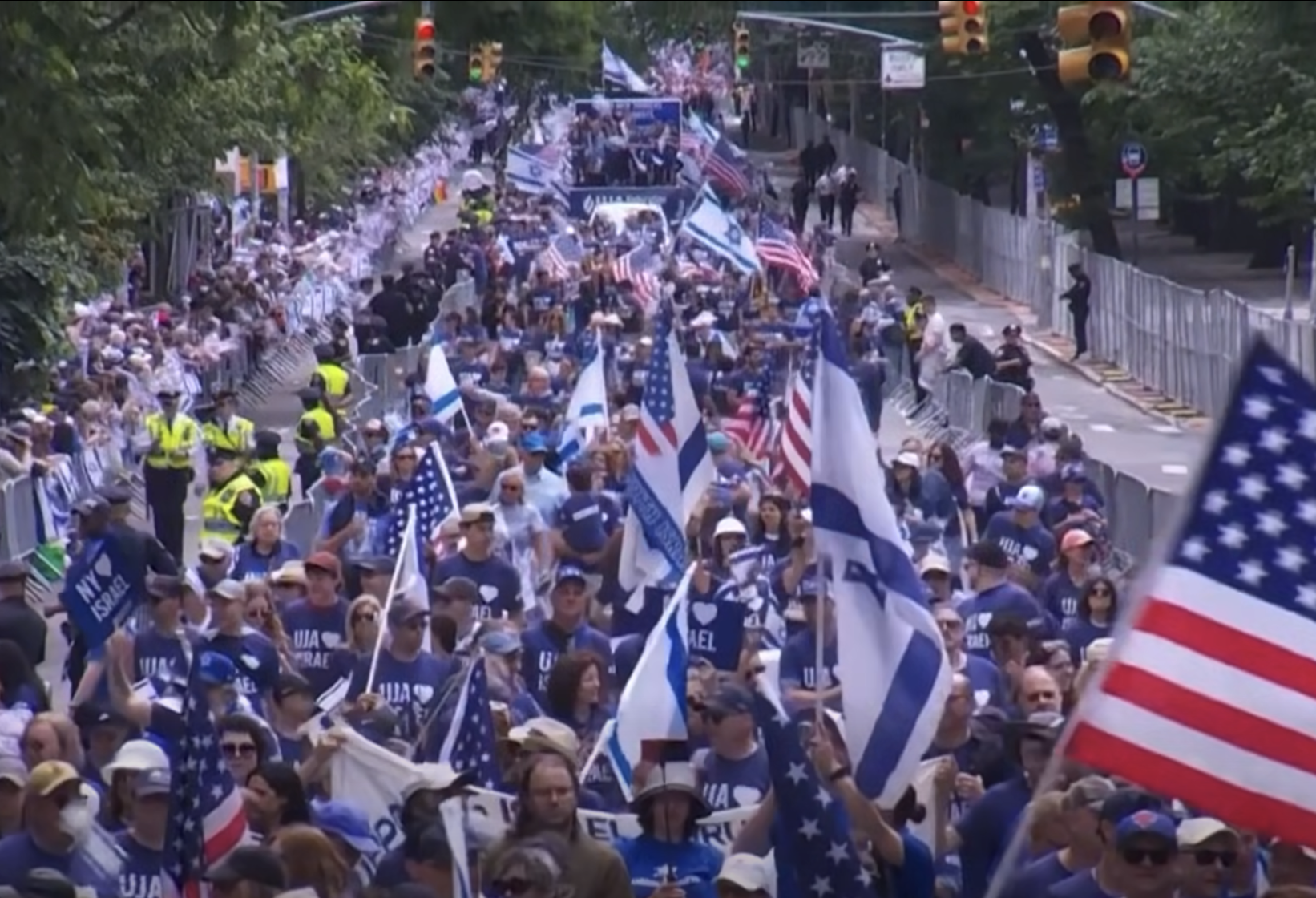
Some have suggested that the Israel Day Parade should be transformed into a broader celebration of Jewish diversity, one in which Israel is merely one thread among many. That sounds generous. It sounds inclusive. It is also a profound misreading of what happened today on Fifth Avenue.
More than 60,000 Jews and allies marched. Not despite the current moment, but because of it. We marched as American Jews. We marched as religious Jews and secular Jews. We marched as liberals and conservatives, immigrants and native-born New Yorkers, day school students and public school students, synagogue members and cultural Jews. We marched carrying Israeli flags not because Israel exhausts Jewish identity, but because Israel remains one of its central expressions.
The attempt to separate Judaism from Zionism is not new. We have seen versions of it before. The fringe, fundamentalist sect Neturei Karta does it from one theological extreme, arguing that Jewish sovereignty is illegitimate until messianic redemption. Parts of the contemporary Jewish far left do it from the opposite direction, arguing that Jewish peoplehood can and should be detached from national self-determination altogether. The ideologies are different. The outcome is remarkably similar: the severing of Judaism from one of its deepest historical and collective commitments.
Both positions remain marginal for a reason. That is where these fringe ideologies belong.
The overwhelming majority of Jews did not arrive at Zionism because of propaganda, tribalism, or political conformity. We arrived there because Jewish history arrived there, urgently. After centuries of exile, vulnerability, longing, persecution, return, language revival, cultural rebirth, and collective reconstruction, Zionism became the primary way modern Jewish peoplehood expressed itself in history, demanding dignity for Jews not only in our reclaimed indigenous homeland but wherever we make our lives.
Ahad Ha’am, the founder of Cultural Zionism, understood this long before statehood. His dream was not political sovereignty but the creation of conditions conducive to original Jewish creativity. That is precisely what Israel has become: a center of Jewish language, culture, scholarship, ethics, argument, technology, music, literature, and communal life unfolding in Jewish time and Jewish space.
The Israel Parade today reflected that reality. Some want a “Jewish parade” instead of an “Israel parade,” as though these are competing categories. But the tens of thousands who filled Fifth Avenue did not experience a contradiction between their Judaism and their Zionism. They experienced them as intertwined realities. Not identical. Not interchangeable. But inseparable.
That does not mean every Jew must agree with every Israeli government. It does not mean criticism is forbidden. It does not mean Israel is beyond moral scrutiny. It means that the effort to redefine Jewish identity by removing Zionism from its center is not representative of Jewish life as it is being lived by the Jewish community. Importantly, it also means that any ideology that denies the joy and pride of Jewish self-determination belongs on the sidelines of Jewish life.
The crowd on Fifth Avenue today made that unmistakably clear.
The future of Jewish life will contain many voices. It always has. But the claim that Zionism is somehow external to Judaism, or merely one optional preference among many, was answered not by polemic but by presence.
Sixty thousand people showed up and answered it together.