
A comedic survival guide to a country that breaks you, rebuilds you, and calls it Tuesday.
Toldot: Two brothers, one blessing and the world’s most expensive bowl of soup
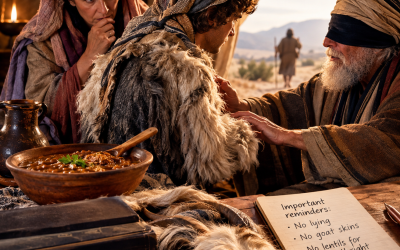
I come from a family of ten children. I know sibling rivalry, parental favoritism and the occasional urge to change my identity and leave the country. But even my lot would struggle to compete with Yitzchak, Rivkah, Esav and Yaakov, who turn their household into a biblical production of Succession, complete with deception and an elderly father whose failing eyesight becomes a family business opportunity.
Welcome to Toldot. Two brothers fight before birth, one sells his birthright for lentils, and the future of the Jewish people ends up depending on a man wearing bits of goat. G-D has entrusted this lot with a covenant. One can only admire His optimism.
Rivkah waits twenty years to conceive. When her twins begin fighting inside her, she consults G-D and learns that two nations are struggling in her womb, with the elder destined to serve the younger. Most expectant mothers receive an ultrasound photograph. Rivkah receives a geopolitical forecast.
Esav emerges first, red and hairy, followed by Yaakov, gripping his brother’s heel. Esav becomes a hunter; Yaakov prefers the tents. Yitzchak favors Esav; Rivkah favors Yaakov. Two children, two parents, two favorites. Anyone wondering why the boys develop a complicated relationship might examine the seating arrangements at supper.
One day Esav returns ravenous. Yaakov is cooking lentil stew and offers him a deal: food in exchange for his birthright. I have negotiated pet-sitting contracts involving more due diligence. The Torah tells us Esav despised his birthright, but Yaakov’s exploitation of his hunger hardly qualifies as brotherly love.
And lentils! Not cheesecake, Belgian chocolate or a magnificent roast. Lentils. I enjoyed dinner, celebrating a friend’s birthday belatedly this week, and nobody was required to surrender their inheritance between courses. Clearly, civilization has made some progress.
Meanwhile, famine drives Yitzchak to Gerar, where he introduces Rivkah as his sister because he fears being killed for her beauty. King Avimelech discovers the truth. Apparently, the patriarchs have inherited divine promises and an appalling marital security protocol.
Yitzchak prospers, but disputes erupt over wells. His servants dig, the locals quarrel, and he moves on. Having moved fifty-two times, I appreciate walking away from an argument, although I would prefer not to relocate whenever somebody behaves like an arse.
Then comes the real disaster.
Yitzchak, old and nearly blind, summons Esav and requests his favorite meal before bestowing a blessing. Rivkah overhears and immediately organizes an alternative succession plan. She prepares food, dresses Yaakov in Esav’s clothing and covers his hands and neck with goatskins.
Consider the lunacy. A mother orchestrates identity theft. Her son impersonates his brother using pieces of dead goat. His father is blind, not stupid, and the scheme depends on nobody noticing that something smells distinctly agricultural.
After finally having my hair cut and my nails done this week, I have a renewed appreciation for the transformative possibilities of personal grooming. But even at my most adventurous, I draw the line at goatskin accessories.
Yitzchak is suspicious. The voice sounds like Yaakov, but the hands feel like Esav’s. Eventually, he gives Yaakov the blessing.
And suddenly the comedy develops teeth.
I have a problem with the deception, and an even bigger problem with how readily we excuse it because we approve of the outcome. Yaakov is our patriarch, Rivkah our matriarch, and apparently that earns them a retrospective exemption from the ordinary rules of honesty. But a lie doesn’t become truth because the liar is important, and exploiting a vulnerable father doesn’t become righteous because the family eventually produces twelve tribes.
Yaakov doesn’t merely disguise himself. He lies directly to his father, even invoking G-D to explain his suspiciously speedy hunting expedition. His objection to Rivkah’s plan is not that it is dishonest, but that he might get caught and cursed. Apparently, the moral dilemma begins and ends with risk management.
Perhaps G-D intended Yaakov to receive the blessing all along. Perhaps Rivkah understood that better than anyone. But surely an Almighty capable of creating the universe could have managed the succession without requiring an elderly man to be fooled by a pair of goatskin gloves.
And if the argument is that the ends justify the means, I would suggest we examine where that particular philosophy has taken humanity before congratulating anybody.
Esav returns, discovers the fraud and cries out in anguish. Yitzchak trembles violently. Esav threatens to kill his brother, and Rivkah sends Yaakov to her brother Lavan. Sending somebody to Lavan for an ethical reset is rather like recommending a pickpocket for financial compliance.
And here is where I stop laughing.
This woman waited twenty years for her children. She endured a frightening pregnancy, believed she understood their destinies and watched her husband favor the son she believed was not destined to lead. Perhaps she feared that doing nothing meant betraying G-D’s promise. Perhaps protecting Yaakov seemed worth any price.
But her suffering doesn’t absolve her of responsibility for causing it.
Imagine sending away the child you fought so fiercely to protect, knowing his brother wants him dead. Imagine the hurried preparations, the uncertainty of his journey and the silence afterwards. No WhatsApp, no telephone, no reassuring photograph from Lavan’s house. The Torah never records their reunion.
And Esav? He is her son, too. His anguish is real. Rivkah must live with what her decision has done to both boys, and with the possibility that she has mistaken control for protection.
She secures Yaakov’s blessing but loses his presence. The son she wanted to protect is now beyond her protection.
There is another deliciously uncomfortable detail. Later, Lavan deceives Yaakov by substituting Leah for Rachel on his wedding night. The man who impersonated his older brother finds himself tricked by the substitution of an older sister. Biblical justice occasionally has a wicked sense of humor.
Being the smartest person in the room doesn’t necessarily make you the wisest. Sometimes it means you can engineer a more sophisticated disaster. Rivkah gets the result she wants, but the Torah never records her seeing Yaakov again. That’s a hell of a price for being right.
The covenant continues, but that doesn’t refund the emotional cost. Nor does it make the deception acceptable simply because history eventually vindicates Yaakov’s place in the family.
I don’t need my ancestors to be flawless. I do need the freedom to question them. Otherwise, what exactly are we learning from their mistakes?
So if anybody in my family is contemplating an inheritance dispute, I insist upon independent legal advice, no parental impersonation and absolutely no livestock-based disguises.
And nobody is getting my birthright for lentils. Particularly at today’s prices.
Shabbat shalom.
Related Topics
Related Posts