
Writer covering Israel–Africa, Jewish affairs, and Israel worldwide
Torn Between Self-Sufficiency and Uncle Sam: Israel’s Dependency Paradox
Armed to the teeth, yet tethered to Washington: Israel’s dreams of self-reliance collide with the reality of US aid
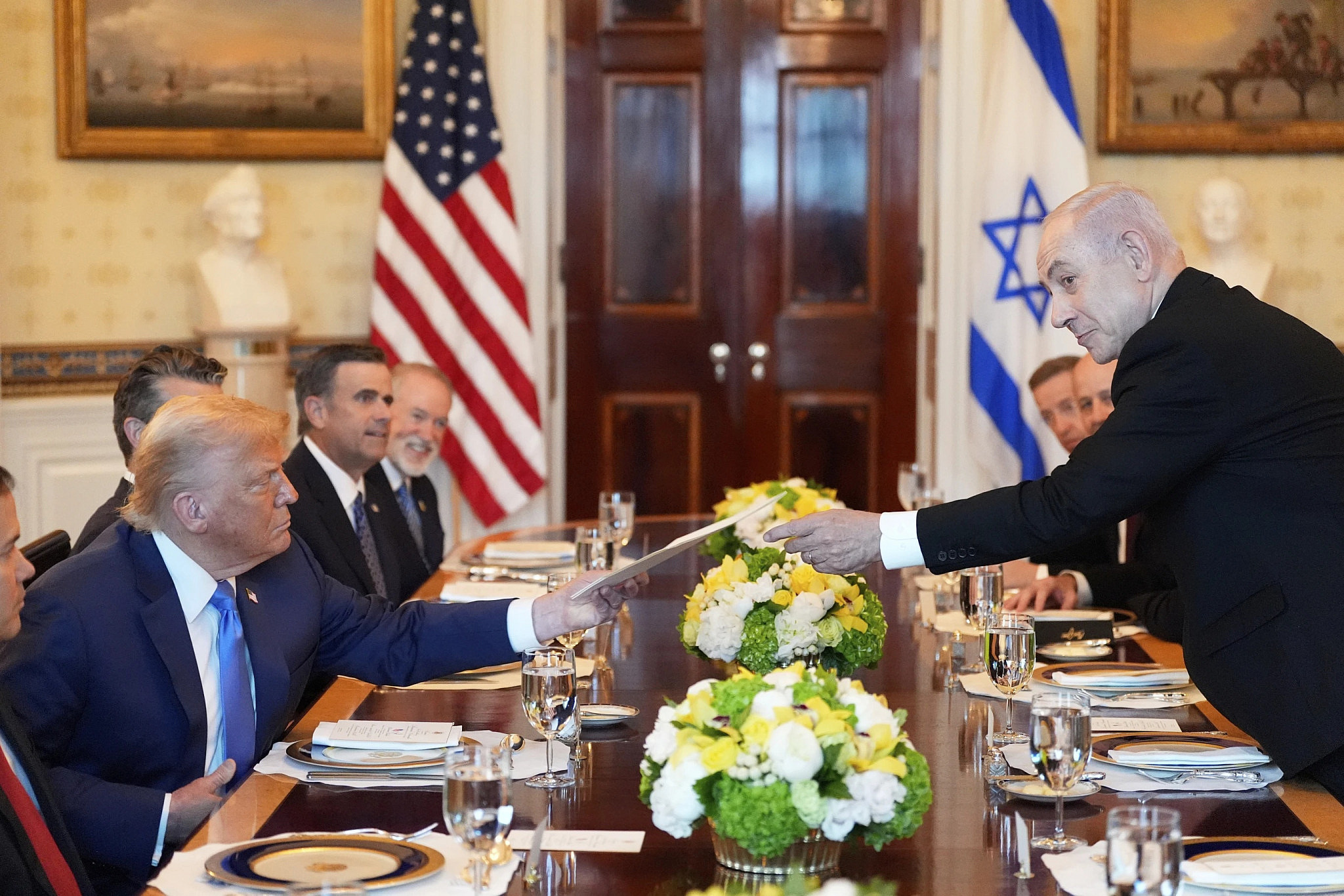
Israel’s Prime Minister Benjamin Netanyahu, right, hands President Donald Trump a folder during a meeting in the Blue Room of the White House, Monday, July 7, 2025, in Washington. (AP Photo/Alex Brandon)
The Ideology of Self‑Reliance vs. the Reality of Dependency
Benjamin Netanyahu has repeatedly cast his vision in heroic, almost mythic terms: Israel is not content merely to be “Athens”, enlightened, cultured, innovative, but will become a “super‑Sparta,” militarily self-sufficient, iron-willed, and unassailable.
Yet, seemingly, this narrative of autarky may be more aspirational than real as per current dynamics. Israel may be producing more ammunition and components domestically, but it will not manufacture F‑35s or submarines. As Axios recently reported, Israel is quietly negotiating a 20-year military aid deal with Washington, extending U.S. support deep into the 2040s. The super‑Sparta image may be rhetorically attractive, but strategically, Israel is strapping its own arms to someone else’s chariot, and hoping it doesn’t veer off course.
The 2016 Obama Deal: The Modern Architecture of Dependence
The foundations of this dependence were laid in 2016, when Israel and the U.S. signed a record $38 billion Memorandum of Understanding over 10 years. On paper, it was massive: $3.8 billion per year, plus $5 billion earmarked for missile defense.
But strings came attached. Israel pledged not to lobby Congress for more FMF funds during the decade and faced limits on using U.S. money for domestic arms production. In short, the very deal designed to secure Israel’s defense also institutionalized dependence — or, as one might quip, “freedom, leased in 10-year increments.”
How U.S. Leverage Played Out During the Gaza War
Dependencies of this kind are not theoretical, they have a very real, very sharp edge. In October 2024, the Biden administration sent an unusually blunt letter warning that unless Israel improved humanitarian conditions in Gaza, weapons deliveries could be affected. The message was unmistakable: American military aid could be turned on or off like a tap.
Tensions peaked further during the debate over a full-scale Rafah operation. The Biden administration openly threatened to withhold munitions if the IDF moved ahead. As Axios reported at the time, the White House considered Rafah a “red line” — and Israel was told to adjust its war plans accordingly.
And then came perhaps the most surreal moment of the conflict. Reports about the United States pressuring Israel to ensure safe passage of roughly 200 Hamas fighters trapped in a tunnel on the Israeli-controlled side of the yellow line. Yes, in a conflict triggered by the worst massacre of Jews since the Holocaust, Washington was reportedly leaning on Jerusalem to protect the very men responsible for it. One might have expected the IDF to be allowed to eliminate 200 hardened terrorists hiding underground on its own side of the line. But no. In a twist that would have been comedic had it not been tragic, Israel, the supposed “super-Sparta,” found itself contemplating a scenario in which its own army might be obliged to assist Hamas fighters to safety.
This is the sort of diplomatic innovation only Washington could devise: Hamas tunnels as humanitarian corridors, with the IDF as the concierge. The deeper point is unavoidable: when a foreign capital can dictate not only the pace of Israel’s war, but also the fate of the very terrorists Israel is fighting, the problem is no longer about aid. It is about sovereignty.
4. The Saudi F‑35 Issue: A Shifting U.S. Commitment to Israel’s QME
If the U.S.–Saudi F-35 discussion once seemed like a theoretical headache, it has now blossomed into a full-blown migraine. Washington insists it can safeguard Israel’s Qualitative Military Edge, yet somehow keeps flirting with the idea of giving one of the region’s most rapidly diversifying military partners the most advanced American fighter ever built.
And the problem isn’t just the jet. It’s the company Riyadh keeps. As U.S. officials have quietly admitted, and as a New York Times report spelled out on November 13, Pentagon analysts fear that F-35 technology could be compromised through Chinese espionage, or simply through China’s security partnership with Saudi. Beijing, after all, is already helping Riyadh acquire, build, and operate ballistic missiles. The world’s most sensitive stealth technology being paired with Chinese missile cooperation is… not quite what Israel’s QME legislation had in mind.
And the concerns hardly end there. In October, Riyadh conducted the Blue Sword-4 naval exercise with China — the second run in barely a year, an exercise meant to “strengthen military cooperation” and “raise combat readiness,” according to the Saudi Press Agency. Which raises the obvious question in Jerusalem: Since when do we hand out F-35s to countries conducting joint military drills with Beijing?
Even optimists in D.C. quietly acknowledge the obvious: partners trusted with America’s crown-jewel fighter probably shouldn’t be testing amphibious maneuvers with the People’s Liberation Army Navy. Could the deal move forward? Yes — if Riyadh decisively disentangles itself from China and provides guarantees airtight enough to satisfy both Pentagon engineers and congressional lawyers. But Congress will (or at least should) insist that the law be followed. And in this case, the law is not a suggestion.
The Arms Export Control Act, specifically section 36(h), mandates that the U.S. preserve Israel’s qualitative military edge — not because today’s political climate demands it, but because the Middle East has a habit of reinventing itself at dangerous speeds. Governments fall, alliances shift, and yesterday’s partner becomes tomorrow’s “strategic complication.”
This is why the statute wisely focuses on capabilities, not vibes. Washington must examine Israel’s ability to counter the improved capabilities of any state, and consider how the sale alters the relative strategic balance. And here the math is simple: you cannot hand Saudi Arabia the F-35 without narrowing Israel’s comparative edge. It doesn’t automatically mean rejecting the sale, but it certainly means that Israel’s capabilities must be strengthened further to compensate.
In short: F-35s to Saudi Arabia aren’t just about Saudi Arabia. They’re about the entire regional balance, and whether Washington still takes Israel’s edge as seriously as it says it does.
5. The Supplementary Aid Question: Helpful Boost or Strategic Trap?
Since the Gaza war began, the U.S. has delivered at least $21.7 billion in additional military aid, replenishing Israeli stockpiles of interceptors, precision munitions, and other critical systems.
While undoubtedly critical, these supplementary packages also reinforce dependence: Israel fights, U.S. replenishes, U.S. gains leverage. Every war becomes another opportunity for Washington to shape Israeli strategy. In other words, the “helpful boost” has a side effect: a subtle leash. And like any leash, it is easiest to ignore, until it yanks you in an inconvenient direction.
6. Strategic Costs of Dependency: What Israel Risks
Looking at the realpolitik consequences, Israel’s political freedom is constrained whenever Washington disapproves, leaving the country exposed to delayed approvals, withheld shipments, or thinly veiled threats. Operationally, Israel relies on American stockpiles for critical munitions, which may not be guaranteed in moments of crisis. The 2016 MOU further limited Israel’s ability to use U.S. funds on domestic arms production, slowing the growth of its own defense industry just when self-sufficiency is most urgent. Diplomatically, the Rafah episode showed that U.S. leverage shapes Israeli military strategy in real time, turning battlefield decisions into bargaining chips. In short, the super-Sparta fantasy masks a far more fragile, and occasionally comically precarious, reality. It’s Sparta, but with training wheels borrowed from Uncle Sam.
7. The Big Question: Can Israel Wean Itself Off U.S. Aid?
Israel can, in theory, build a self-reliant defense posture. It has the talent, the domestic arms capacity, and the economic means. Achieving it requires a profound shift in political will: ramping up domestic production, diversifying supply chains, investing in R&D while retaining control, and stockpiling for contingencies beyond U.S. support. But doing so means rejecting the comfort of guaranteed aid and accepting risk, uncertainty — and true strategic independence. One could almost hear a Spartan lament float across Jerusalem’s skyline — the march to self-reliance rugged and steep, while U.S. dollars beckon like a soft, golden melody.
The Spartan Dilemma
Can Israel break free from its U.S. crutches and become the “super-Sparta” of Netanyahu’s rhetoric? Not fully, at least not without a radical rethinking of its security doctrine. The rhetoric of muscular, self-reliant Sparta sounds inspiring, but the institutions beneath are woven deeply into the U.S.-Israel alliance. The 2016 MOU, supplementary aid during wartime, and a looming 20-year deal form the infrastructure of dependence.
Worse, Israel now faces the possibility that its qualitative edge may be compromised by its own ally. Selling F‑35s to Saudi Arabia threatens the exclusivity that underpins decades of Israeli air power. Washington may trade away Israel’s advantage, and Israel may have little choice but to comply.
If Israel truly desires strategic independence, it must treat U.S. aid not as a foundation, but as temporary scaffolding. The question is whether its leaders have the courage, and the sense of irony, to dismantle it, rather than rebuild upon it. After all, Sparta is supposed to be fearsome, not reliant on Uncle Sam’s checkbook.
Related Topics
Related Posts