
Toronto No Longer Feels Like Home: A Canadian Jew’s Reckoning
I returned to Toronto recently for the first time in nearly four years. Eleven days in the city where I spent my university years, where I walked familiar streets, where I once felt rooted. But this time, something was different. Something was off.
I came back for my niece’s bat mitzvah, a joyous occasion, a celebration of Jewish continuity. But the joy was tempered by a sense of unease that followed me throughout my visit. Toronto didn’t feel like the city I left. It felt like a city I no longer recognized.
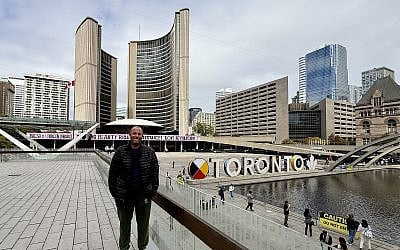
A Changed Landscape
I visited the area around Ryerson, now Toronto Metropolitan University, where I completed my undergraduate degree. It was once a place that proudly flew Canadian flags, symbols of shared identity and civic unity. Now, those flags were gone. In their place, Palestinian flags fluttered in the wind. Not just one or two, but many. They felt permanent.
Graffiti reading “Free Palestine” was scrawled across walls and alleyways. It wasn’t just political expression, it was a statement of dominance. A rebranding of public space. And it left me unsettled.
This wasn’t the Canada I remembered. This wasn’t the Toronto I called home.
The Erosion of Safety
I felt it most acutely on Shabbat, walking into the synagogue for my niece’s bat mitzvah. Armed security stood at the entrance. My tallis bag was searched before I was allowed in. I understood the need for caution, especially in today’s climate, but it was jarring. This wasn’t the Canada I grew up in. This was a Canada where Jewish safety could no longer be taken for granted.
The rise in antisemitism is no longer abstract; it’s visible, palpable, and increasingly normalized. Just days ago, the Kehillat Shaarei Torah synagogue in North York was vandalized for the tenth time. Four windows were smashed in what police are investigating as a suspected hate-motivated offense. The synagogue had already installed steel fencing and security measures after previous attacks, but the violence continues. This isn’t just a local incident, it’s part of a disturbing pattern.
Hatred in Professional Spaces
The hatred isn’t confined to the streets—it’s creeping into professional spaces too. My sister-in-law is an OBGYN that works at Mount Sinai Hospital, a Jewish-founded institution. She was verbally assaulted while speaking at a refugee health conference in Toronto. Her talk had nothing to do with Israel—it focused on refugee care. But she was harassed simply for supporting Israeli doctors who want to do observerships in Toronto.
She has spent years building bridges between Canadian and Israeli medical systems, especially now, when many Israeli doctors have been sidelined during the war. Her experience wasn’t just upsetting, it was meant to intimidate. When I saw her the day this incident happened, she was visibly shaken. It was a stark reminder that antisemitism isn’t just political, it’s personal.
Leadership That Fuels Division
What makes this moment even more troubling is the rhetoric coming from political leaders. Toronto Mayor Olivia Chow recently referenced a “genocide in Gaza,” a claim that not only distorts reality but dangerously inflames tensions. When elected officials echo propaganda, they legitimize hate. They embolden those who seek to silence and intimidate Jewish voices.
This isn’t about politics. It’s about truth. It’s about safety. It’s about the soul of a country that once prided itself on fairness and pluralism.
A Sobering Return—and a Clearer Resolve
My visit to Toronto was meant to be a reconnection. Instead, it became a reckoning. The city I once knew has changed. Canada has changed. And for Jewish Canadians, the question is no longer whether we belong, but whether we are safe.
I’m grateful I made aliyah. In Israel, I don’t have to explain my identity. I don’t have to justify my existence. I don’t have to wonder if the flag flying above me still represents me.
To my fellow Jews in Canada who are feeling the weight of this moment: I see you. I understand your unease. And I urge you to consider what it means to live in a place where you don’t have to hide, apologize, or fear. Israel is not perfect, but it is ours. It is the only place where Jews can fully be themselves, without compromise.
The world is changing. But we don’t have to be passive observers. We can choose where we stand, and where we belong.