London based entrepreneur, cybersecurity analyst doing a PhD in AI
Tough Love for Elected Leaders – USPI Index.
Tough Love for World Leaders
Your job is to serve us, not lord over us
Dear presidents, prime ministers, kings, generals, ministers, central bankers, consultants, judges and mandarins:
Who made you Pharaoh?
Who gave you the right to decide which neighbourhood gets bombed, whose children are sent to war, how much of our earnings are taken, how much debt is placed upon children not yet born, whether housing becomes unaffordable, or whether billions are spent on weapons rather than hospitals?
At what precise moment did public service become dominion?
Somewhere between the red ties and blue ties, military uniforms and turbans, motorcades and Jaeger-LeCoultre watches, McKinsey decks and Accenture programmes, central-bank models and defence contracts, the human being disappeared.
The taxpayer became a number.
The civilian became collateral.
The soldier became a unit.
The country became a balance sheet.
And leadership became theatre.
The Qur’an’s Pharaoh is not merely a cruel man. He is also the archetype of political power forgetting its limits:
“Indeed, Pharaoh exalted himself in the land and made its people into factions.”
— Qur’an 28:4 (Quran.com)
There is another model.
ʿUmar ibn al-Khaṭṭāb رضي الله عنه.
The Prophet Muhammad ﷺ said:
“If there were to be a Prophet after me, it would have been ʿUmar ibn al-Khaṭṭāb.”
The report appears in Jāmiʿ al-Tirmidhī 3686, where al-Tirmidhī describes it as ḥasan gharīb. (Sunnah)
This does not make ʿUmar رضي الله عنه a prophet. Islam is explicit that Muhammad ﷺ is the final Prophet.
The importance is what the statement tells us about the qualities associated with ʿUmar رضي الله عنه:
discernment;
justice;
courage;
responsibility;
and an extraordinary consciousness that political authority is an amānah — a trust.
So let us stop using ʿUmar رضي الله عنه merely as historical nostalgia.
Use him as a benchmark.
Call it the:
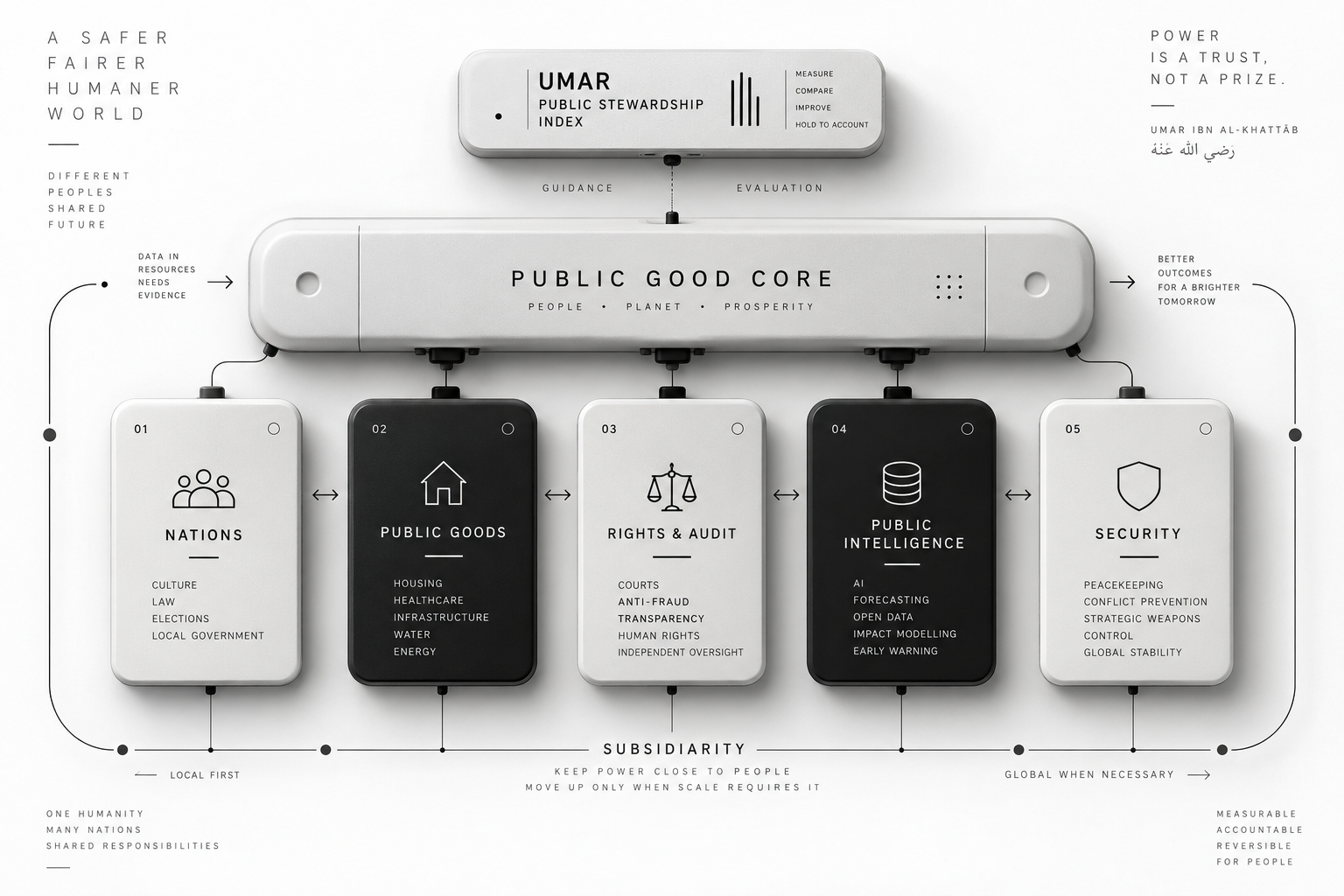
ʿUmar Public Stewardship Index
The question behind it is simple:
How closely does your exercise of power resemble stewardship rather than domination?
Remove the gate
Reports from ʿUmar’s caliphate describe his anger when a governor became insulated from ordinary people behind an official gate.
The principle is larger than the architecture:
there must not be a door between government and the governed.
Modern governments have constructed much more sophisticated doors.
Lobbying.
Classified committees.
Private dinners.
Opaque procurement.
Consultancy language.
Party machinery.
Algorithms the public cannot inspect.
The modern equivalent of removing the governor’s gate is transparency.
Open the spending data.
Open the procurement data.
Open the models.
Open the assumptions.
Publish the outcomes.
The Qur’an says:
“Allah commands you to return trusts to their rightful owners; and when you judge between people, judge with fairness.”
— Qur’an 4:58 (Quran.com)
Public office is an amānah.
The problem is scale.
ʿUmar رضي الله عنه could walk through his society, encounter hunger and personally investigate what government had failed to see.
The modern world contains billions of people.
No president can walk every street.
No minister can inspect every hospital.
No finance department can personally visit every hungry household.
So we need to industrialise the moral principle.
That is where data science and artificial intelligence become useful.
Not as rulers.
As instruments of public accountability.
From moral example to constitutional engineering
Telling leaders to “be more like ʿUmar” is not enough.
Good character cannot be legislated. And without the 5 daily prayers at least , and a deep knowledge of religion, it is almost impossible to even get to a much lower level of a man of such stature.
Systems must function even when leaders are vain, partisan, incompetent or self-interested.
The deeper solution is therefore structural:
separate political sovereignty from the delivery of essential public goods.
Europe already gives us part of the blueprint.
The European Union does not simply erase its Member States. Its treaties divide authority into different categories: some competences belong to the Union, others are shared, and others remain primarily with Member States. (Eur-Lex)
Even more important is the European principle of subsidiarity:
power should remain as close to the citizen as reasonably possible, and move upward only where the scale or effects of a problem make higher-level action demonstrably more effective. (European Parliament)
That is the constitutional architecture the world needs.
Not a world emperor.
Not one president of Earth.
Not one government deciding everything.
A Global Public Goods Union.
Britain remains Britain.
Israel/Palestine/Jordan/Syria/Lebanon remains Israel/Palestine/Jordan/Syria/Lebanon – or name it whatever you want “Holy Land Union”.
India remains India.
Nigeria remains Nigeria.
Languages, cultures, religious traditions, ordinary law, municipal government, local democracy and national identity remain.
But certain functions become structurally separated from short-term political competition.
The Four Layers
Layer One: Democratic nations and local government
This is ordinary political sovereignty.
Elections.
Local taxation.
Culture.
Education.
Most domestic law.
Policing.
Municipal government.
Land use.
Community life.
Its presumption should always be localism.
If a town can solve it, the nation should not.
If a nation can solve it, the global layer should not.
Only when scale produces a demonstrably better result does authority move upward.
This is subsidiarity applied globally.
Layer Two: Public Goods Authorities
This is the operational layer.
Create treaty-based institutions for functions where continuity, expertise or cross-border scale matter more than party ideology.
A Housing and Urban Systems Authority would not decide what every house looks like.
It would monitor affordability, supply, infrastructure capacity, homelessness, construction rates and land constraints; finance housing-enabling infrastructure; publish international comparisons; and intervene only where national systems repeatedly fail.
A Health and Biosecurity Authority could coordinate disease surveillance, strategic medical stockpiles, drug procurement, interoperable standards and emergency preparedness.
An Infrastructure and Mobility Authority could plan cross-border rail, electricity grids, ports, water systems, strategic roads and digital networks over thirty- and fifty-year horizons rather than four-year electoral cycles.
A Food, Water and Environmental Authority could handle risks that physically refuse to recognise national borders.
And eventually there could be a Common Security Authority.
National policing and ordinary civil defence could remain local.
But nuclear weapons and other strategic capabilities capable of destroying entire cities should face collective control, independent inspection and thresholds far higher than the personal judgment of a handful of politicians.
The principle is simple:
centralise the problem, not the country.
Layer Three: Rights, audit and enforcement
The people spending public money must never be the only people auditing it.
The third layer therefore contains:
an independent court;
an auditor;
an anti-fraud authority;
and a public prosecutor for the common budget.
Again, Europe provides an intriguing model.
The European Public Prosecutor’s Office has a central EU structure combined with delegated prosecutors working inside participating countries. It investigates offences against EU financial interests while prosecutions still operate through the relevant national judicial systems. (EU Public Prosecution Office)
That is almost exactly the institutional architecture a wider Public Goods Union would need.
Central oversight. Local execution.
The rule should be:
one public pound, one traceable purpose.
One contract, one beneficial owner.
One programme, one outcome.
One audit trail.
Fraud involving the common public purse becomes independently investigable whether the suspect is a minister, corporation, contractor or official.
Layer Four: The Public Intelligence Layer
This is where artificial intelligence belongs.
Not above the constitution.
Below it.
AI models consequences.
It forecasts shortages.
It detects procurement anomalies.
It compares interventions.
It predicts infrastructure demand.
It shows decision-makers what their policy is likely to do to ordinary human beings.
But it does not become sovereign.
Policy can be represented through a transparent Public Good Function:
P = w₁L + w₂I + w₃F + w₄C + w₅W + w₆J + w₇S
Where:
L = life and health
I = intellect and education
F = family and future generations
C = conscience and religious freedom
W = wealth and property security
J = justice
S = environmental and fiscal sustainability
This takes conceptual inspiration from Maqāṣid al-Sharīʿah: preservation of religion, life, intellect, lineage or family, and property.
But there is an essential mathematical distinction.
Some values belong inside the objective function.
Others must be hard constraints.
You cannot compensate for thousands of innocent deaths by adding enough GDP elsewhere.
You cannot torture someone because an optimisation function predicts a security benefit.
You cannot eliminate freedom of conscience because uniformity makes administration cheaper.
Human rights form the boundaries of the optimisation problem.
AI searches for better policy inside those boundaries.
That is how we prevent the machine becoming Pharaoh.
The ʿUmar Public Stewardship Index
The Public Good Function evaluates policies.
The ʿUmar Public Stewardship Index — UPSI — evaluates institutions and leaders.
For example:
U = 100 × (0.20L + 0.15B + 0.15J + 0.15A + 0.15W + 0.10R + 0.10F)
with every component normalised between zero and one.
Where:
L = protection of life
B = basic needs: food, shelter and healthcare
J = equal justice
A = accessibility and transparency of power
W = integrity of public wealth
R = responsiveness when evidence shows failure
F = stewardship toward future generations
The exact weights should not be sacred.
Debate them.
Test them.
Publish them.
Allow universities, economists, civil society and rival AI systems to challenge them.
But finally give political leadership a dashboard more meaningful than opinion polls.
Did preventable mortality fall?
Did housing become more affordable?
Did child poverty fall?
Did corruption decline?
Did citizens obtain better services per pound spent?
Did government publish where the money went?
Did it reverse failed policy?
Did it leave future generations assets—or liabilities?
That is a far more serious measurement of government than whether a politician performed well at a press conference.
But how do we actually build this?
Here is where the proposal must stop being philosophy.
Do not begin by abolishing the United Nations.
Use it.
The UN itself now admits that its institutional architecture requires substantial reform.
The 2024 Pact for the Future explicitly calls for transforming global governance. (United Nations)
The more recent UN80 Initiative goes considerably further. Its own analysis identifies proliferating meetings and reports, duplicated effort, unclear divisions of labour, fragmented delivery, misaligned funding and weak mechanisms for reviewing whether mandates actually achieve results. (United Nations)
As of September 2026, UN80 is even developing a system-wide results-management mechanism designed to strengthen transparency and collective accountability. (United Nations)
So the world already possesses much of the diplomatic shell.
What it needs is a better operating system.
Phase One: turn the UN into the constitutional forum
Keep the General Assembly.
Keep international adjudication.
Keep human-rights institutions.
Keep diplomacy.
But create a Global Public Goods Protocol through which participating states can transfer precisely enumerated competences to the Public Goods Union.
No blank cheque.
Every transferred competence must state:
what problem is being transferred;
why national action is insufficient;
the funding source;
the measurable objective;
the rights constraints;
the audit mechanism;
the review date;
and the procedure for returning the competence downward if centralisation fails.
Call it:
subsidiarity with an expiry date.
This is crucial.
Power should have to justify remaining centralised.
Phase Two: one back office, one data layer
Before building new headquarters, consolidate administration.
One supplier registry.
One common procurement rail.
One grant-management architecture.
One public-goods data standard.
One outcome dashboard.
One identity architecture.
One audit trail.
This is not theoretical.
The UN’s own Resident Coordinator reforms have explicitly tried to reduce duplicated activity. In its 2025 reporting, 79% of surveyed host governments agreed that Resident Coordinators helped minimise duplication among UN agencies, while consolidation of operational services produced measurable cost avoidance. (UNSDG)
Scale the principle.
Why should dozens of international organisations separately purchase cloud infrastructure, vehicles, analytics, travel platforms, insurance, legal support and procurement systems?
Shared services are boring.
That is precisely why they matter.
Phase Three: pool capital, not politics
Then create common financing.
The EU again provides the precedent.
The European Commission now issues common EU-Bonds through a unified funding approach and allocates proceeds from a central funding pool to different programmes. The mechanism grew out of the financing architecture used for programmes including NextGenerationEU. (European Commission)
A Global Public Goods Union could eventually issue Public Goods Bonds for participating states.
The money could finance:
cross-border transport;
water resilience;
electricity interconnection;
pandemic infrastructure;
climate adaptation;
housing-enabling infrastructure;
and major scientific projects.
Projects would compete based on transparent expected public benefit.
Funds would be released against measurable milestones.
Fail the milestones and subsequent funding pauses.
Politicians no longer receive a giant pot of money with a press release attached.
The public purchases an outcome.
Phase Four: replace duplication, not sovereignty
Now review international institutions function by function.
Where multiple bodies maintain overlapping procurement, logistics, analytics, country administration or development infrastructure, consolidate the machinery.
This is already broadly consistent with the direction of UN80, which is examining shared services, country-team reconfiguration, pooled funding, stronger data infrastructure and structural realignment across the UN system. (United Nations)
Do not destroy useful expertise.
Move it.
The UN becomes increasingly the diplomatic and constitutional forum.
The Global Public Goods Union becomes the operational layer.
Nation-states remain the democratic layer.
Courts, auditors and prosecutors form the accountability layer.
AI forms the intelligence layer.
That is far cleaner than creating another organisation every time humanity discovers another problem.
Phase Five: security comes last
Do not begin by demanding that nuclear powers surrender their arsenals.
That proposal dies before the first meeting ends.
Start smaller.
Joint procurement.
Shared peacekeeping logistics.
Weapons transparency.
Independent inspection.
Cyber-defence.
Anti-piracy.
Disaster response.
Peacebuilding.
Then establish treaty thresholds requiring progressively wider collective authorisation for increasingly destructive classes of military action.
The existing Security Council veto demonstrates precisely why concentration of strategic authority is difficult: a negative vote by any permanent member can block substantive Council action. (United Nations)
Reform therefore has to be gradual.
Reciprocal.
Verifiable.
Strategic weapons are the last competence to move upward, not the first.
But the destination should be clear:
a world in which one president, prime minister, king or general cannot casually convert the machinery of an entire nation into an extension of personal ego.
The child does not care who won
Because somewhere tonight there is a child who does not care whether the person responsible for his suffering wears a red tie, a blue tie, a turban, a military uniform or a Jaeger-LeCoultre watch.
He does not understand sovereign spreads.
He does not understand strategic deterrence.
He does not understand party politics.
He understands hunger.
He understands fear.
He understands whether his mother is alive.
That is why the answer cannot merely be:
find better politicians.
We have spent thousands of years attempting that.
The deeper solution is to redesign the machinery so that fewer necessities of human life depend upon political vanity.
Housing should survive elections.
Hospitals should survive elections.
Water should survive elections.
Roads should survive elections.
Food security should survive elections.
And eventually:
peace should survive elections.
ʿUmar ibn al-Khaṭṭāb رضي الله عنه could walk through his society and discover the hungry family himself.
We cannot reproduce that scale.
But we can reproduce the principle.
Every person counts.
Every public pound is a trust.
Every policy requires an observable human outcome.
Every failure requires correction.
Every concentration of power must answer to something outside itself.
That is the purpose of the ʿUmar Public Stewardship Index.
And this is the architecture behind it.
Not one world ruler.
Not one global Pharaoh.
A constitutional separation between politics and public goods.
Centralise only what genuinely requires centralisation.
Keep everything else as close to people as possible.
Measure the result.
Audit the money.
Publish the evidence.
Open the algorithms.
And when the evidence says that the system is hurting the people it exists to serve—
change the system.
That should not be revolutionary.
That should simply be government.
Related Topics
Related Posts