
Where Objectivity Meets Reality
Toward Two States: A pragmatic vision in a complex reality
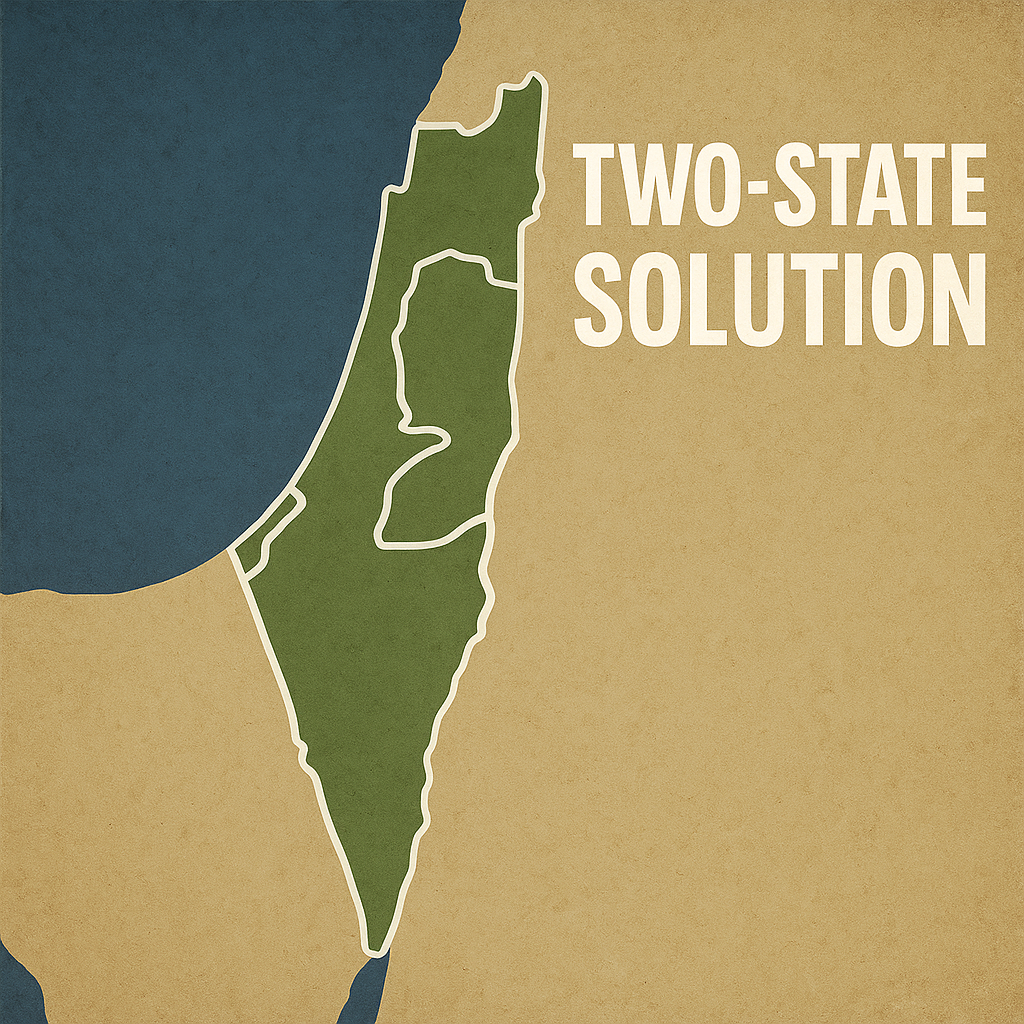
The two-state solution is routinely presented as the singular path to peace in the Middle East’s most volatile and complex region, a seemingly straightforward concept that, in practice, is entangled in decades of historical grievances, contested borders, deep-seated political divisions, security dilemmas, and competing national aspirations, making the journey from theory to reality anything but simple.
This article is presented as a thought experiment rather than a definitive prescription. It explores one possible pathway toward a two-state resolution of the Israeli-Palestinian conflict, emphasizing pragmatism over ideology. Every step toward peace, however modest, deserves consideration, and every proposal that could yield positive outcomes—whether in terms of security, economic development, or political stability for both Israelis and Palestinians—merits careful reflection.
The aim here is not to advocate a single solution or to issue ultimatums, but rather to examine the challenges and opportunities inherent in a two-state framework. By setting aside dogmas and political vetoes, we can consider measures that are realistic, mutually beneficial, and grounded in historical lessons, technical possibilities, and the shared human interest in lasting coexistence.
Building on this perspective, it is essential to consider the historical record. Israel has, on multiple occasions, relinquished territory in pursuit of peace, most notably during the 2005 Gaza disengagement, demonstrating that compromise is possible even under difficult circumstances. Yet history also shows that land alone does not guarantee security or political stability. With Gaza effectively separated and governed independently, the unresolved question remains the West Bank and East Jerusalem. These areas pose complex challenges, from territorial contiguity and settlement expansion to the governance of Jerusalem and the possibility of a corridor linking Gaza with the West Bank. Understanding these realities is a necessary first step toward imagining a two-state solution that is both feasible and mutually beneficial.
Learning from history: Oslo and Gaza 2005
The two-state solution has long been the touchstone of Israeli-Palestinian diplomacy. But history reminds us that translating principle into practice is fraught with difficulty. The Oslo Accords of the 1990s established Palestinian self-governance without defining permanent borders, leaving final-status issues—including Jerusalem, borders, and settlements—to future negotiation.
Israel has repeatedly demonstrated willingness to make painful concessions. The 2005 unilateral disengagement from Gaza, which saw the removal of 21 settlements and thousands of Israeli citizens, confirmed that Israel can relinquish territory for the promise of reduced conflict—even if the anticipated peace did not materialize. Beyond the rhetoric of current far-right ministers, Israeli governments have historically shown flexibility, as also reflected in the Clinton Parameters of 2000 and the Annapolis talks of 2007–2008. Yet these efforts also reveal the limits of unilateral actions: territory alone does not guarantee security or political progress.
Borders and the challenge of contiguity
With Gaza effectively separated and governed by Hamas, the unresolved question remains the West Bank and East Jerusalem. The Oslo framework left borders undefined, recognizing that permanent lines must emerge from negotiation. Today, East Jerusalem embodies the most sensitive challenge. Israel sees it as an indivisible capital; Palestinians see it as the heart of their future state.
One emerging idea is a loose confederation or shared-capital arrangement, inspired by examples such as the former Serbia-Montenegro union. In such a framework, both states would retain sovereignty, yet Jerusalem’s governance would be shared: West Jerusalem under Israeli authority, East Jerusalem under Palestinian administration, while holy sites in the Old City are managed under an internationally guaranteed regime ensuring access for all faiths. This model could preserve the city’s symbolic and practical significance for both peoples while preventing unilateral control that would provoke regional or international backlash.
Meanwhile, plans to build over 3,000 new housing units in the E1 area highlight the practical obstacles. Territorial continuity between the northern and southern West Bank is essential for a viable Palestinian state, yet settlements continue to fragment the landscape. Any credible vision must reconcile Israel’s security concerns with the political and economic viability of Palestinian governance.
Gaza–West Bank connection: the Corridor question
A viable Palestinian state requires more than symbolic borders—it needs physical connectivity. Linking Gaza and the West Bank is essential for political cohesion and economic viability. Yet between the two territories lies Israeli land, making a simple passage politically impossible.
Proposals include tunnels or subterranean passages, allowing movement without compromising Israel’s territorial integrity, or elevated and secured transit corridors under international supervision. These solutions require engineering ingenuity, political trust, and rigorous monitoring. The corridor is a microcosm of the broader two-state challenge: technical solutions exist, but without political and regional buy-in, even the best plans risk failure.
Security: the cornerstone of any agreement
Security is the foundation of a sustainable two-state framework. UN Security Council Resolution 242 affirmed Israel’s right to live within secure and recognized boundaries. History has shown that vacated territory without robust safeguards can be exploited for violence, as in Gaza post-2005.
Any two-state plan must therefore include demilitarized Palestinian territories, enforceable international guarantees, and clear Israeli rights of intervention in cases of imminent threats. Palestinian security forces should maintain law and order but remain limited in offensive capacity. International actors may provide monitoring, but effectiveness will depend on political will and on-the-ground enforcement, as past missions in Rafah and Lebanon have illustrated.
Economics and governance: building a viable state
Political compromise alone is insufficient; Palestinians require the foundations of economic viability. Gaza and the West Bank must have integrated infrastructure, trade links, and opportunities for employment. International aid must prioritize institution-building, transparency, and anti-corruption measures, rather than short-term financial handouts that entrench patronage networks.
The Trump-era “Gaza Reconstitution, Economic Acceleration, and Transformation Trust” (GREAT Trust) illustrates the tension between economic ambition and political feasibility. While economic investment is crucial, forced resettlement or coercive measures violate international law and risk inflaming tensions. Correctly designed, economic frameworks—including corridor-linked trade routes—could promote mobility, investment, and regional integration, but only if combined with governance reform and security guarantees.
Regional and international dynamics
The two-state solution cannot succeed in isolation. The EU and the US provide political and financial support, while Arab states have the potential to serve as guarantors and investors. However, regional readiness remains uneven. Palestinian political fragmentation, internal dissent, and varying levels of Arab commitment complicate implementation. Normalization trends, such as the Abraham Accords, demonstrate that Israel can achieve regional ties even absent Palestinian resolution, but also underscore the paradox: diplomatic successes outside the Palestinian question do not automatically solve the internal impasse.
Israel’s role: history of concessions
It is crucial to recognize that Israel, except for the current far-right ministers, has historically been willing to make concessions in pursuit of peace. Gaza 2005, the willingness to negotiate East Jerusalem, and prior peace offers demonstrate that Israeli opposition is not the primary obstacle. Instead, the challenge lies in political divisions, regional pressures, and entrenched positions on the Palestinian side and among neighboring Arab publics. Any two-state vision must acknowledge this reality, highlighting that compromise is required not only from Israel, but also from Palestinians and regional actors.
Toward a pragmatic two-state framework
A viable two-state solution would combine several elements:
- Contiguous, secure borders, accounting for settlements and realistic territorial swaps.
- A functional Gaza–West Bank connection, designed with security and practicality in mind.
- Jerusalem as a shared or loosely confederated capital, with international guarantees for holy sites.
- Demilitarized Palestinian territories with enforceable security arrangements and rights for Israel to defend itself.
- Economic foundations promoting opportunity, trade, and institutional integrity.
- Regional and international backing, ensuring incentives for constructive behavior and credible enforcement.
Such a framework recognizes Israel’s historical willingness to compromise, while also acknowledging that the greatest challenges lie in Palestinian governance, regional politics, and the international community’s inconsistent approach. Pragmatism, flexibility, and enforceable mechanisms, rather than idealistic maximalism, offer the only credible path forward.
Conclusion
The two-state solution remains far from easy, but it endures as the least destructive option for both peoples. It requires courage, creativity, and compromise on multiple levels: political, territorial, economic, and symbolic. The corridor, Jerusalem, security, and governance are all pieces of a complex puzzle that cannot be solved by unilateral action or simplistic narratives. Recognizing Israel’s past willingness to engage and focusing on the broader regional and political challenges may offer the most realistic hope for a durable peace. The road is narrow, but with ingenuity and sustained international engagement, the vision of two states could yet move from abstract principle toward tangible reality.
Bibliography
Historical context & territorial concessions
- Shlaim, Avi. 2024. Deluge: Gaza and Israel from Crisis to Cataclysm. OR Books.
Analyzes Israel’s unilateral withdrawal from Gaza in 2005, arguing it was a strategic move to undermine Palestinian statehood rather than a genuine peace initiative.
- Beres, Louis René. 2019. “The Oslo Accords: More Than Israel Deserves.” American University International Law Review 34 (3): 639–664.
Critiques the Oslo Accords, suggesting they were invalid under international law and questioning the legitimacy of the Palestinian party’s participation.
- Al Jazeera. 2025. “Israel’s Gaza ‘Disengagement’ That Paved the Way for Conquest.” Al Jazeera, May 17.
Argues that Israel’s 2005 withdrawal from Gaza was a strategic move to thwart Palestinian statehood.
- United Nations. 2005. “The Israeli ‘Disengagement’ Plan: Gaza Still Occupied.” UNISPAL.
States that despite Israel’s withdrawal, Gaza remains under Israeli occupation due to continued control over its external affairs.
Oslo Accords & two-state solution
- Britannica. 2025. “Oslo Accords.” Encyclopaedia Britannica.
Provides an overview of the Oslo Accords, highlighting their role in establishing a peace process for the Israeli-Palestinian conflict.
- Carnegie Endowment for International Peace. 2023. “The Illusion of Oslo.” Carnegie Endowment for International Peace.
Critiques the Oslo Accords, arguing they institutionalized a power imbalance and provided Israel with means to run a relatively cheap occupation.
- Harvard Kennedy School. 2015. “Some Determinants of the Oslo Breakthrough.” Harvard University.
Discusses the factors that led to the Oslo Accords, including mutual recognition and the integration of Israel into the Middle East.
Gaza–West Bank Corridor proposals
- Geneva Initiative. 2020. “West Bank-Gaza Corridor.” Geneva Initiative.
Proposes a corridor connecting the West Bank and Gaza Strip, outlining its route and physical structure.
- Palestine Emerging. 2024. “The Corridor.” Palestine Emerging.
Discusses the necessity of connecting Gaza and the West Bank for a sustainable Palestinian economy.
- Systematica. 2019. “Road and Transportation Master Plan of West Bank and Gaza Strip.” Systematica.
Presents a comprehensive master plan for transportation in the West Bank and Gaza Strip, aiming to promote integration.
Jerusalem as a shared capital
- Monmouth University. 2020. “The Holy Land Confederation as a Facilitator for the Two-State Solution.” Monmouth University.
Proposes a confederation model allowing for greater cooperation between Israel and Palestine, with Jerusalem as a shared capital.
- Cultural Diplomacy Institute. 2020. “Chapter 6: Jerusalem: Two Capitals and Coordination Between Them.” Cultural Diplomacy Institute.
Explores the concept of Jerusalem serving as two capitals, with coordination between Israeli and Palestinian authorities.
- Middle East Policy Council. 2015. “Separation or Confederation: Is the Two-State Solution Over?” Middle East Policy Council.
Discusses the viability of the two-state solution and the potential for a confederation model, including shared governance of Jerusalem.
Abraham Accords & regional dynamics
- Carnegie Endowment for International Peace. 2025. “The Abraham Accords After Gaza: A Change of Context.” Carnegie Endowment for International Peace.
Analyzes the impact of the Abraham Accords on regional dynamics, particularly in the context of the Gaza conflict.
- Arab Center Washington DC. 2023. “Assessing the Abraham Accords, Three Years On.” Arab Center Washington DC.
Evaluates the effects of the Abraham Accords, suggesting that Arab-Israeli normalization has not achieved its stated goals.
- American Jewish Committee. 2020. “The Abraham Accords, Explained.” American Jewish Committee.
Provides an overview of the Abraham Accords, highlighting their role in normalizing relations between Israel and several Arab states.
Security, governance & international perspectives
- Washington Institute for Near East Policy. 2025. “Remembering Gaza Disengagement 13 Years Later.” Washington Institute for Near East Policy.
Reflects on the outcomes of Israel’s disengagement from Gaza, noting the lack of supportive political and security settings.
- United Nations. 2005. “The Israeli ‘Disengagement’ Plan: Gaza Still Occupied.” UNISPAL.
States that despite Israel’s withdrawal, Gaza remains under Israeli occupation due to continued control over its external affairs.
- The Guardian. 2025. “Friday Briefing: Why Are Palestinians Shut Out of Post-War Plans While Tony Blair Discusses Their Future?” The Guardian, August 29.
Highlights criticism over the exclusion of Palestinians from international discussions on postwar Gaza’s future.
Related Topics
- Abraham Accords
- Activism
- Arab Israelis
- Benjamin Netanyahu
- Bezalel Smotrich
- Donald Trump
- East Jerusalem
- Europe
- Gaza
- Gaza Border
- Israel At War
- Israeli Economy
- Israeli-Palestinian Confederation
- Jerusalem
- Lebanon
- Oslo Accords
- Palestinian Authority
- Palestinian Elections
- Palestinian Statehood
- Palestinians
- Serbia
- Settlements
- United Nations
- West Bank