Owner of the world's largest Herzl collection
Treasure Trove: How to Debate On Both Sides (circa 1937)
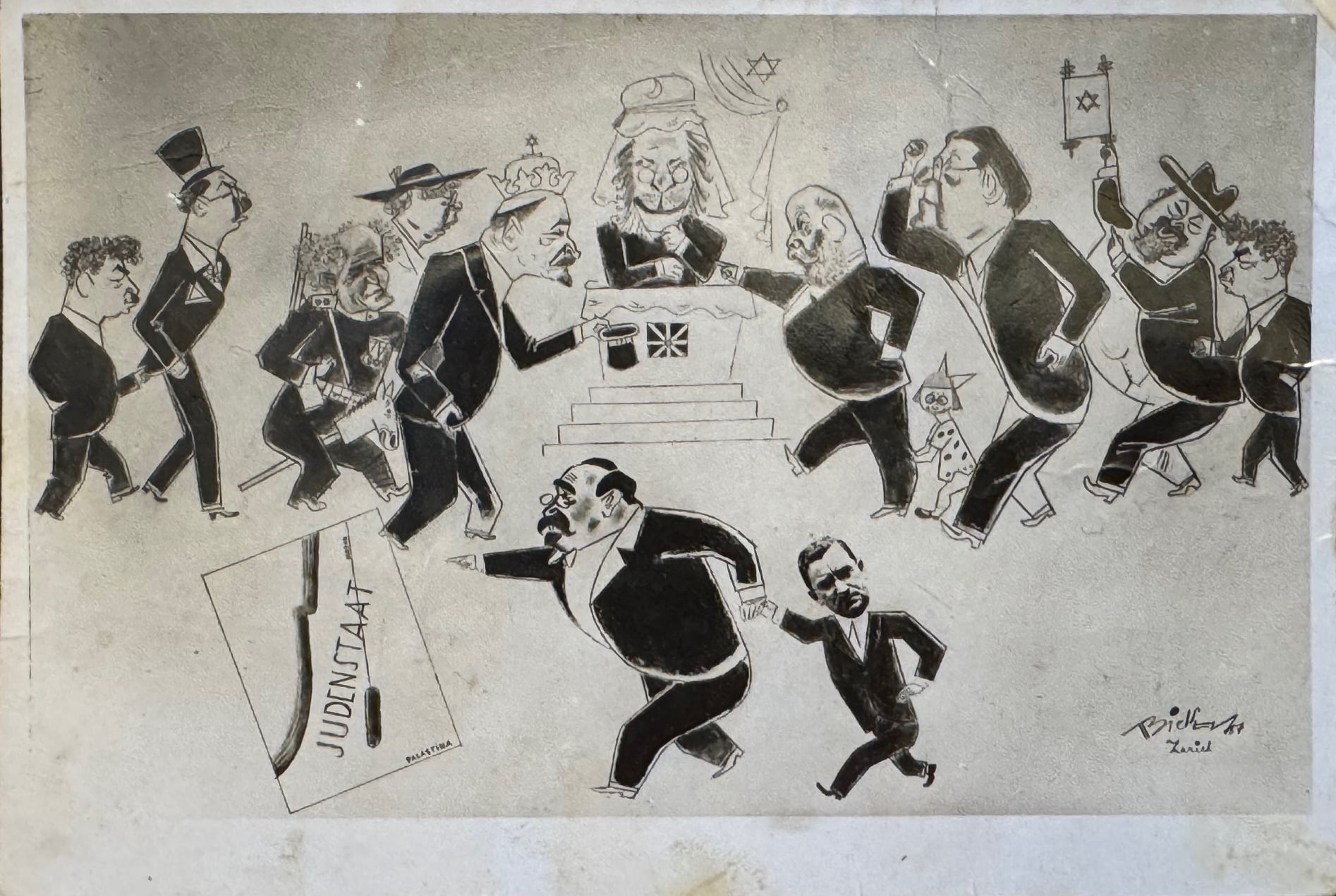
1937 Postcard illustrating the debate over the Peel Commission's partition propasal from the Herzl and Zionsim Collection of David Matlow, Toronto (www.herzlcollection.com). Photograph by David Matlow
Debates within the Jewish community are not new. Rather, a Jewish community without heated debates would be something new; something we have not yet seen. Given that the debating will never end, perhaps we can learn new ways to engage in the arguments, so that we can disagree yet move forward together.
The Polish artist, Jakub Bickels, used humour to make his points. He was a psychiatrist and an artist, combining exceptional talent and a wicked sense of humour. Born in Lviv in 1911, he died during the Warsaw Ghetto uprising. During his short life, he used his pen to protest against fascism through his caricatures in Polish satirical magazines.
He also attended two Zionist Congresses: in Luzern in 1935 and in Zurich in 1937. In Zurich he drew this caricature showing the heated debate regarding the report of the British Peel Commission [https://thecjn.ca/arts-culture/treasure-trove-delegates-were-encouraged-to-go-dry-at-the-1937-zionist-congress/] which recommended the separation of Palestine into a Jewish state, an Arab state and a neutral territory containing the holy places.
Depicted in the middle is a representation of Britain. To its left are those supporting partition including:
Chaim Weizmann,
David Ben Gurion [https://thecjn.ca/arts-culture/treasure-trove-on-israels-independence-day-a-reminder-of-david-ben-gurions-humility/],
Lord Melchet (Alfred Mond) [https://thecjn.ca/arts-culture/treasure-trove-tells-a-tale-of-oranges-fertilizer-and-bombs/]
and Berl Katznelson [https://thecjn.ca/arts-culture/treasure-trove-the-kibbutz-named-in-honour-of-one-of-israels-pioneers-was-on-the-frontlines-of-the-oct-7-hamas-attack/].
To its right are those opposing the partition including:
Menahem Ussishkin [https://thecjn.ca/arts-culture/treasure-trove-recalls-the-dedication-of-pioneering-zionist-menachem-ussishkin/],
a baby representing Hashomer Hatzair,
Rabbi Meir Berlin [https://thecjn.ca/arts-culture/treasure-trove-examines-the-birth-of-the-religious-zionist-movement-and-its-founder-rav-meir-berlin/]
and Berl Katznelson.
Bickels drew Katznelson on each side: both supporting and opposing partition. I asked Romi Hod, the Executive Director of the Berl Katznelson Center, why he thought Bickels would draw Katznelson this way. Hod responded “Berl personally opposed partition in 1937. He believed that dividing the land would weaken the historical and cultural foundations of the Zionist project and create a Jewish state that was too small and vulnerable. At the same time, he worked to preserve unity within the movement and insisted that the debate remain restrained and responsible rather than divisive. That is why the cartoon shows him ‘on both sides’.”
Not all of us have the artistic skills to participate in contentious debates through humorous drawings. However, all of us have the ability to show restraint, act responsibly and work to preserve unity. If you are angry with me that I wrote that, then that is a good place to start.
For more treasures from the Herzl and Zionism Collection of David Matlow, which appear weekly in the Canadian Jewish News (https://thecjn.ca/) see https://herzlcollection.com/treasure-trove
Related Topics
Related Posts