Owner of the world's largest Herzl collection
Treasure Trove: The Knesset Building Turns 60 and Hopes For Its Next Occupants
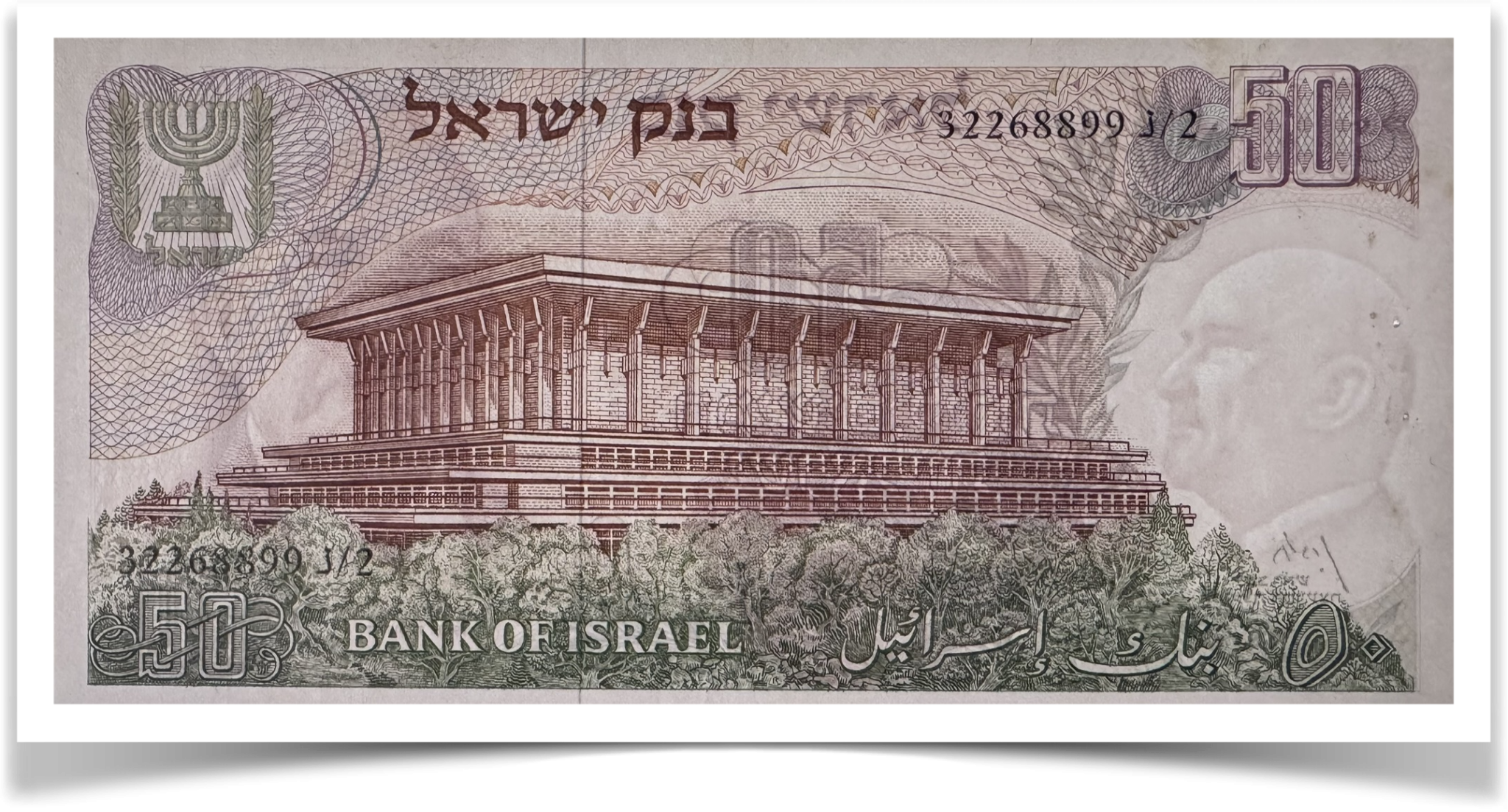
From the Herzl and Zionism Collection of David Matlow, Toronto (www.herzlcollection.com). Photograph by David Matlow.
Israel’s Knesset building, shown here on the back of Israel’s 50 lira banknote from 1968, celebrates the 60th anniversary of its official opening on August 30, 2026.
When Israel was proclaimed on May 14, 1948 the Moetzet HaMedina HaZmanit (the Provisional State Council), which was comprised of the 37 individuals who signed the Declaration of Independence, served as the temporary legislature of the new country. It operated in several locations in Tel Aviv until the first general election for the Knesset took place in January 1949.
The newly elected Knesset held its first four meetings at the National Institutions Building in Jerusalem in February 1949. That building on King George Street is now home to the World Zionist Organization, the Jewish Agency, the Keren Hayesod and the Jewish National Fund.
The Knesset then moved to a theater in Tel Aviv and then back to its first location at the National Institutions Building before settling at the Froumine House in downtown Jerusalem in March 1950. Although not completed at the time, the building was selected because of its large main floor hall (which was designed to be a bank) which could serve as the legislative chamber. The Froumine House was intended to be a temporary location for the Knesset, which remained there for 16 years while plans were developed to build a permanent home for Israel’s parliament. The Froumine House has recently been opened as a museum dedicated to the story of Israel’s democracy. [See https://main.knesset.gov.il/en/about/pages/museumabout.aspx]
Construction of the permanent Knesset was financed in part by a large donation from James de Rothschild (the son of Baron Edmond de Rothschild). [See https://thecjn.ca/arts-culture/treasure-trove-celebrates-passover-and-remembers-israels-first-vineyards/] The family also helped finance the construction of the Supreme Court Building and the new National Library of Israel, continuing the proud tradition of the Rothschild family that dates back more than 140 years. This is a tangible reflection of the role that diaspora Jewry has played in the building of Israel’s most important institutions.
The term Knesset is derived from the ancient Knesset HaGdola or Great Assembly, which according to Jewish tradition was an assembly of 120 scribes, sages, and prophets, in the approximately two century period from the end of the Biblical prophets to the time of the development of Rabbinic Judaism in about 200 BCE. The Knesset name reflects the spiritual, if not literal, connection between the Jewish people’s proud history and the primary institution of a modern sovereign democratic state.
Israel’s direct proportional representation electoral system is a continuation of the system that was and continues to be used to elect delegates to the Zionist Congresses starting with the Second Congress in 1898.
Israel’s 60 year old Knesset building is a tangible manifestation of the combination of our Jewish tradition and the aspirations for a democratic state envisioned by its visionary, Theodor Herzl, and by the country’s founders. As Israel approaches its next Knesset election which is scheduled for October 27, 2026, let us hope that the building’s halls will thereafter be filled by those who will actualize the highest ideals for our one Jewish state.
Treasure Trove is a program of The Herzl Project. Another program is The #Herzl100. 100 Herzl artifacts will be posted over 100 days on Instagram, FaceBook and TikTok. The first seventy episodes are now available on YouTube. The first 70 episodes on YouTube can be found here:
Numbers 100 to 90: https://youtu.be/heFTqAkriF4
Numbers 89 to 80: https://youtu.be/okZ0hmvygJc
Numbers 79 to 70: https://youtu.be/zMeR8vUFuDo
Numbers 69 to 60: https://youtu.be/pT9U13r-yhI
Numbers 59 to 50: https://youtu.be/HT-xJLZAmDM
Numbers 49 to 40: https://youtu.be/3NFy7-S62N0
Numbers 39 to 30: https://youtu.be/R6Yy8dqxxp0
Search #Herzl100 on TikTok, Instagram and Facebook to see, like and share the individual episodes to date, with the Top 18 aretfacts still to come! A new one drops every day.
For more treasures from the Herzl and Zionism Collection of David Matlow, which has appeared weekly in the Treasure Trove column in the Canadian Jewish News (www.thecjn.ca) since February 2021, see https://herzlcollection.com/treasure-trove
Related Topics
Related Posts