Treat a Israel-Syria Deal as a Hudna: Leverage Talks for Golan Recognition
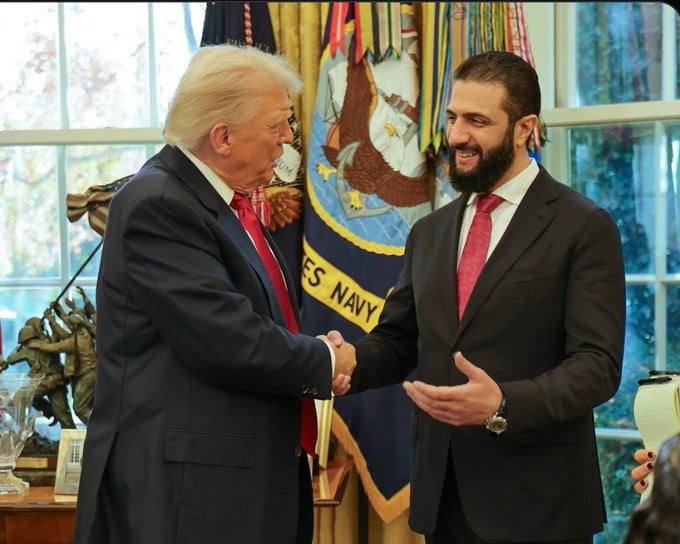
As Ahmad al-Sharaa, Syria’s transitional president and the former jihadist leader known as Abu Muhammad al-Jolani met President Donald Trump at the White House, the world witnesses a pivotal chapter in Middle East diplomacy. This marks the first official visit by a Syrian head of state to Washington since 1946, a dramatic shift from Jolani’s days as a US-designated terrorist with a $10 million bounty on his head.
The agenda included counter-terrorism cooperation, highlighted by Syria’s recent preemptive raids against Islamic State cells, resulting in 61 operations, 71 arrests, and seizures of weapons and explosives—as well as Syrian reconstruction, sanctions relief, and regional stability. While framed as joining anti jihadist efforts, it is more likely that Jolani sees this as a perfect way to solidify his position and get rid of rivals while framing it as anti jihadist for western and regional audiences.
The meeting happened during ongoing indirect security talks between Syria and Israel, mediated by the US. These discussions could redefine the region’s fragile post-Bashar al-Assad landscape, but Israel must approach them with eyes wide open: Any deal with Jolani is, at best, a hudna—a temporary truce rooted in jihadist ideology—not a path to enduring peace. This was underscored by an interview he gave to Fox News where Syrian President Ahmed al-Sharaa was asked about Syria joining the Abraham Accords. His answer was: ‘ Not while Israel “occupies” the Golan heights.
What We Know About the Security arrangement Talks
Israel and Syria have been in indirect US-mediated talks to come to a security arrangement between Syria and Israel to ease border tensions . Recent reports say the talks are in an advanced stage , with some sources suggesting they are “99% done” but facing final hurdles over sovereignty issues (Reuters, November 6, 2025; i24NEWS, November 7, 2025). From open-source information and leaks, we know the pact focuses on practical measures to address immediate threats. Key elements include demilitarization of southern Syria, ensuring no heavy weapons or terrorist infrastructure south of Damascus in areas like Sweida, Quneitra, and Daraa; security guarantees for the Druze minority in Sweida, including withdrawal of Jolani’s Hay’at Tahrir al-Sham (HTS) forces and protections against sectarian violence; Israel’s retention of full control over the Syrian side of Mount Hermon for surveillance purposes; assurances against Turkish military bases at Homs, Palmyra (T4), or anywhere south of Damascus to curb Erdogan’s expansion; and a possible humanitarian corridor for aid to Sweida, though Jolani has resisted on sovereignty grounds (Times of Israel, October 2025; France 24, September 2025). Recent developments also suggest US plans for a military presence at a Damascus airbase to monitor compliance, though denied by Syria (Reuters, November 6, 2025). These elements suggest a narrow pact focused on immediate threats rather than comprehensive normalization
The Hudna Framework: Jolani’s True Intentions
For Israel, it will be very important to engage these talks for a security arrangement with eyes wide open, this will at most be for Jolani a hudna, a temporary truce in jihadist ideology, stemming from his background in ISIS and al Nusra. A jihadist like Jolani will not accept Israel and in their ideology with an enemy at most you come to a hudna when it is convenient for you, to rearm, strengthen and you break it when the time is right for you. It is the exact way how Hamas treated every ceasefire with Israel, as a temporary truce to rearm and attack at a later moment of their choosing. The same dynamic applies to any deal with Jolani.
Once a key figure in al-Qaeda’s Syrian affiliate, Jolani has publicly pledged diversity and recovery, distancing from his past. But archived videos and statements from his HTS days reveal vows to “march on Jerusalem” after consolidating Syria (Foundation for Defense of Democracies report, 2024). There’s no evidence of a genuine ideological shift, or deradicalization. This is underscored with the well documented persecution of minorities in Syria since he took power, also the appearance of morality police in major cities enforcing sharia law and dress codes, and ruthless violence against the Druze as in jihadist circles they are considered as heretics.
Instead, his moderation appears tactical: a facade to attract Western and Gulf aid while biding time. His position is precarious: He faces internal rivalries from jihadist factions—ISIS remnants, HTS splinters, and others—competing in radicalism for recruits and street credibility. To solidify his grip on a fragmented Syria, he must deliver quick, tangible wins: power to end blackouts, food to avert famine, jobs through reconstruction, and basic services to shore up support amid crises like blackouts and famine. This is further underscored by reports today from Syria that Syria foiled two Islamic State assassination plots on Jolani.
Sanctions relief and aid are his lifelines, and Gulf donors like Saudi Arabia and the UAE have pledged billions of dollars in aid and debt relief (e.g., Saudi’s $6.4 billion for infrastructure), believing they can pull Syria into their moderate Sunni orbit. But Jolani and Erdogan likely see these investments as resources to exploit while maintaining their alliance, not a shift away from Turkish influence.
As Jolani has deep Erdogan ties (Turkey’s backing since al-Nusra days, with Turkey providing safe haven, funding, and military backing) he will likely not switch camps but remain loyal to Erdogan. Recent arms deals with Turkey for heavy weapons, drones, and air defenses underscore their intent to rearm and rebuild the Syrian army (Al-Monitor, August 2025) strengthening the perception that a security arrangement will be at best a hudna.
Israel’s Interests: The Upper Hand in Asymmetry
For Israel, the power imbalance is clear and in Israel’s favor, creating a window of opportunity: The IDF holds strategic positions like Mount Hermon, and it can operate in Syria largely unchallenged. Israel doesn’t need the deal—the status quo provides freedom to operate, protect the Druze and borders, and keep Turkey at bay. Additional interests include blocking Hezbollah rearming through the Iranian landbridge, stop Turkish base creep to safeguard the Golan, and maintaining full control over Hermon for surveillance—ensuring no concessions on strategic highs or freedom of operations. Ideology matters less for Israel; the focus is on verifiable deterrence rather than ideological alignment. This upper hand in power in the current situation offers Israel the chance to use those vulnerabilities of Jolani to get from him a major concession that, even though this is a hudna, will have lasting benefits for Israel.
Other Stakeholders: Complicating the Landscape
Other stakeholders’ interests factor into Israel’s strategy by creating both threats and opportunities that can be leveraged for bolder demands. Turkey, under Erdogan, sees Syria as a neo-Ottoman sphere, using Jolani as a proxy to counter Kurds and expand bases—a deal limiting southward push threatens this, but Jolani’s loyalty ensures Erdogan remains his backbone. Factoring this as a risk Israel can counter by demanding assurances against Turkish bases around Homs, Palmyra/T4 and further south to safeguard the Golan.
Russia, with declining influence (~2,000 troops at Tartus and Khmeimim), seeks to retain broker status—a US-led pact marginalizes Moscow further. Iran, desperate to restore its landbridge for Hezbollah arms (severed post-Assad), could exploit any gaps to reestablish proxies, escalating if Jolani allows it covertly—this factors as a threat Israel can mitigate by insisting on Syria blocking any restoration of an Iranian landbridge to Hezbollah.
The Proposal: Demand Golan Sovereignty Recognition
So the current vulnerabilities and urgent needs of Jolani and Israel’s upper hand position it well to make an ambitious demand: formal Syrian recognition of Israeli sovereignty over the Golan Heights (west of the DMZ). Controlled by Israel since 1967, the Golan was gained in a defensive war against Syrian aggression, justifying retention for secure borders under international law (UN Charter Article 51 ambiguities). A sizable minority of legal scholars, like prominent international law professor Eugene Kontorovich, argue territories acquired in self-defense can be kept for security, bolstered by historical Jewish ties—ancient synagogues and biblical kingdoms like Solomon’s, where borders extended into modern Syria (Kohelet Policy Forum papers, 2023).
Syrian recognition of the Golan as Israeli enables Israel to diplomatically get the label occupied removed in many countries, boosting its diplomatic standing, it can boost trade and tourism in the Golan and cement Israeli control of this strategic high ground, important for Israel’s defense.
In exchange, Syria would be offered permanent US sanctions relief and $5-10B neutral aid (via UAE/USAID). Embed poison pills for breaches like snapback sanctions to extend the period Jolani will stick to the arrangement. Knowing Jolani will likely break the arrangement at some point Israel will need to move quickly after signing the security arrangement by going on a diplomatic offensive to gain as many diplomatic recognitions of the Golan as Israel as possible. What will help Israel is that the Golan is internationally less controversial then Judea and Samaria as no Palestinians live there, only Israeli’ s and Druze (of whom a growing minority also have taken Israeli citizenship).
Israel can get US president Trump on board likely if it emphasizes how it retroactively validates his 2019 Golan recognition as visionary, shifting the US from isolator to trendsetter. And provisions banning Turkish bases near Homs/Palmyra and further south avoid direct Israel-Turkey clashes, preventing a big dilemma for the US as it would face a major NATO ally versus its closest middle east ally Israel. Though it wouldn’t trigger official NATO involvement as Turkey’s actions in Syria do not fall under NATO protection, but unofficially it would be a diplomatic problem. Increased aid also supports Trump’s investment in Syrian progress, aiding regional peace.
Now it is likely Jolani will at first resist a demand for recognition of the Golan as Israeli land and would possibly counter with vague formula’ s like acknowledging current “lines of control” language (sidestepping diplomatic recognition). It will be important to reject it as that gains Israel nothing, be explicit and keep insisting on sovereignty or nothing. Impress that this one-time window helps him secure his position with quick aid; be ready to walk, showing Israel’s upper hand.
Risks and Benefits
The benefits unfold like this: Locking in formal recognition creates a window to cash in diplomatically with diplomatic recognition of the Golan, validating Trump’s 2019 move as visionary and removing the “occupied” label from numerous countries, though realistically many also wont due to anti Israel sentiments. but enough may be open to it then to normalize it and get the occupied label removed. In time pragmatism/realpolitik will likely lead more to follow suit as it is hard to maintain it is occupied when even on paper Syria says its Israeli land. Golan’s Druze population (seen as heretics by many Sunnis) stirs no outrage like Palestinian issues, facilitating acceptance.
Yet risks loom: Jolani rejects due to ideology, stalling talks—mitigate with low-key rollout. Or he reneges early, limiting gains—poison pills delay this. It’s a long shot, but asymmetry makes it worth pursuing—Israel loses nothing.
Conclusion
Israel should seize this rare moment of strength and Jolani’s vulnerabilities to gain diplomatic recognition of the Golan. Naysayers will dismiss it, but underestimate how vulnerable his position is, rivals ready to pounce as we saw last week when Syria reported two failed assassination attempts on Jolani. Many rivals want his position and he needs to deliver fast to consolidate his position. This is the time to use his pressure points not just for security and Druze guarantees but to gain international recognition of Israeli sovereignty over the Golan . Capitalizing on this can turn a hudna into enduring gains, even if Jolani breaks it down the line.