
Middle East Analyst
Trump and MBS at the Scorpion’s Gate – Part 2
By author (AI)
A month ago I compared Donald Trump’s and Mohammed bin Salman’s predicament to the trap in Richard Clarke’s 2005 novel Scorpion’s Gate: a strategic position in the Persian Gulf that is cheap to enter and expensive to leave. Trump had already been stung at the Strait of Hormuz. MBS had not, but his proximity to the gate made him vulnerable. The sting has now come at the second pincer, the Bab el-Mandeb, and it landed within a day of a strike on the pipeline that Saudi Arabia built to avoid the first gate. Both men now face constraints that follow directly from decisions each made on instinct, against advice.
The Sting Arrives in Stages
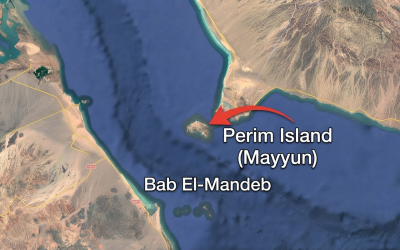
The Houthis resumed attacks on Saudi Arabia in mid-July and declared a blockade of Saudi ports and ships in the Bab el-Mandeb on July 20. On September 8 they fired ballistic missiles and drones at Abha, Khamis Mushait, Jazan and Najran, and Saudi authorities reported civilian injuries and disruption at oil facilities. A Houthi offensive along Yemen’s western coast, which AP reported killed more than 1,500 government soldiers, took the port of Mokha and then reached the strait itself. Reports place the fall of Perim Island, the small island that divides the strait into two shipping lanes, on September 10 or 11. The first report rested on a single outlet, but a Houthi official later confirmed it, and AFP reported that the Houthis now hold Yemen’s entire Red Sea coast.
The Houthis claim navigation remains safe for all companies except Saudi ships. Traffic through the strait was nonetheless reported to have roughly halved as the Houthis closed on Perim. Whether the ban covers Saudi-flagged hulls or Saudi cargo on foreign-flag tankers has not been settled in the public reporting, and it matters a great deal for Saudi exports. Insurers and shipowners will price the ambiguity long before a navy or air force resolves it.
On September 19 the attacks reached Riyadh. Saudi Arabia said it intercepted a ballistic missile aimed at the capital. The Houthis claimed strikes on “sensitive” sites there and on an Aramco installation in Yanbu, and AFP reported a fire at an Aramco fuel tank near King Khalid International Airport. It was the first Houthi launch at Riyadh since July.
The Bypass Meets the Second Gate
The most consequential event of the week may have come a day before Perim fell. On September 10–11, drones launched from Iraq’s Maysan province struck the East–West pipeline, the 1,200-kilometer line that carries crude from the Eastern Province to Yanbu on the Red Sea. With Hormuz largely closed since the war began, the pipeline had been moving roughly five million barrels a day. Saudi Arabia shut it down, and officials told AP that repairs could take three to five weeks, with partial operation possible in the meantime. Kpler estimated that the Yanbu tanks held about fifteen million barrels, roughly four days of exports at normal withdrawal rates.
The pipeline was Riyadh’s hedge against the first gate, and its terminus sits on the sea lane the second gate controls. Asia-bound cargoes from Yanbu go south through the Bab el-Mandeb. Within roughly a day, the hedge was cut and the sea lane it depended on became hostile to Saudi shipping. That sequence is the Scorpion’s Gate in operational form. It also reveals a third vector. Baghdad confirmed the drones came from its territory and dismissed a military commander in Maysan. Trump pointed at Iran-backed groups in Iraq, and Tehran denied it. Saudi Arabia chose not to retaliate at the Iraqi prime minister’s request.
Trump: Was Warned, and Went Ahead
Trump was reportedly warned against launching the preemptive Iran war by nearly every senior national-security adviser around him. Vice President Vance reportedly cautioned that it would bring regional chaos, heavy casualties and a fractured political coalition. CIA Director Ratcliffe reportedly told the inner circle, the day after Netanyahu’s Situation Room presentation, that the regime-change scenario was “farcical.” Director of National Intelligence Gabbard reportedly warned that killing Supreme Leader Ali Khamenei would install a harder-line regime, that Iran would move to close Hormuz, and that it would strike US forces and Gulf partners. Chairman of the Joint Chiefs Caine reportedly cautioned that US munitions could sustain a campaign of weeks, not months. Defense Secretary Hegseth was the exception.
The war is now more than six months old. The Pentagon’s own inspector general, in its first report on the conflict, has confirmed a strategic munitions shortfall and industrial-base bottlenecks. As of September 3, 2026, the estimated cost of the US military operations in Iran has reached approximately $43.6 billion. Trump proceeded on instinct anyway, and the shortage Caine described now decides what Washington can do for its principal Gulf partner.
MBS: Warned by Everyone Except, Apparently, Himself
The public record says nothing about the counsel MBS receives from his own advisers, and there is little reason to think it is candid. What is on the record is the counsel he received from outside. Since his elevation to Crown Prince in 2017, allies and independent analysts have warned that the Iran-backed Houthis could not be beaten by an indiscriminate air campaign and tentative diplomatic arrangements, and that the weakness of Saudi land forces was a severe long-term vulnerability. A US Special Forces team was training Saudi ground troops on the Yemen border by 2017, which suggests allies saw the gap early. The years after 2015 confirmed the limits of air power: it damaged targets without producing a stable political outcome, and Riyadh gradually scaled back its direct role.
Independent reporting has consistently suggested that his attention and money went instead to spectacular real estate projects and trophy defense procurements that did nothing to shore up the kingdom’s Achilles heel. The megaprojects have since been cut back. The PIF cancelled billions in contracts for Trojena, construction on The Line has all but ceased, and a leaked NEOM board presentation reported by the Wall Street Journal projected costs that no fiscal plan could carry. This month the Houthis ran over the Yemeni forces Saudi Arabia had trained and backed for a decade, seized the Red Sea coast and Perim Island, and fired ballistic missiles at Riyadh. That but it is the same weakness one step removed: a kingdom without capable ground forces of its own depends on partners who cannot hold.
Cheap to Enter, Expensive to Leave
Both men reportedly rely more on personal instinct than expert advice. Both are now bound by constraints they did not plan for. Trump cannot escalate freely because of the munitions arithmetic, a November midterm calendar, and the risk of Iranian retaliation through proxies. MBS cannot get relief because his patron is depleted and the world’s other suppliers of air defense are short.
The numbers are stark. A CSIS analysis found that Patriot interceptor stocks fell from 2,330 at the start of the war to fewer than 850 by the end of July, and THAAD stocks from 452 to about 250. On September 16, AP reported that Saudi Arabia had asked France, Britain, Pakistan and Egypt for air-defense help as its own interceptors ran low. One official tied the request to the depletion of American stocks. As of that report, no country had announced support. The Saudi shield thinned at the moment the Houthis shifted their fire to the capital.
This is where the air-power problem meets the arithmetic. The 2019 Abqaiq attack showed that cheap drones and missiles could bypass expensive defenses to hit critical infrastructure. The lesson called for layered, distributed, inexpensive defenses: short-range air defense, electronic warfare, hardened redundancy and capable ground forces. High-end platforms that depend on external logistics and a steady supply of expensive interceptors cannot substitute for them, and adversaries who impose attrition with cheap, repeatable attacks are exploiting exactly that gap.
The Decision in Front of Washington
Trump cut short a weekend at Camp David and returned to the White House after the attack on Riyadh. Security analyst Alex Plitsas said the meeting was convened to review Yemen strike options. The White House has not confirmed that, and I would treat it as evidence that options are being weighed, not that a decision has been made. The State Department warned that the conflict could escalate rapidly, and regional missions told citizens to prepare for disruption.
The prior baseline points the other way. Axios reported that MBS called Trump twice last week urging strikes on the Houthis, and Trump refused. US officials met Houthi representatives in Muscat, where the Houthis reportedly pledged to spare American, Israeli and other commercial shipping while excluding Saudi vessels. That arrangement gives Washington little direct reason to intervene, since US and allied shipping is largely spared. The exposure is indirect: Saudi credibility, oil prices before the midterms, and the durability of the American security guarantee.
Trump’s incentives cut both ways. Avoiding a new front argues for restraint, as does a depleted arsenal, and the May 2025 truce with the Houthis, which ended a two-month bombing campaign, gives him something to lose. A Red Sea oil shock before November argues for action, and so does the cost to American credibility of standing aside while Riyadh burns. Any strike also risks giving Tehran a reason to widen proxy attacks, at a moment when Trump has told Axios he faces “a big decision” on whether to resume major strikes on Iran itself.
MBS’s Options Are Narrower Than They Look
Saudi Arabia has hedged. It signed the Makkah Joint Defence Agreement with Turkey and Pakistan last month, and Turkish Foreign Minister Fidan said this weekend that Riyadh could request support under it and Ankara was prepared to provide unspecified technical assistance. As of AP’s September 16 reporting, Turkish and Pakistani officials said they had received no request. Invoking the pact would carry political weight in Riyadh and in Washington, and it would test whether the pact is a real guarantee or a diplomatic signal.
A second option, Israeli air-defense help, is closed for now. A Saudi source quoted by Israel’s Kan said Riyadh would not normalize relations even if Jerusalem helped against the Houthis, and that no resolution of the Palestinian question was in sight. MBS’s legitimacy at home and across the Muslim world does not allow it, so he is left with the Americans he has been unable to move, the Turks and Pakistanis he has not yet asked, and a stockpile that is running down.
What to Watch
Several indicators will show which way this breaks. The first is whether the Houthi shipping ban is enforced by flag or by cargo, and how insurers and shipowners price it. The second is Yanbu’s tank levels and how much of the East–West pipeline’s capacity returns during repairs. The third is whether any state announces air-defense deployments to the kingdom, and whether Riyadh formally invokes the Makkah pact. The fourth is whether Washington moves from intelligence and targeting support to direct strikes, and whether Iran or its proxies widen the front in response.
Humility, Not Spectacle
Boldness has its place. But two leaders who chose instinct over counsel have arrived at a trap whose defining feature is that the cost of leaving exceeds the cost of entering. The way out is unglamorous: layered defenses, capable ground forces, replenished stockpiles, and allies who share the burden. Both men have ignored critical requirements, and no rhetorical bravado will substitute for them. Aligning the appropriate military capabilities with the character of the threat is slower than a strike, and it is the only approach that survives contact with an adversary who can attack cheaply and repeatedly.
Related Topics
Related Posts