
Middle East Analyst
Trump and Netanyahu Risk Being Played by Putin and Xi
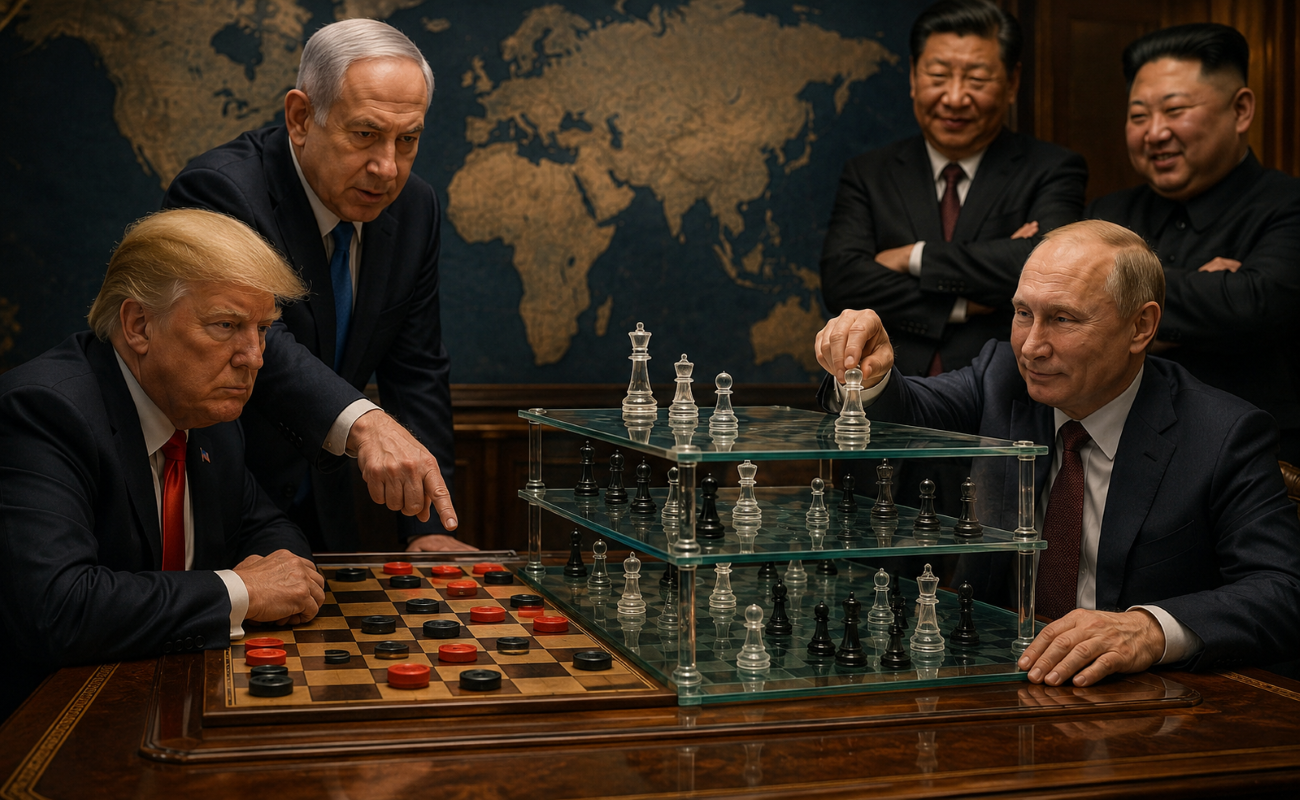
By author (AI)
Checkers Vs. Three-Dimensional Chess:
On August 30, the Washington Post reported something that had been building in the Secretary of Defense Orders Book since at least August 14: senior US military leaders formally logged “non-concur” positions against extending force deployments associated with the Iran war, some of them through 2027. The dissent did not come from commanders refusing to carry out their orders. They will comply. Nor was it a public rebellion over Iran policy. It was something more consequential: the military leadership formally recording its judgment that sustaining the war is imposing unacceptable costs on US readiness elsewhere.
That distinction matters. A classified planning document is not a hearing room, a press conference or an anonymous leak. It is where military leaders are expected to put their professional judgment on the record. And what they recorded was essentially a warning about the kind of war Washington thinks it is fighting—and the number of wars it may actually have to be prepared to fight.
The Iran war has been running, in one form or another, since the February 28 strikes that killed Ali Khamenei. Trump, Netanyahu and Hegseth have approached it primarily as a contest between the United States and Israel on one side and Iran on the other, with success measured by Iranian capitulation, restraint or collapse. That is checkers: one board, one opponent, one immediate objective.
The commanders responsible for the rest of America’s military posture do not have that luxury. Their job is to look across the entire board simultaneously. They have to worry about what Moscow is doing in Europe, what Beijing is doing in the Indo-Pacific and what Pyongyang is doing on the Korean Peninsula while the Pentagon is concentrating forces, aircraft, ships, missile defenses and munitions on Iran. They are not objecting to the existence of the Iran war. They are warning about its opportunity cost. That is what makes the August 14 non-concurs so significant.
The Board Is Bigger Than Iran
The mechanics reported by the Post make the problem concrete. Forces and equipment assigned to sustain the Iran campaign have been pulled from other commands, reducing their ability to train, maintain readiness and respond to contingencies in their own theaters. The issue is not simply whether the United States possesses enough military power to fight Iran. It is whether it possesses enough immediately available power to fight Iran and remain ready for everything that happens while it is doing so. That is a different question.
America’s adversaries do not have to defeat the United States in the Middle East to benefit from this situation. They only have to recognize that American resources are finite. This is where the increasingly consequential relationship among Russia, China, Iran and North Korea becomes relevant. Researchers at the Center for a New American Security and elsewhere have described these four states as an “axis of upheaval”—not a formal military alliance, but a loose strategic convergence among governments that share an interest in weakening US power and challenging the international order Washington has dominated since the end of the Cold War.
The significance of the relationship is not that Moscow, Beijing, Tehran and Pyongyang have suddenly become a unified military command. They have not. The significance is that each can create problems for the United States that make the others’ problems easier to pursue. China benefits when American military resources and political attention are concentrated elsewhere. Russia benefits when Washington’s capacity to support European security is strained. North Korea benefits when U.S. forces and intelligence assets are absorbed by another crisis. Iran benefits when the United States is forced to divide its attention among multiple theaters.
None of this requires a secret meeting at which the four governments agree on a common operational plan. It requires only compatible interests. And increasingly, it is accompanied by material cooperation. Iran supplied Russia with Shahed drones and other military equipment after Russia’s invasion of Ukraine in 2022 and helped Moscow develop domestic production capacity for the systems. The relationship has since evolved in the other direction. During the current conflict, US and independent assessments have reported Russian assistance to Iran involving drone technology, targeting information and other military support. The old relationship—Iran supplying Russia—has become reciprocal. That matters because the strategic value of the relationship is not measured by whether Russia and Iran have signed an alliance treaty. It is measured by whether each can help the other impose costs on the United States and its partners. The answer increasingly appears to be yes.
The Arsenal Has an Opportunity Cost
The most tangible evidence of that opportunity cost is not the rhetoric about the “axis.” It is the ammunition expenditure. The United States entered the current period already concerned about the sustainability of its missile-defense inventories. During the 2025 Israel-Iran war, American forces fired more than 150 THAAD interceptors. The expenditure represented a major draw on an inventory that is tiny compared with the potential demand generated by a major missile war. The Pentagon subsequently redirected hundreds of millions of dollars from previously authorized Israel-security funding toward replenishing THAAD stocks. Current assessments put the Army’s THA D inventory at only a few hundred interceptors.
The precise percentage consumed during the 2025 war is disputed because the underlying inventory figures are classified and different analysts use different baselines. The important fact is less controversial: the United States expended a substantial portion of a scarce, sophisticated missile-defense inventory defending Israel and then had to accelerate procurement to rebuild it.
The current war has reopened that problem. That is not merely a Middle Eastern accounting issue. THAAD is an American strategic asset. The same production capacity, trained personnel, logistics and interceptors that can be used to defend Israel are part of the broader US ability to respond to missile threats elsewhere. The distinction is important.
Gulf states have also expended substantial quantities of Patriot and other interceptors against Iranian missiles and drones. But much of that expenditure comes from systems they purchased and maintain themselves. The United States has its own costs in defending American bases and personnel throughout the Gulf, but the burden is distributed differently.
Israel is different. Washington has made the defense of Israel a central American military commitment, and increasingly large quantities of US-owned missile-defense assets are being consumed in fulfilling it. The Gulf states are largely drawing down their own shelves. Israel’s defense is drawing down Washington’s. That distinction becomes strategically important when the shelves cannot be restocked overnight.
Iran Is Dangerous. That Isn’t the Same as Saying It Is the Biggest Threat.
None of this requires minimizing Iran. Iran has an extensive ballistic-missile arsenal. It can attack US forces and bases throughout the region. It can threaten Israel. It can disrupt energy markets and shipping through the Strait of Hormuz. It has developed a sophisticated network of regional partners and proxies. And its nuclear program has brought it dangerously close to the threshold at which a nuclear weapon could become technically feasible. But Iran does not possess a nuclear weapon. Russia possesses thousands. China possesses hundreds and is rapidly expanding its arsenal. North Korea is believed to possess roughly 50 nuclear weapons and continues to develop the systems required to deliver them.
According to the Stockholm International Peace Research Institute’s latest estimates, Russia possesses roughly 5,500 nuclear warheads in total, China roughly 600-plus, and North Korea roughly 50. The precise numbers vary depending on whether one is counting total inventories, military stockpiles or deployed weapons, but the strategic hierarchy is not in serious dispute. More importantly, Russia, China and North Korea possess—or are assessed to possess—missile capabilities capable of reaching the continental United States. Iran does not.
That does not make Iran irrelevant. It makes the opportunity cost of treating Iran as though it were the only strategic problem on the board more difficult to ignore. The United States is expending military resources to destroy or constrain a potential Iranian nuclear capability while simultaneously maintaining readiness requirements for three nuclear-armed states that possess the ability to threaten the American homeland.
The question is not whether Iran deserves American attention. The question is how much American attention Iran can absorb before the marginal cost of that attention becomes more dangerous than the threat it is intended to eliminate. That is the question the combatant commanders have now put on paper.
The “Imminent Threat” Problem
The argument for extraordinary urgency rests partly on the proposition that Iran represented a uniquely urgent nuclear danger. But urgency has to be measured comparatively. Russia has represented an existential nuclear threat to the United States for generations. The Soviet Union acquired the atomic bomb in 1949. The Cuban Missile Crisis in 1962 brought Washington and Moscow extraordinarily close to nuclear war. China subsequently became a nuclear power, and North Korea eventually joined the nuclear club.
The United States has spent decades managing these threats while maintaining a military posture designed to deter more than one adversary at a time. That is precisely what makes the present situation unusual. The problem is not that Washington has suddenly discovered that Iran is dangerous. The problem is that the United States is now conducting a sustained major military operation against Iran while simultaneously facing three other strategic competitors whose interests are increasingly aligned with keeping American power tied down. The difference is not simply the size of Iran’s arsenal. It is the number of boards being played simultaneously.
The Other Players Don’t Have to Move Together
There is an important analytical distinction here. There is no need to argue that Russia, China, Iran and North Korea constitute a unified military alliance or that they are coordinating every move against Washington. The evidence does not establish that. The more consequential possibility is simpler: they increasingly understand how their separate actions interact. Russia can help Iran. Iran can help Russia. China can provide Russia with economic and industrial support while benefiting from American strategic distraction. North Korea can supply Russia with artillery, missiles and other military assistance while watching American attention remain fixed elsewhere.
Each actor gains something when American military resources are concentrated in another theater. That creates what might be called a strategic multiplier without a formal alliance. Washington does not have to lose a war in Iran for its adversaries to gain an advantage. It only has to remain sufficiently occupied there that its ability to deter or respond elsewhere becomes less credible. This is the calculation that conventional force planning is designed to prevent. It is why the combatant commands exist. It is why the Pentagon worries about readiness even when American forces are winning individual engagements. And it is why a “non-concur” in a planning document can be more significant than a dozen public statements by politicians.
The Cost of Winning
The fundamental problem with the current strategy is therefore not whether the United States can defeat Iran. It probably can. The harder question is what defeating Iran requires—and what Washington has to give up while doing it. Every ship tied down in the Middle East is a ship unavailable elsewhere. Every fighter squadron extended in theater has maintenance and readiness consequences. Every missile interceptor fired has to be replaced.
Every deployment extended into 2027 consumes personnel, training cycles and equipment availability that cannot simultaneously be used to prepare for another contingency. Every dollar spent replacing an interceptor is a dollar that cannot be spent somewhere else. And every additional month in which the United States concentrates its attention on Iran gives the other players on the board another month in which to adjust their own calculations. This is the strategic blind spot embedded in a two-player conception of the war.
Trump and Netanyahu can reasonably focus on the question of whether Iran can be compelled to surrender, disarm or abandon its nuclear ambitions. Hegseth can reasonably focus on the forces required to execute that policy. But the combatant commanders have a different responsibility. They have to ask what happens if Iran is not the last crisis. Their job is not to win one war. Their job is to preserve enough military power to deter or fight the next one, potentially against a much more capable adversary. Potentially against several more capable adversaries. That is why the August 14 non-concurs matter.
They are not insubordination. They are not a refusal to fight. And they are not necessarily even an argument about whether the Iran campaign is strategically justified. They are a professional warning that the cost of the campaign cannot be measured only in Iranian casualties, destroyed missiles, nuclear facilities or days remaining in the war. It must also be measured in the military capacity Washington no longer has available elsewhere. And “elsewhere” is not an abstraction. It is Europe, where Russia remains at war. It is the Indo-Pacific, where China continues to expand its military power. It is the Korean Peninsula, where North Korea continues to develop nuclear weapons and the missiles to deliver them.
Those actors do not pause while Washington finishes with Tehran. That is the board Trump, Netanyahu and Hegseth risk overlooking. They are playing checkers. The people responsible for America’s military strategy are looking at three-dimensional chess.
Related Topics
Related Posts