
Trump in Sanae’s Kingdom: How Japan Is Quietly Reclaiming Its Power
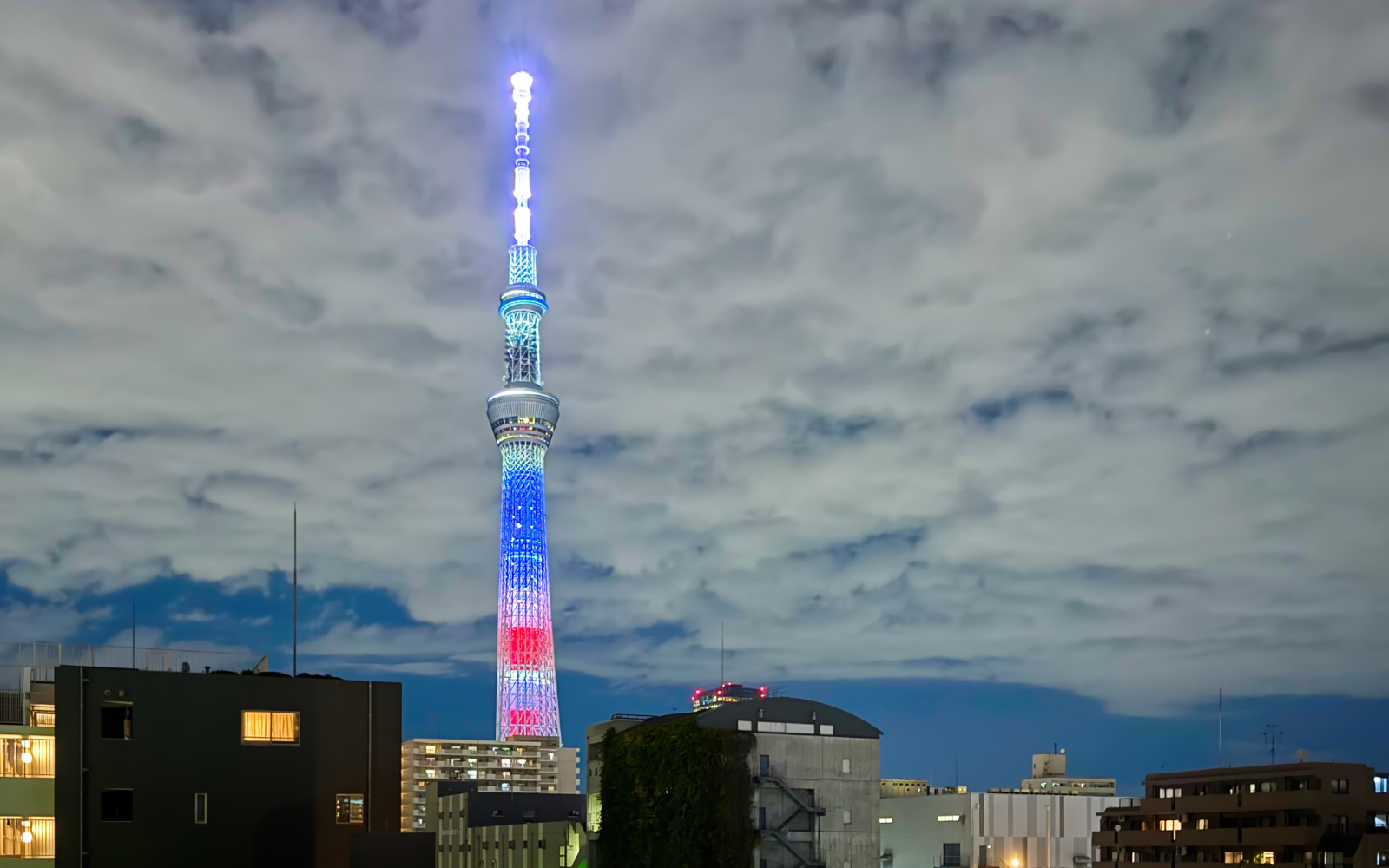
Tokyo Skytree illuminated in red, white, and blue during Donald Trump’s visit to Japan, October 27 – 29, 2025. (Photo by the author)
Trump was a long-expected beloved prince in Japan. The eagerness of people to see him, the tight security, and the environment of the city all signaled that someone important was coming to Tokyo.
When Donald Trump’s Air Force One landed in Tokyo on October 27, 2025, the city moved with quiet precision. More than 18,000 police officers guarded every corner of the capital. From Haneda Airport to the Imperial Palace, every route was planned, every step watched. For two days, Tokyo turned into a symbol of discipline, order, and pride.
It was unbelievable how calm and controlled everything was. The security plan worked like a perfectly rehearsed performance.
Japan now stands at a turning point. The country faces heavy economic pressure from debt, inflation, and an aging population. It also faces rising threats from North Korea and China. Amid growing uncertainty in American politics, Trump’s visit carried a clear message: Japan must move from protection to preparation. The alliance with the United States is no longer one-sided. It is now a partnership of equals.
Even the atmosphere of the Japanese capital reflected that change. Tokyo Tower and the Skytree, two major Japan’s landmarks, lit up in the colors of the American flag. These two landmark lights reflected across the Tokyo sky, glowing like a signal of new confidence.
Families stood quietly on both sides of the streets, watching history unfold while they were waiting for Trump’s arrival. While I was among them, I felt as if Japan was not only welcoming a guest but also showing the world that it was ready to lead with confidence.
Prime Minister Sanae Takaichi, Japan’s first female leader, received Trump at the Akasaka Palace on October 28. She greeted him warmly. Through Trump’s visit, her leadership marks a new era for Japan. She believes, “Peace without strength is fragile. Peace with preparation endures.”
We know that Sanae Takaichi took power at one of Japan’s hardest moments. After Prime Minister Abe’s death, many tried to fill the gap, but no one succeeded. Sanae had to fight her way into leadership, breaking Japan’s long male-dominated tradition. She did it with both charm and courage.
She is a great leader. We see her on the TV screen, she is cheerful in spirit, like a teenager, but sharp as a Samurai when facing national challenges.
Besides, she has some very sharp government officials. Among them, two of her strongest allies are Finance Minister Satsuki Katayama and Defense Minister Shinjirō Koizumi. Both are bold and reform-minded. Koizumi, in particular, is seen by many as a future prime minister. No doubt, together, they formed a government ready to take bold action for a new Japan.
One of the most significant points of this visit was that Trump and Takaichi announced a landmark deal on rare-earth and critical minerals. The agreement goes far beyond trade. It secures the industrial survival of two major democracies in a world racing for resources. These materials, neodymium, praseodymium, dysprosium, terbium, europium, and yttrium, are the hidden engines behind modern life. These materials are used to make electric cars, radar systems, guided missiles, and jet engines possible. Whoever controls them controls innovation and security.
For years, China has dominated nearly 80% of global rare-earth production. Japan learned the risk in 2010, when China cut off supplies during a dispute. Prices spiked. Factories stopped. Tokyo realized how dangerous dependency could be. That event changed Japan’s entire national strategy.
The new US-Japan agreement fixes that weakness. It builds a democratic supply chain from mining to recycling, so no nation can hold Japan’s economy hostage again. Analysts say this is more than an economic pact. It is a new form of self-defense protecting Japan’s economy and freedom at once.
Japan is an Island, surrounded by sea. So, we can say that Japan’s future also lies under the sea. More than that, near Minamitorishima Island, scientists have discovered a vast area of rare-earth-rich mud containing up to 16 million tons of usable material. These metals are vital for Japan’s technology and defense. The Sanae government plans to start test mining in 2026. If successful, Japan could shift from importer to exporter, joining the few democracies that control their own critical materials.
The impact could be historic. Japan would finally end its dependence on others. It would gain leverage equal to its technological power. Its industries would be secure, its allies supported, and China would lose one of its main sources of pressure. This is not just a story about minerals; it is about independence and power.
The Akasaka Palace summit lasted about only forty minutes, followed by a signing ceremony and lunch. But the significance of the meeting is vast. Both leaders agreed to deepen cooperation on security, energy, and defense production. Takaichi called it “a cornerstone for a new golden era of Japan–US relations.” Trump said, “Anytime Japan needs us, America will stand beside her.”
That is huge for Japan, indeed.
Trump’s visit also sent a message that went beyond politics. Both leaders described their partnership as part of a global defense of democracy. Japan, like Israel, understands that small nations surrounded by danger must rely on discipline and unity, not sympathy. The Japan–US alliance now stands as one of the strongest democratic partnerships in the world, built on conviction, not convenience.
The timing of the visit was also meaningful. It came as tensions rose in both the Indo-Pacific and the Middle East, two regions now linked by shared security challenges. Japan’s role in the Taiwan Strait mirrors Israel’s in the Middle East: both are democratic frontlines defending freedom and stability. The message from Tokyo was clear, “Democracies must prepare together before the next crisis begins.”
Japan knows now where it is heading. It is rebuilding its industrial base, securing its technological leadership, and preparing for long-term competition.
At the same time, immigration policy is changing. Takaichi’s government is updating the immigration policy. The new government is only ready to welcome skilled workers but insists on clear rules to protect its culture and social order. Visa systems are being tightened. Illegal labor is being stopped. Integration will happen with strict discipline. These measures echo Trump’s call for control, but without hostility. Japan’s goal is a balance between growth and identity, openness and order.
Many consider it to be one of the most time-demanding policies in Japan, as the majority of Japanese do not want to see the same scene as the present Europe.
This leadership is steady but strong. Japan will not return to militarism. It will lead through precision, planning, and trust. The same values that built its post-war miracle now guide its rise as a strategic power.
Many political policymakers around the world see Trump’s visit as a turning point for Japan. Because Japan can mine, refine, build, and defend, it is no longer shaped by history; it is shaping history. The handshake between Trump and Takaichi was more than a ceremony. It showed that Japan has stepped out of China’s shadow and joined the builders of a new world order based on resources and responsibility.
When Trump left Tokyo on October 29, 2025, many waved in quiet admiration as he departed. Yet the feeling that remained was one of confidence, discipline, and hope. Japan has proven that true strength is calm, quiet, and prepared. Under Sanae Takaichi’s leadership, Japan is showing the world that democracy and determination can still walk hand in hand, the economy can be rebuilt, and security can be reformed.
October 30, 2025
Tokyo, Japan
Tokyo, Japan
Related Topics