
Founder & Principal, Line of State
Trump Is Not Leading the World, He Is Directing the Show
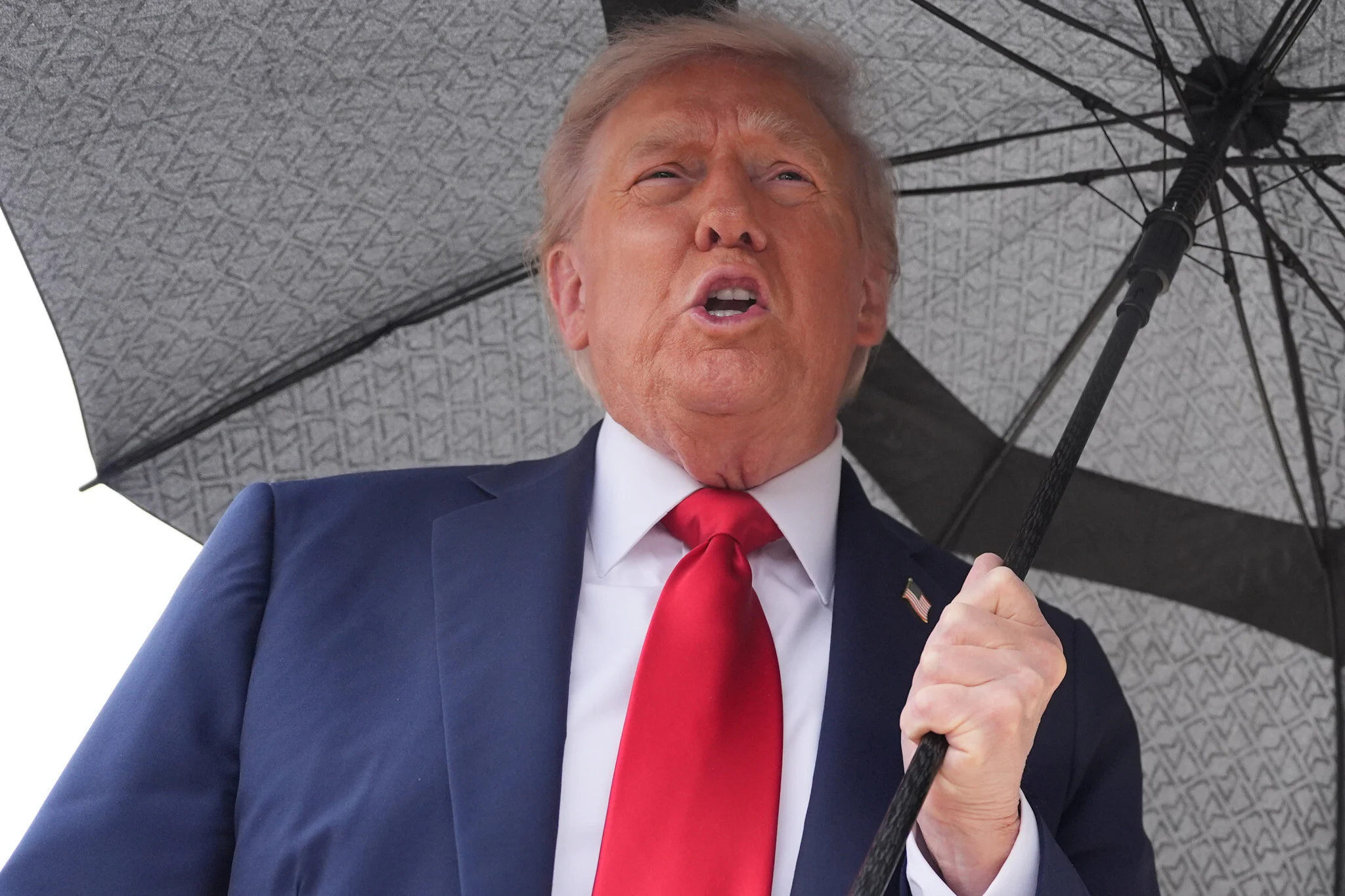
Trump under his own umbrella - shielding the performance, not the world. US President Donald Trump speaks to reporters before boarding Air Force One, October 12, 2025, at Joint Base Andrews, Maryland, as he heads to the Middle East. (AP Photo/Evan Vucci)
In an interview with Politico, Donald Trump once again turned foreign policy into reality television. Europe is “rotting”, its leaders “weak”, Viktor Orbán “gets it”, Erdogan is “tough”. This is not provocation; it is method. Trump does not evaluate states through long-term interests or durable alliances, but through what they provide him: utility, force projection, a moment on camera. He believes in the deal, not the institution; in the gesture, not the structure. Europe, Israel and NATO are not stabilizing frameworks to him – they are props that rise or fall according to how well they serve the script of the day.
Trump is not inconsistent by accident – inconsistency is his operating doctrine.
With Russia, the pattern is clear. The Kremlin welcomes an American posture that questions NATO expansion and blurs the principle of fixed borders. Trump’s emerging “peace plan” for Ukraine freezes Russian gains and distances Kyiv from NATO in line with Moscow’s preferences. It reverses the logic of the 1994 Budapest Memorandum: then Ukraine surrendered its nuclear arsenal for assurances; now it is asked to surrender territory for the same – paper. It signals to an aggressor that time works in his favor, and to allies that guarantees can bend when politics demands it.
Trump praises Erdogan as a “strong leader” who “knows how to handle things” just as Turkey positions itself as a new Iran: a nuclear reactor on the Mediterranean built with Rosatom, missiles pointed at Athens, military control over occupied northern Cyprus. Washington simultaneously smooths Ankara’s path back into Western structures – lifting S-400 sanctions, advancing the F-35 reopening, exploring a quiet end to the Halkbank sanctions-busting case. This is not a reset – it is the elevation of a threat. A US president who admires rather than restrains Erdogan multiplies regional danger. Washington’s “creative solutions” do not limit Erdogan’s leverage – they expand it.
The threat to Israel, Cyprus and Greece is immediate. Turkey advances a revisionist maritime doctrine, disputes sea boundaries with Greece, undermines Cyprus’s agreements and treats any energy project that bypasses Ankara as provocation. Even an undersea power cable linking Europe to Cyprus and later Israel becomes leverage the moment Ankara decides it “does not exist” without its permission. The Eastern Mediterranean is no longer a periphery – it is Europe’s exposed frontier, and Israel sits on the same fault line.
This is the pattern: posturing against political Islam while indulging the states that fuel it. Declaring parts of the Muslim Brotherhood as terrorist entities produces headlines but hides the softening toward Turkey and Qatar – long-time patrons of the movement. It is counterterrorism that avoids its principal state sponsors.
Qatar makes the contradiction undeniable. Trump guaranteed Qatar’s territorial security – an implicit military shield – shortly after receiving from Doha a private jet, a gift given to individuals, not states. A similar aircraft went earlier to Erdogan. These are not gestures; they are instruments of influence. A real-estate deal between the Trump Organization and a Qatari state company completed the alignment. When money and security converge, national interest gives way to personal interest. This is not diplomacy but an architecture of dependency.
In Syria, Trump granted early legitimacy to President Ahmad al-Shar’a and began easing sanctions before the regime demonstrated any break from terror networks or illicit finance. Congress is now moving to repeal the Caesar Act even as the crimes continue. The regime changed; the method did not. Trump favors the image over the reality. His gift of an expensive perfume to Syria’s president at a White House reception became a symbol of trying to mask the stench of a regime still engaged in atrocities. Perfume does not conceal decay.
The hostage deal is credited to him – and sometimes those seeking personal credit do achieve the right outcome, as the Hebrew phrase “מתוך שלא לשמה בא לשמה” (mitoch shelo lishma ba lishma)¹ captures: an act born of mixed motives can still produce real value. But the day after exposed the cost: no planning, no stability, and a vacuum filled by the very actors Trump courts – Turkey and Qatar, long-time hosts and political protectors of Hamas’s leadership. It is a pattern. Those who chase images rarely see who gains strength behind them, and the price does not fall in Washington – it falls on Israel. Trump is never “with you” – Trump is always with himself.
Even on the political right – European, Israeli, and the non-Trumpist American right – something has cracked. The mantra of “borders, migration, victory and terror” no longer holds. The principle is obvious: Trump aligns with whoever benefits him. If Erdogan provides a photo, he is with Erdogan; if Qatar offers a gesture, he is with Qatar; if Putin enables him to say “I brought peace”, he falls in line. You cannot build an alliance on someone whose red line is a frame.
Europe is beginning to recognize this – but not enough. Germany speaks of autonomy without funding it; France calls for reduced dependence without implementing it; Poland spends 5 percent of GDP on defense yet remains isolated; the Baltic states expand their militaries; Greece and Cyprus face Turkey largely alone. Brussels repeats “strategic autonomy” more than it practices it. Europe refuses to rely on a leader who can declare NATO a “bad deal” overnight. Israel should do the same.
Even Netanyahu now says so. He told the Knesset’s Foreign Affairs and Defense Committee: “The American security assistance – 3.8 billion dollars – looks like a lifeline but creates dependence. Israel must wean itself from it”. Most of the money returns to the US defense industry – from Iron Dome interceptors made in Arizona to Namer armored vehicles in Pennsylvania – and even the Arrow-3 sale to Germany was delayed because the Pentagon favored a competing system. It is not assistance – it is a supply chain disguised as solidarity.
The question is not whether Trump is “good for Israel” – but whether any state can anchor its security in a man who shifts positions like scripts, prefers gestures over processes and confuses the pursuit of a Nobel Prize with the work required to build peace grounded in stability, not a photo-op. He closes a story without checking the details and leaves a dangerous reality behind. Stability is not created in a moment. Trump does not bring order – he brings noise and chaos dressed as structure. Noise is a dangerous foundation for strategy.
—
¹ “Mitoch shelo lishma ba lishma” is a classical rabbinic principle (Talmud, Pesachim 50b; Nedarim 62b) meaning that an action initially driven by mixed or self-interested motives can nonetheless produce an outcome of genuine value.
An earlier version of this essay appeared in Hebrew on Walla (Israel) under the title “טראמפ לא מוביל את העולם, הוא מביים אותו”. This English version is a revised and expanded edition prepared by the author.
Related Topics
Related Posts