The views expressed herein are solely mine.
Trump Must Play the Falklands Card on Iran
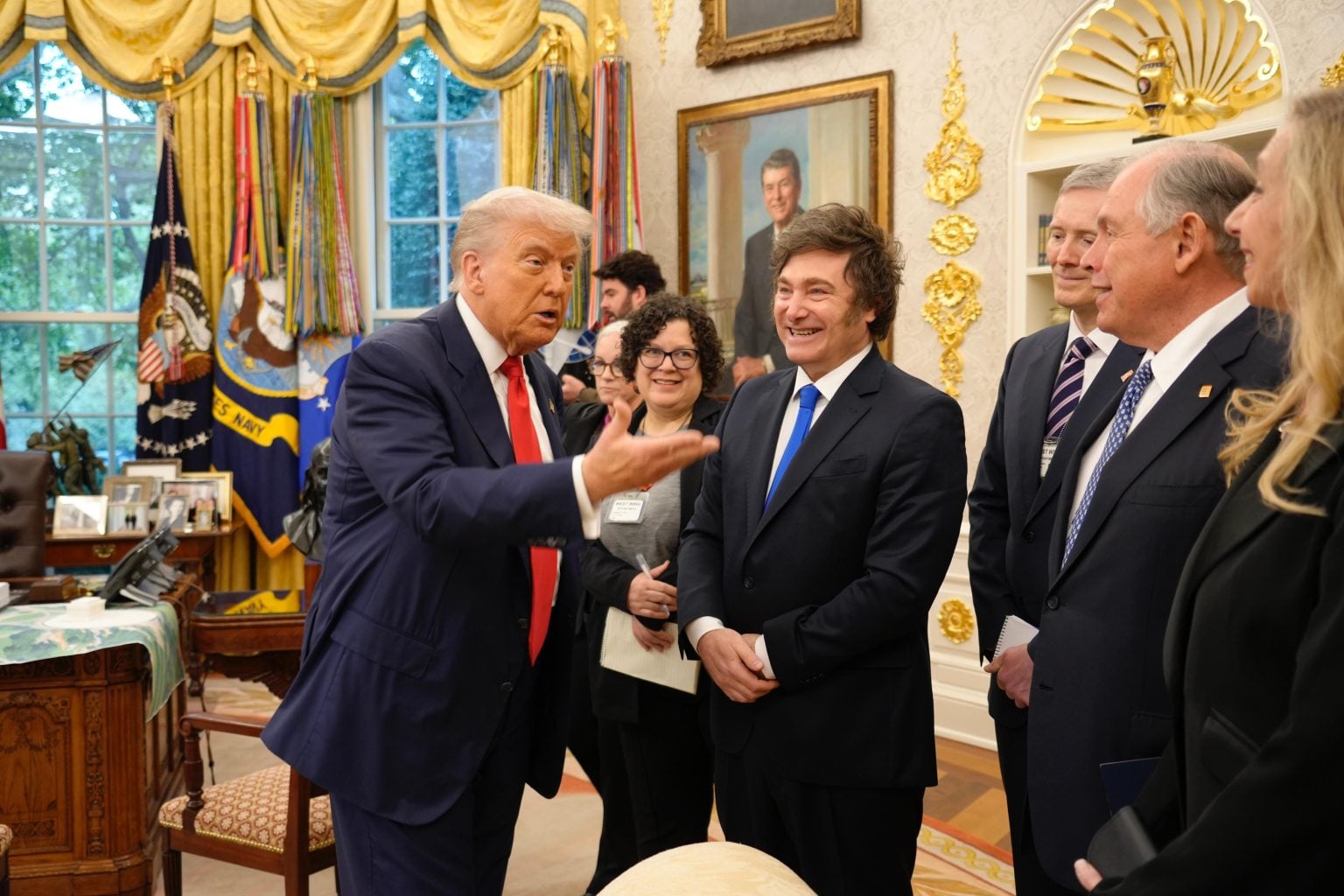
President Donald Trump speaks and gestures during a meeting with Argentine President Javier Milei in the Cabinet Room of the White House, Tuesday, Oct. 14, 2025, in Washington. (AP Photo/Alex Brandon).
The South Atlantic is no frozen backwater. It straddles vital sea lanes linking the Atlantic and Pacific, commands access to Antarctic resources valued in the trillions in oil, gas, and minerals, and offers a potential forward base to counter growing Islamist, Russian, and Chinese activity in the polar south.
Moscow and Beijing have quietly probed the region for dual-use ports and airfields. A reliable new partner in Buenos Aires is now denying them that foothold far more effectively than an overstretched British presence ever could.
For decades, Washington has backed British sovereignty over the Falklands. That policy no longer serves American interests in 2026. Britain remains a valued ally, but its rhetoric has increasingly outrun its capability.
Argentina, by contrast, has stabilized its economy, aligned firmly with the United States and Israel, confronted Iran and China head-on, and launched the Isaac Accords. The numbers and the actions make the choice clear.
Britain’s performance in the ongoing Iran operation laid bare the gap between alliance language and actual commitment.
When American and Israeli strikes hit Iranian leadership and missile sites on February 28, 2026, London initially refused full use of the Royal Air Force Fairford and Diego Garcia bases for offensive missions; access came late -after Diego Garcia was directly targeted by Iran- and was limited to defensive tasks around the Strait of Hormuz.
British warships downed drones over allied airspace but avoided broader offensive operations. Even after its own bases in Cyprus came under attack, Britain mounted no counterstrike. It took weeks to dispatch a meaningful naval presence to the Middle East—long after the French had arrived and begun operations. In a conflict testing alliances, these calibrated half-measures left American forces carrying the primary burden.
Britain’s naval weakness only compounds the problem. At the start of 2026, the Royal Navy could field just seven frigates and six Type 45 destroyers, many sidelined by maintenance. The Ministry of Defence faces a £16.9 billion shortfall in its equipment plan, with shipbuilding programs repeatedly raided and the planned Type 45 replacement deferred. A navy once dominant now struggles with routine patrols and rapid response. When a partner cannot sustain credible maritime power, its distant territorial claims become harder to defend.
Russian gray-zone activity underscores the vulnerability. In the first three months of 2026 alone, more than 300 sanctioned shadow-fleet tankers transited the United Kingdom’s exclusive economic zone and the English Channel, some shadowed by Kremlin warships. Russian submarines and reconnaissance vessels loitered near vital subsea cables and pipelines off the British coast. London monitored and attributed the incursions but lacked the hulls to deter them proactively. A country unable to secure its own backyard cannot credibly project power 8,000 miles away.
Argentina presents the opposite picture. Since President Javier Milei took office in late 2023, the country has delivered one of the sharpest economic turnarounds in the hemisphere: inflation plummeted from 211 percent to 31.5 percent by the end of 2025, GDP expanded 4.4 percent in 2025, and it recorded its first primary fiscal surplus in fourteen years. Foreign reserves have climbed, investment has surged into Vaca Muerta’s shale and lithium fields (which hold 20 percent of global identified resources), and the national currency has stabilized.
This month President Milei and Israeli Prime Minister Benjamin Netanyahu signed the Isaac Accords—a framework for security cooperation, AI innovation, and joint action against terrorism and antisemitism. Argentina designated the Islamic Revolutionary Guard Corps (IRGC) a terrorist organization, expelled senior Iranian diplomats, halted major Chinese infrastructure projects, and rejected Beijing’s bids for dual-use port facilities.
These steps carry strategic weight: they directly block China’s aggressive land acquisitions across Argentina’s Patagonia and its expanding dual-use projects in Antarctica, including the controversial deep-space station in Neuquén that has raised concerns over intelligence and military applications. Where Britain hesitates, Argentina delivers a concrete partnership.
In a less publicized but equally critical dimension of the new U.S.–Argentina alliance, Buenos Aires is sharing high-value intelligence on IRGC and Hezbollah networks in the Tri-Border Area—one of the Western Hemisphere’s most notorious terror-financing hubs—while pursuing aggressive legal and financial measures against those tied to the 1990s Asociación Mutual Israelita Argentina and the Israeli Embassy bombings. This quiet cooperation is eroding Iranian influence in Latin America far more effectively than is widely understood.
The Falklands dispute tests whether U.S. policy prioritizes perpetual sentiment or geostrategic advantage. Britain asserted sovereignty in 1833 over islands long claimed by Argentina on grounds of geographic proximity and Spanish colonial inheritance. Tensions erupted in 1982 when Argentina’s military junta invaded, prompting Britain to dispatch a task force that recaptured the islands in a 74-day war that claimed nearly 1,000 lives.
The 2,900 islanders voted overwhelmingly in 2013 to remain British; that democratic preference and the 1982 precedent deserve real weight. Yet self-determination requires a credible guarantor. Britain’s fiscal and naval constraints render that guarantee increasingly theoretical.
Argentina offers stable access to the South Atlantic and Antarctic gateways, along with a pro-Western democracy resistant to adversarial influence. This recalibration simultaneously strengthens President Trump’s ‘Shield of the Americas’ alliance.
Buenos Aires’ turnaround under President Milei is real. A new U.S. policy on the Falklands would also help smooth relations across Latin America, which has long viewed Washington through a colonialist lens, while enabling Argentina to champion the emerging freedom movement in Chile, Bolivia, and beyond.
A trailblazing U.S. recalibration must include ironclad guardrails: (1) a binding, internationally supervised referendum among the islanders to establish an efficient co-sovereignty arrangement; (2) permanent demilitarized status for the islands; and (3) guaranteed American basing and access rights. These conditions safeguard democratic principles while locking in strategic gains from Greenland to Antarctica.
In an era of great-power competition, American interests lie with the reliable partner that matches words with ships, surpluses, and strategic alignment. Washington should recalibrate its position on the Falklands accordingly. The Iranian-influenced South Atlantic will reveal whether the United States chooses 1982 history or 2026 reality.
Related Topics
- Anti-Zionism
- antisemitic violence
- Antisemitism
- Argentina
- Benjamin Netanyahu
- China
- Cyprus
- Donald Trump
- Europe
- Great Britain
- Greenland
- Hezbollah
- Iran
- Iran Nuclear Deal
- Islam
- Israel At War
- Israel-Iran Conflict
- Israel-US Relations
- Israel: Jewish and Democratic
- Israeli Foreign Policy
- Latin America
- Lebanon
- Middle East
- Russia
- Spain
- Terrorism
- The Arab World
- United Kingdom
- US Midterm Elections
- US Politics
- Venezuela
- Weapons
Related Posts