The views expressed herein are solely mine.
Trump Re-Arms for Iran Rematch
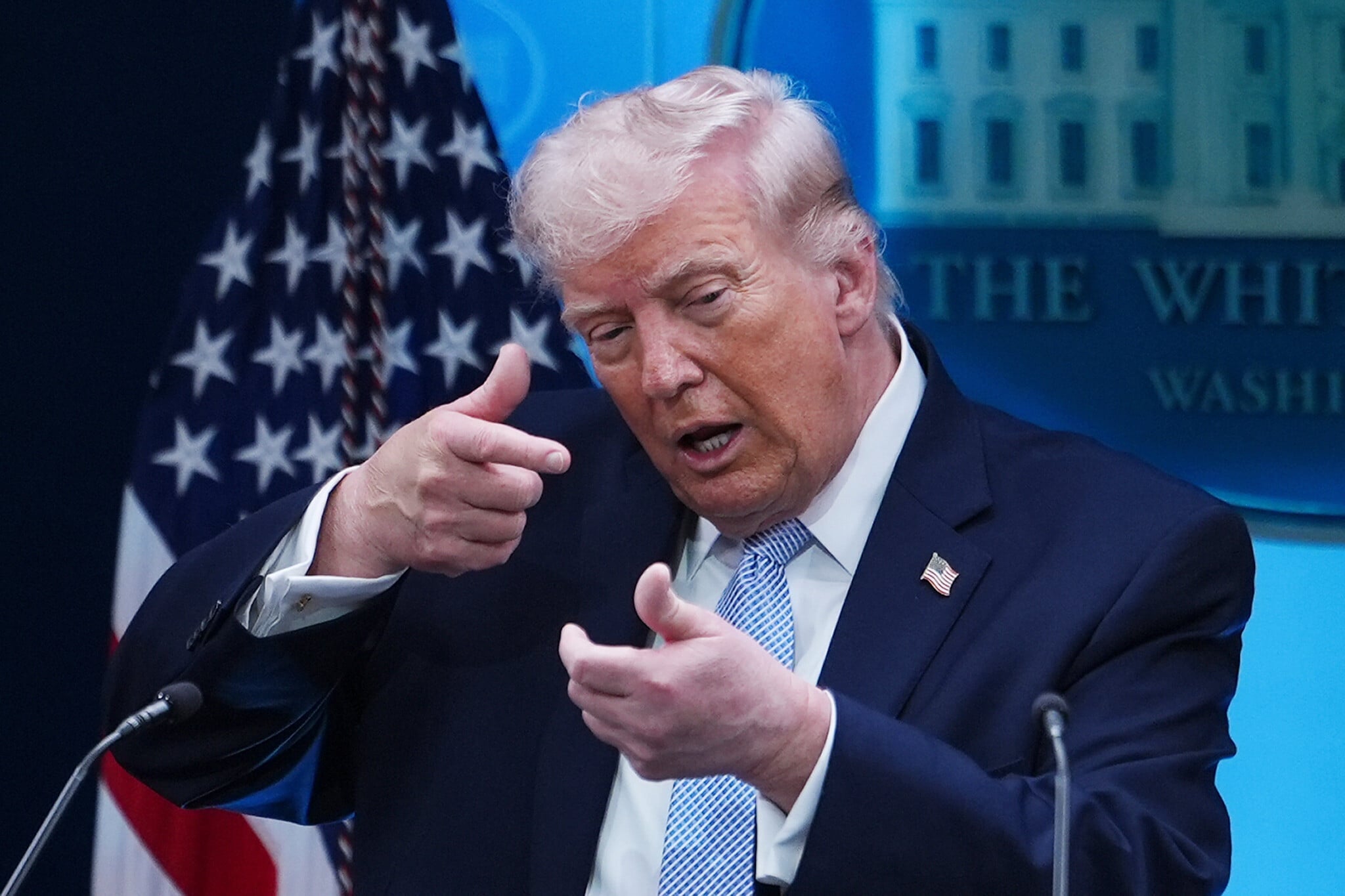
US President Donald Trump pretends to aim a sniper gun while speaking with reporters in the James Brady Press Briefing Room at the White House, April 6, 2026, in Washington. (AP/Julia Demaree Nikhinson).
The Trump administration has moved at remarkable speed to reinforce its Middle Eastern partners. On May 1, Secretary of State Marco Rubio approved more than $8.6 billion in emergency arms sales to Israel, Qatar, Kuwait, and the United Arab Emirates.
Bypassing the standard 30-day congressional review through emergency authority, the packages include $4 billion for Qatar to replenish Patriot air and missile defense systems, and $2.5 billion for Kuwait to acquire an integrated battle command system. Israel secured $992 million in laser-guided rocket kits for 10,000 units, while the United Arab Emirates obtained additional precision-guided munitions.
This diplomatic move was matched by a massive surge in physical activity. In a single 24-hour operation, the United States delivered 6,500 tons of munitions, military equipment, trucks, and light tactical vehicles to Israeli ports at the Ashdod Port and the Port of Haifa via cargo ships and aircraft. Israeli officials confirmed the delivery as part of a larger effort that has brought more than 115,600 tons of support since major operations against Iran began in late February.
These concrete steps coincide with clear signals from Israeli leaders that the campaign against Iran is far from over. Defense Minister Israel Katz stated this week that while Israel supports American diplomatic efforts, it may soon be required to act again to achieve strategic objectives. Prime Minister Benjamin Netanyahu has convened his security cabinet amid ongoing tensions, underscoring that planning continues at the highest levels.
At the same time, the Trump administration executed a precise legal maneuver under the ‘War Powers Resolution’. As the 60-day statutory clock neared its end, the White House notified Congress that hostilities beginning February 28 had terminated due to the April ceasefire. This declaration resets the authorization clock and preserves executive flexibility for potential future operations without the immediate need for fresh congressional approval.
Geopolitically, this rearmament strengthens a formidable arc of deterrence from the Mediterranean Sea to the Arabian Sea. Israel gains deep reserves of precision munitions to sustain pressure on Iranian proxy networks across Lebanon, Syria, and beyond.
The scale of American support also highlights the strategic requirement for the State of Israel to sharply reduce foreign military exports and concentrate resources on rapidly increasing production of the Arrow 3 missile defense system while accelerating advanced anti-drone systems. These steps counter the expected rise in Hezbollah drone attacks, which incorporate Russian and Iranian technology, should operations against Iran resume.
In tandem, resolving the grain dispute with Ukraine, where Kyiv accuses the Jewish State of accepting shipments of grain stolen by Russia from disputed Ukrainian territories, opens the door to immediate coordination with Ukrainian technology and expertise on anti-drone systems, at least in the short term. Saudi Arabia has already demonstrated the value of such pragmatism by maintaining and expanding close ties with Ukraine despite its membership in the Organization of the Petroleum Exporting Countries alongside Russia.
The strategic logic runs deeper still. Iran continues to hold nearly 440 kilograms of uranium enriched to 60 percent grade — material perilously close to weapons-grade according to International Atomic Energy Agency assessments. In any renewed campaign, extracting this stockpile represents a central priority.
By contrast, controlling or disabling Kharg Island, which handles roughly 90 percent of Iran’s crude oil exports, would inflict a devastating economic blow. Tightening the American naval blockade in the Strait of Hormuz, demining the surrounding waters, and impairing the massive South Pars Gas Field would further strangle regime revenues.
Beyond infrastructure, the next military round must also strike the leadership of the regime’s three rival power centers, arm Kurdish and other minority militias against the Islamic Revolutionary Guard Corps, relentlessly degrade Iran’s drone and ballistic missile production and launch capabilities, and blunt Tehran’s messianic triumphalist rhetoric through sustained cyber operations. Coupled with Israeli and American intelligence sabotage on the ground, such moves would significantly raise the odds of renewed popular unrest.
After two major operations in 2 years and 3 failed rounds of negotiations, these steps represent more than tactical necessities. They form the path to destroying the regime’s capacity to threaten the region and achieving genuine regime change. Half-measures have repeatedly failed to alter Iran’s behavior. A decisive campaign combining military pressure, economic strangulation, internal disruption, and leadership attrition ends the cycle of aggression once and for all.
The table is now set. Massive arms flows have replenished forward stocks. Legal authorities have been positioned. Israeli and American leaders are aligned in their assessment that the fight may resume soon.
In the Persian Gulf, the balance of power has shifted unmistakably against Tehran. The question is no longer whether Iran can be contained, but whether the regime can survive the next phase of determined pressure.
Related Topics
Related Posts