Trump -The Emperor Wants to Go Home
Trump entered the Iran war as a showman entering an arena. Now that the crowd has stopped roaring, he is declaring victory and heading for the exit — even as the humiliation mounts.
When Donald Trump ordered American strikes on Iranian nuclear facilities this past year, the moment had all the hallmarks of a Colosseum event. The imagery was cinematic: B-2 bombers crossing darkened skies, bunker-busting munitions descending on hardened underground sites, a president at his desk projecting sovereign implacability. The crowd — his base, the conservative commentariat, the hawks who had waited years for exactly this — roared. Trump glowed. For a brief, intoxicating moment, it looked like the ultimate performance of American dominance: the emperor’s thumb turned decisively downward, and the gladiator was finished.
Except the gladiator was not finished. And that is when everything changed.
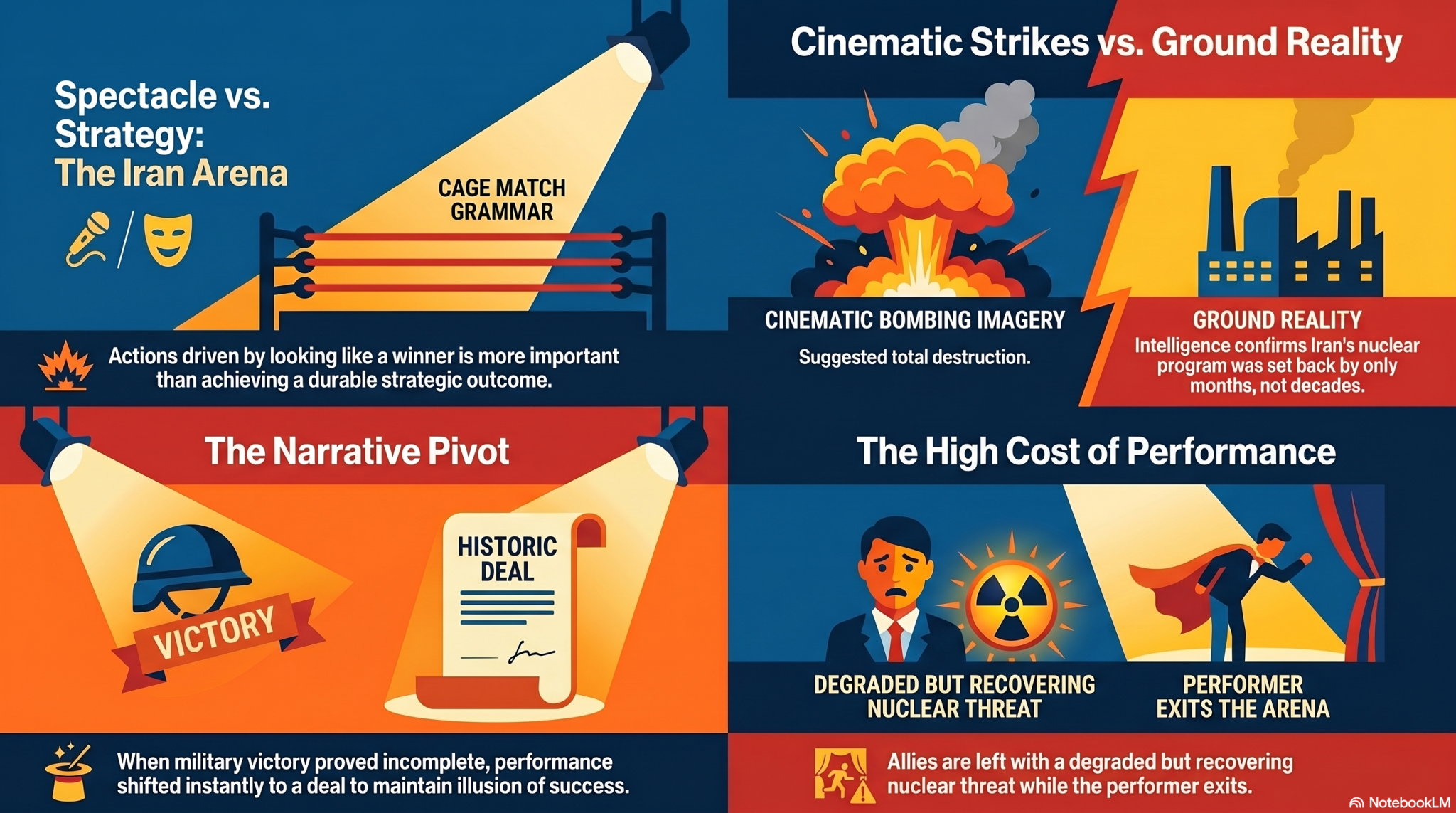
To understand what has happened since — the pivot to negotiation, the impatience with process, the declarations of imminent victory, the increasingly hollow claims of Iranian capitulation — you need to abandon the framework most analysts are using. They are looking for strategy: a theory of escalation, a set of conditions for a durable agreement, a logic connecting military action to political outcome. They are not finding it, and they are confused. They should not be. Trump does not govern Iran through strategy. He governs it through spectacle. And the problem with spectacle is that it has to keep delivering — and this one has stopped.
The strikes were not a strategic decision. They were a performance. The question was never whether they would work. The question was whether they would look like winning.
The Grammar of the Cage Match
To see this clearly, you need to hold two images in your mind simultaneously. The first is Trump presiding over cage fights on the White House lawn — a spectacle that attracted considerable ridicule from his critics and considerable enthusiasm from his supporters, and that was, in its critics’ view, simply bizarre. The second is Trump in the Situation Room, authorizing strikes on Fordow and Natanz.
These are not different kinds of events. They are the same event in different registers. In both cases, Trump is performing the role of the sovereign who presides over violence and confers meaning on its outcome by his presence and approval. The cage fight on the South Lawn is the White House as Roman Colosseum — the executive residence converted into an arena in which the president’s authority is demonstrated not through the exercise of law or deliberation, but through the theatrical display of dominance. The strike on Iran’s nuclear facilities is the same grammar, scaled to geopolitical consequence.
The Roman emperor Commodus did not attend the gladiatorial games as a spectator. He descended into the arena himself, fought as a gladiator under the name Hercules, and declared his victories — against opponents who had been carefully prepared to lose. The crowd understood, eventually, what was happening. The performance required the outcome to be guaranteed before the gates opened. Trump’s Iran campaign has had the same structural problem: the performance required Iran to behave as a cooperative adversary, accepting the role of defeated gladiator. Iran has declined.
The Peak: When the Crowd Roared
In the early months of Trump’s second engagement with the Iran file — as the Gaza war metastasized into a broader regional confrontation, as Iran’s proxies pressed on multiple fronts, as the pressure from Israel and from his own base to act mounted — Trump found himself in a position of genuine theatrical opportunity. The strikes, when they came, were everything a presiding sovereign could want: dramatic, decisive-looking, visually overwhelming. The images of destruction at Iranian nuclear sites circulated globally. Iranian officials issued statements of outrage that read, to the American audience consuming them, as confirmation of the strikes’ impact.
Trump was visibly energized. His social media output in the days following the strikes had the specific quality of a performer who has received a standing ovation — the repetition, the superlatives, the insistence that what had just happened was unprecedented in its greatness. He declared the Iranian nuclear program set back by decades. He announced that Iran was broken, desperate, ready to deal. He positioned himself as the man who had done what his predecessors lacked the courage to do.
The crowd roared. Genuinely. Even some of Trump’s critics fell momentarily silent, uncertain whether the strikes had achieved what was claimed. It was, by the metrics that matter to a performer, a triumph.
The crowd roared. The emperor glowed. For a brief moment, it looked like the ultimate performance of American dominance. Then the assessment came back.
When the Assessment Came Back
The problem, as it always is with spectacle substituting for strategy, was the morning after. The intelligence assessments — American, Israeli, allied — did not confirm the narrative Trump had performed. Iranian centrifuges at Fordow had been damaged but not destroyed. The deeply buried facilities had survived more intact than the bombing imagery suggested. Iran’s enriched uranium stockpile, the most critical variable in any breakout calculation, had been partially dispersed before the strikes and remained largely available. The nuclear program had been set back by months, not decades.
This is not a criticism of the military operation on its own terms — strikes of this complexity against hardened targets are extraordinarily difficult, and some damage was real and significant. It is a criticism of the performance that was layered on top of the military reality. Trump had claimed a conclusive victory over a program that remained substantially intact. The gap between the claim and the reality was not a rounding error. It was the entire premise of the spectacle.
Iran, for its part, understood the grammar of the moment perfectly. It did not collapse. It did not beg. It made controlled, calibrated gestures of distress — enough to confirm that something had happened, not enough to confirm that it was finished. It signaled, through back channels and through the careful modulation of its public statements, that it was willing to negotiate — but on terms that acknowledged its continuing nuclear capability, not its surrender. The gladiator was wounded. The gladiator was still standing. And the gladiator was refusing to perform the prostration gesture that the emperor needed for the crowd.
The Pivot No One Should Be Surprised By
What happened next has bewildered analysts who insist on looking for strategic logic. Trump pivoted — rapidly, almost seamlessly — from triumphalist declarations of Iranian defeat to expressions of interest in a magnificent deal. The rhetoric of total victory gave way to the rhetoric of historic diplomacy. Envoys who had been delivering ultimatums began returning from meetings in Oman speaking of progress and momentum. The president who had announced that Iran was finished began announcing that Iran was ready to make a deal unlike any deal ever made before.
This is not incoherence. It is the entirely predictable behavior of a performer who has lost control of his narrative and is rewriting it in real time. The spectacle of crushing military victory was not available — the facts on the ground would not support it. So the spectacle pivoted to the next available performance: the historic negotiation, the deal that ends the Iranian threat, the triumph of American diplomatic power under a president bold enough to both strike and to talk.
The cage match framing illuminates exactly this moment. When the fight is not going as the crowd expected — when the gladiator is still on his feet, when the outcome is ambiguous, when the crowd’s roar has turned into something more complicated — the emperor does not sit with the discomfort. He reaches for the gesture that restores his centrality to the narrative. He extends the thumb. He confers mercy. He makes the ambiguous outcome into an act of sovereign will rather than an admission of incomplete victory. The deal becomes the trophy that the strike could not quite deliver.
The pivot from ‘Iran is finished’ to ‘Iran is ready to deal’ is not incoherence. It is the performer rewriting the narrative in real time.
The Humiliation in the Details
And here is where the analysis becomes genuinely painful for those who care about the actual strategic outcome — for Israel, for the Gulf states, for the broader architecture of regional security that depends on Iran being durably constrained rather than temporarily inconvenienced.
The deal that is now being negotiated — whatever form it ultimately takes — will not reflect the maximalist position that Trump’s strikes were supposed to enforce. Iran retains enrichment capability. Iran retains a nuclear infrastructure that, even degraded, gives it a breakout pathway. The verification mechanisms being discussed are not more stringent than those in the JCPOA that Trump spent years denouncing as the worst deal in American history. In some respects, given Iran’s advanced nuclear position today compared to 2015, the deal is less constraining than the one it implicitly replaces.
This is the humiliation that is arriving not in a single, legible moment but in the fine print of draft agreements and the hedged language of diplomatic readouts. Trump will not experience it as humiliation — he is constitutionally incapable of that experience. He will announce the deal as the greatest diplomatic achievement in American history, and a significant portion of the media ecosystem that covers him will process the announcement within his own frame. The signing ceremony will have all the production values of a Colosseum finale: the imperial presence, the defeated adversary performing sufficient submission, the crowd invited to roar.
But the strategic community — in Jerusalem, in Riyadh, in Abu Dhabi, in Washington’s permanent national security apparatus — will read the fine print. And what they will find is that the emperor declared the games concluded before the gladiator was actually down.
What Comes After the Ceremony
Israel faces a specific and acute version of this problem. The strikes on Iranian nuclear facilities were, from an Israeli strategic perspective, an opportunity that may not recur — a moment when American military power was applied directly to the Iranian nuclear program, with Israeli support and coordination. The question was always whether that application would be sufficient to genuinely set back the program, or whether it would produce the appearance of impact without the substance.
The answer is becoming clear. The program was damaged, not dismantled. The follow-through — the sustained pressure, the enforcement mechanism, the credible threat of renewed strikes if Iran reconstitutes — is now being traded away in the negotiation for the signing ceremony Trump needs. Israel will be left with a degraded but recovering Iranian nuclear program, a deal that constrains it less than its advocates will claim, and a Trump who has moved on to the next performance.
The Roman crowd eventually learned to distinguish between genuine imperial triumph and manufactured spectacle. The laurel bestowed on a fighter who had not actually won still looked like a laurel. The victory procession had the right costumes. But something had shifted — a note of performed enthusiasm, of participation in a fiction everyone had agreed to maintain because the alternative was more disturbing.
Israel cannot afford that fiction. It must plan for the strategic reality that will exist after the signing ceremony: an Iran that has survived American military strikes, extracted a nuclear agreement on tolerable terms, and demonstrated to the region that patient resistance to American pressure — even military pressure — produces survivable outcomes. That is a more dangerous Iran than the one that existed before Trump ordered the planes into the air.
The emperor is heading for the exit. The crowd will applaud. And the gladiator — wounded, recalculating, but still standing — will walk back through the gates into a region where the lesson of the arena has been absorbed by every government watching from the stands.